
Measure from receiving the brief or RFP to the point where a subject-matter reviewer can inspect a complete structure.
Measure proposal-software ROI without pretending it replaces expertise
Proposal software earns its cost in reviewer time, not in words generated. Arc can reduce the work required to assemble a source-grounded first draft and reveal coverage gaps. Your team still owns deal strategy, pricing, commitments, persuasion, and final approval.
The short answer: as of mid-2026, a freelance proposal or RFP writer charges roughly $75–150 an hour, or $500–3,000 per proposal depending on complexity; a dedicated in-house proposal writer or bid manager costs about $60,000–95,000 a year in salary; and an RFP-response consultant or agency engagement for a single complex bid runs about $2,000–8,000. Gixo Arc plans start at $49 a month for a single Starter seat and run to $179 per seat per month on Enterprise, covering all 21 proposal types.
Those hiring figures are illustrative market ranges from buyer's guides as of mid-2026, not vendor quotes — confirm the real number with each vendor. They are also market rates, not Gixo prices. And this is a comparison of the time and cost of producing a first draft, not a claim about who wins more deals: pricing strategy, relationships, and competitive positioning still come from you.
From source material to reviewable draft
See what Arc helps your team review
Choose the proposal type, add the RFP, brief, notes, or prior work, then review a structured first draft before it reaches a client.
- 1Add source materialRFPs, briefs, notes, decks, and prior work
- 2Draft to the proposal typeSections and structure follow the real opportunity
- 3Review before deliveryYour team checks facts, scope, pricing, and commitments
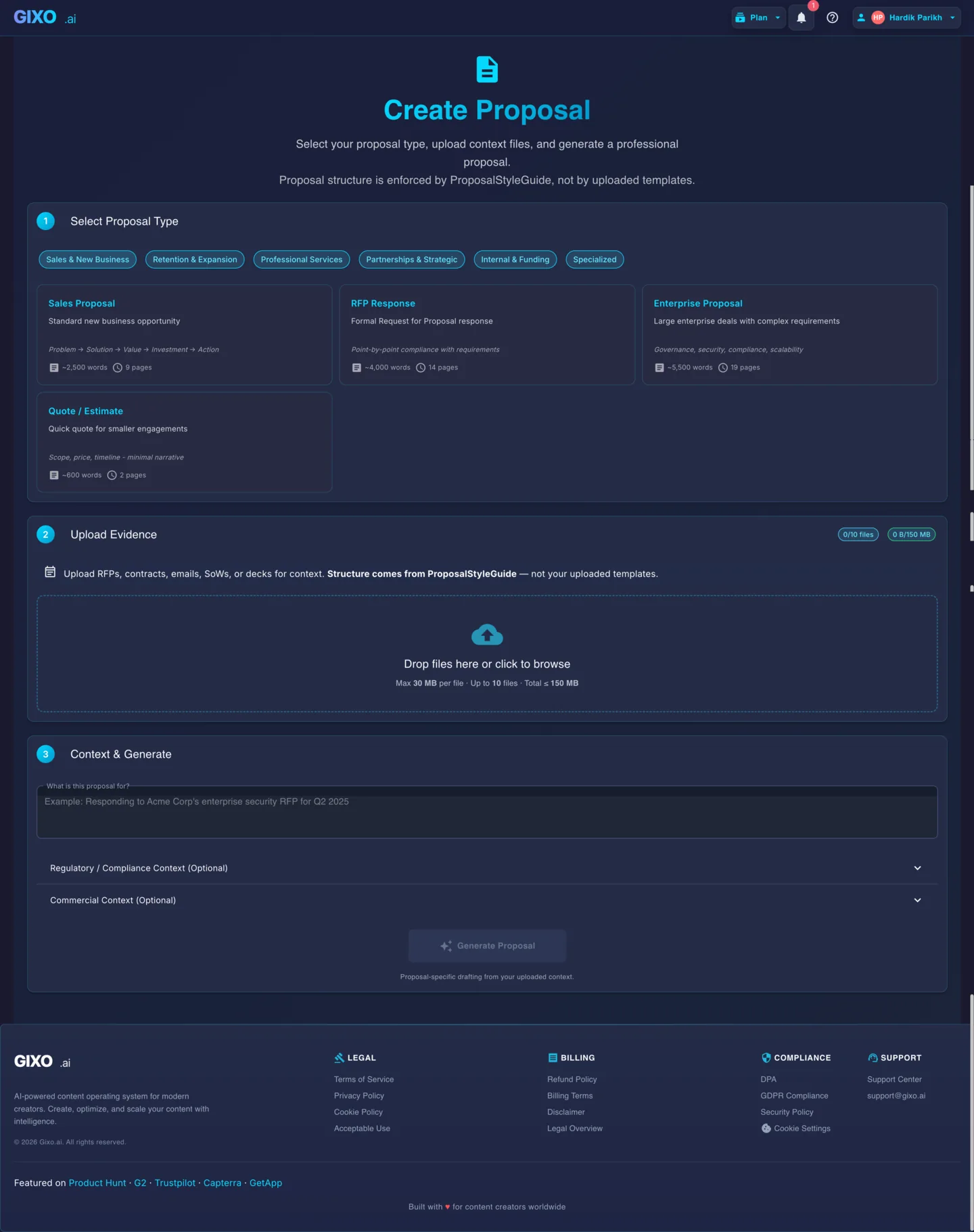
Measure the workflow before you model the savings
Record a baseline over several real proposals, then compare the same stages after adopting the software.
Track the hours spent locating case studies, scope notes, requirements, pricing inputs, and prior approved language.
Count rounds caused by missing sections, overlooked requirements, unsupported claims, or unclear ownership.
Arc runs $49 per seat per month on Starter, $129 on Professional, $149 on Business, and $179 on Enterprise, with higher tiers including a seat minimum (2, 5, and 10 seats respectively). Multiply by the number of people who genuinely need access, and check the live plan table before you commit the number.
Practical model: annual value of time saved and avoidable rework, minus annual software cost and implementation time.
Keep revenue uplift separate unless you can attribute it with your own controlled data.
How much does it cost to hire a proposal writer vs use AI?
Market rates for proposal help as of mid-2026, next to what an Arc subscription costs. The hiring figures are illustrative market ranges from buyer's guides, not vendor quotes — confirm the real number with each vendor.
| Factor | Gixo Arc | Freelance writer | In-house writer | Consultant / agency |
|---|---|---|---|---|
| Cost | $49–179 per seat per month; subscription covers all 21 proposal types | $500–3,000 per proposal ($75–150/hour) | $60,000–95,000 a year in salary | $2,000–8,000 per complex bid |
| Cost at 5–10 proposals a month | Flat — the subscription does not change with volume | $2,500–30,000 a month | Fixed salary, but capped by one person's capacity | $10,000–80,000 a month |
| Time to a first draft | Minutes for a complete, reviewable structure | Days | 1–3 days, subject to workload | Days to weeks |
| Availability | On demand, any hour | Subject to the freelancer's calendar | Business hours, one person's capacity | Subject to engagement scope |
| Consistency | Same structure and coverage checks every time | Varies by writer | Consistent if the same person, but limited capacity | Varies by consultant |
| Pre-submission check | Free deterministic analyzer, 0–100 readiness score, no signup | Manual, writer-dependent | Manual, writer-dependent | Often included in the fee |
Worked example: a team drafting six proposals a month at the low end of freelance rates ($500 each) spends about
$3,000 a month, or $36,000 a year. Two Arc Professional seats at $129 per seat per month is $258 a month, or $3,096 a year —
the drafting spend, not the outcome. The remaining hours of review, strategy, and approval still belong to your team, so count those
hours in the comparison rather than assuming they disappear.
Use Arc and proposal expertise for different jobs
The most credible business case treats Arc as drafting and review support, not as a replacement for the people accountable for the deal.
| Work | Where Arc helps | Where people remain accountable |
|---|---|---|
| Source intake | Organizes the RFP, brief, notes, and prior work used for drafting. | Selecting trustworthy, current source material. |
| First-draft structure | Builds proposal-type sections and a reviewable starting point. | Choosing the deal strategy and deciding what should be promised. |
| Coverage review | Provides deterministic section and requirement-coverage signals. | Judging whether an answer is persuasive, accurate, and sufficient. |
| Commercial terms | Keeps provided scope and pricing inputs visible in the draft workflow. | Approving price, risk, legal terms, timelines, and commitments. |
| Final delivery | Supports editing and export after review. | Final approval and responsibility for what reaches the buyer. |
Proposal-software ROI FAQ, and how proposal writing services compare
Does Arc guarantee a higher win rate?
No. Arc does not guarantee deal outcomes. Relationships, competitive positioning, commercial judgment, and the final proposal remain your responsibility. Model the ROI on drafting time and rework avoided, not on win rate.
Does Arc replace a proposal writer or bid professional?
No. It can accelerate source-grounded first-draft work and deterministic coverage review. Human expertise remains essential for strategy, persuasion, accuracy, and approval, so the hours spent reviewing and approving a draft stay in your cost model either way.
What does the free analyzer prove?
It returns a 0–100 readiness score plus deterministic section, requirement-coverage, and mechanical-readiness signals, with no signup required. It does not verify RFP conformance and does not judge whether an answer will satisfy an evaluator, so treat a high score as 'nothing obvious is missing', not as approval to submit.
How much does it cost to hire a proposal writer vs use AI?
As of mid-2026, a freelance proposal or RFP writer charges roughly $75–150 an hour, or $500–3,000 per proposal depending on complexity; a dedicated in-house proposal writer or bid manager costs about $60,000–95,000 a year in salary; and an RFP-response consultant or agency can charge $2,000–8,000 for a single complex bid. Gixo Arc is a per-seat subscription from $49 a month (Starter) to $179 per seat per month (Enterprise) covering all 21 proposal types, so the drafting cost stays flat as volume rises. The hiring figures are illustrative market ranges from buyer's guides, not vendor quotes — confirm the real number with each vendor.
How does the cost compare if I write 5-10 proposals a month?
At mid-2026 freelance rates of $500–3,000 per proposal, 5–10 proposals a month is $2,500–30,000 a month. Two Arc Professional seats at $129 per seat per month is $258 a month and does not move with volume. The more proposals you draft, the wider the drafting-cost gap — but only the drafting cost; review and approval hours stay with your team either way.
How much does Gixo Arc cost?
Arc is priced per seat per month: $49 Starter (1-seat minimum, so $49 a month), $129 Professional (2-seat minimum, so $258 a month), $149 Business (5-seat minimum, so $745 a month), and $179 Enterprise (10-seat minimum, so $1,790 a month). There is a no-card 14-day trial, and the deterministic proposal analyzer is free with no signup. Arc has no standing $0 tier — after the trial, continued generation requires a paid plan. Model the tier you would actually buy, including its seat minimum, and check the live plan table before committing the number.
What inputs does an Arc first draft need?
Up to 10 source files per proposal, at a maximum of 500 MB per file and 2 GB in total, in any of these formats: PDF, DOCX, PPTX, TXT, XLSX, PNG, JPG, and JPEG. Arc drafts from that material — the RFP, brief, scope notes, pricing inputs, and prior approved language — rather than from a blank template, which is why the source-collection hours in your baseline are the ones most likely to move.
When should I still hire a dedicated writer or consultant?
Highly complex, high-stakes, or relationship-critical bids — a major government contract, a multi-year enterprise deal, or a bid where a consultant's industry relationships matter — may still justify a human specialist who can navigate politics and strategy software cannot. For routine quotes, sales proposals, renewals, and most RFP responses, the speed and cost difference favours drafting in Arc and reserving specialist budget for the few bids that need it.
Where should I start?
Run the analyzer on an existing draft without signup. If you need a new proposal, start the no-card 14-day Arc trial and compare the resulting workflow with your baseline over at least three real proposals before you commit a number.
Test Arc on real proposal work
Use an existing draft for the free analyzer, or create a source-grounded first draft during the Arc trial.
Updated
More from Gixo