
How to Structure a Sales Deck
A sales deck has a different job from a pitch deck: not to explain, but to persuade a buyer to act. The sequence that converts leads with their pain, not your product: audience problem → offer → proof → differentiation → outcomes → call to action. Here's what each slide does — and why real proof, not invented ROI, is what closes.
Why “their problem” goes first: the highest-converting B2B decks follow the strategic-narrative approach popularized by Andy Raskin — open on the shift in the buyer’s world and what’s at stake, not on your company or features. The deck earns attention before it asks for anything.
The short answer
The mistake that kills sales decks is opening with your company and your features. A buyer doesn't care yet — they care about their problem. So a converting sales deck starts where the buyer is (their pain), earns the right to be heard (proof), explains why you over the alternatives (differentiation), shows what they'll get (outcomes), and tells them exactly what to do next (the CTA).
Persuasive, but disciplined: concrete benefits, an explicit ask, and proof that's real — because the moment a prospect catches an invented customer or an inflated ROI figure, the deck is dead.
The sales deck, slide by slide
Open on the buyer's pain in their words. Show you understand the problem better than they expected — that's what earns the next slide.
Your solution, framed as the answer to that pain — not a feature tour. One clear value proposition.
The credibility slide: real customers, metrics, testimonials, case results. This is where a sales deck is won or lost, so use proof you can stand behind.
Why you over the alternatives the buyer is also considering. Be specific and fair — a comparison that's obviously slanted reads as weakness.
What changes for them after they buy — concrete results, tied to the problem you opened with.
One explicit next step — a trial, a pilot, a meeting. A deck without a clear ask leaves the buyer to decide what happens next, which usually means nothing does.
The discipline that makes it convert
A sales deck lives or dies on the proof slide, which is exactly why it's the most tempting place to exaggerate — a customer you're "about to close," an ROI number that's aspirational. Don't. A prospect who catches one inflated claim re-reads the whole deck as marketing.
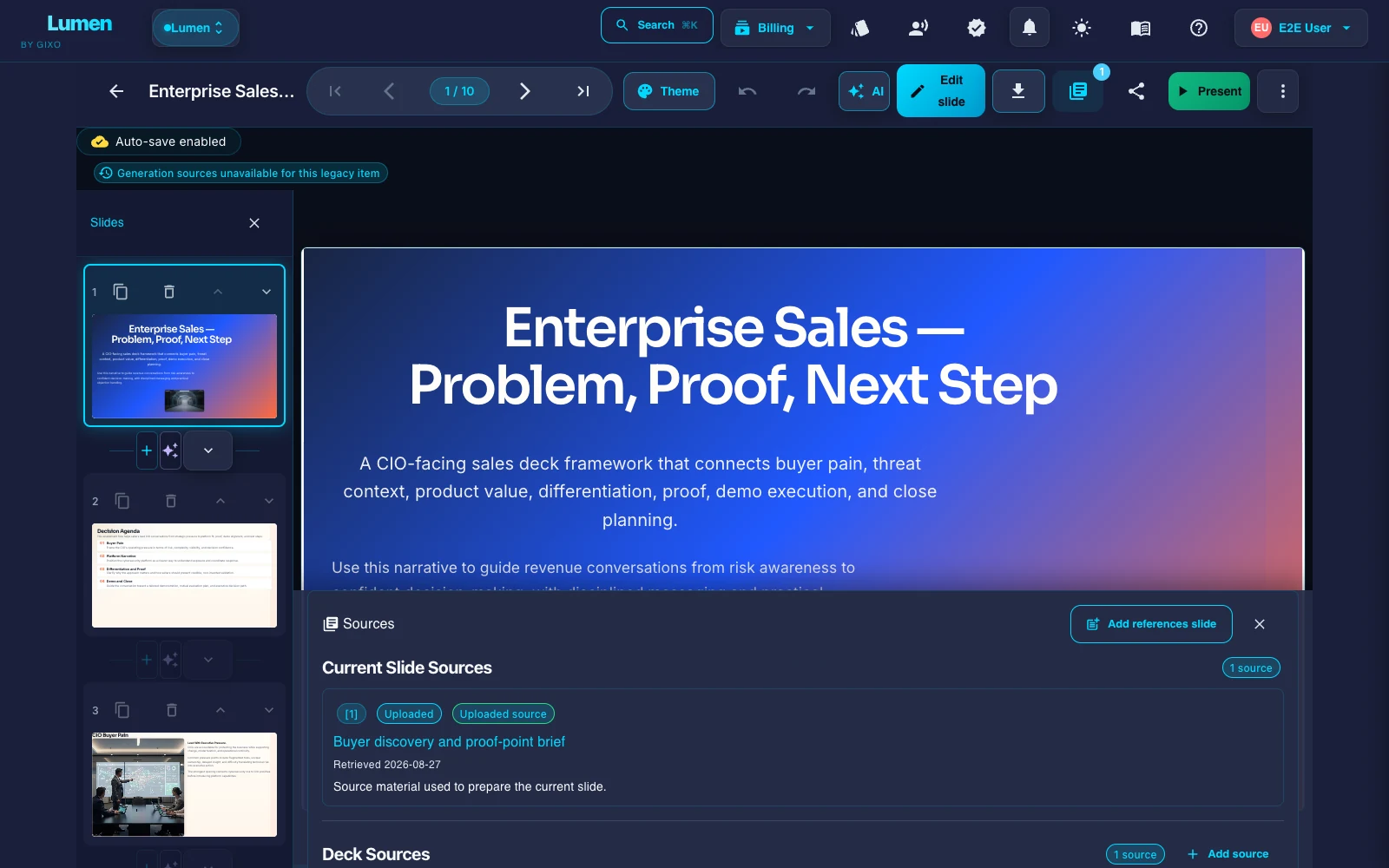
Lumen's sales workflow keeps supplied proof, source settings, generation-time provenance, and citations close to the deck. It does not automatically verify every customer, quote, or ROI figure, so the reviewer must compare sales-critical claims with the approved source before delivery.
Sales deck, pitch deck, elevator pitch, leave-behind slide deck — which one are you building?
The three get used interchangeably and they are not the same document. Getting the label right saves you from writing the wrong deck well.
A pitch deck is for investors. Its job is to argue that the company is worth backing, which is why the running order is problem, market, product, traction, business model, team and the ask — and why the numbers on it get diligence. If that is what you are building, the sequence on this page is the wrong one; use how to structure a pitch deck instead.
A sales deck is for a buyer. Its job is to move one specific account toward a decision, so it opens on their problem and closes on a next step. Same slide count, different centre of gravity: an investor is buying the company, a customer is buying an outcome.
An elevator pitch is neither — it is the two-sentence version you say before either deck opens. It is still worth writing down, because it is the test of whether the offer slide holds up: if the value proposition cannot survive being said out loud in twenty seconds, it will not survive slide three either.
Then there is the fourth thing people mean by “deck”: the slide deck you leave behind. A live sales deck and a leave-behind are different artefacts — one is spoken over, the other is read alone. If a prospect will forward it internally, the proof and outcome slides have to carry the argument without you in the room.
Frequently asked questions
Updated