
How to Structure a Pitch Deck
An investor pitch deck is a causal argument, not a company brochure. Structure the presentation so each slide reduces the next uncertainty: investment thesis → customer problem → solution → market → business model → go-to-market → traction → competition → team → the ask. This guide explains what belongs on every slide, how the structure changes by stage, and how to keep every important claim defensible.
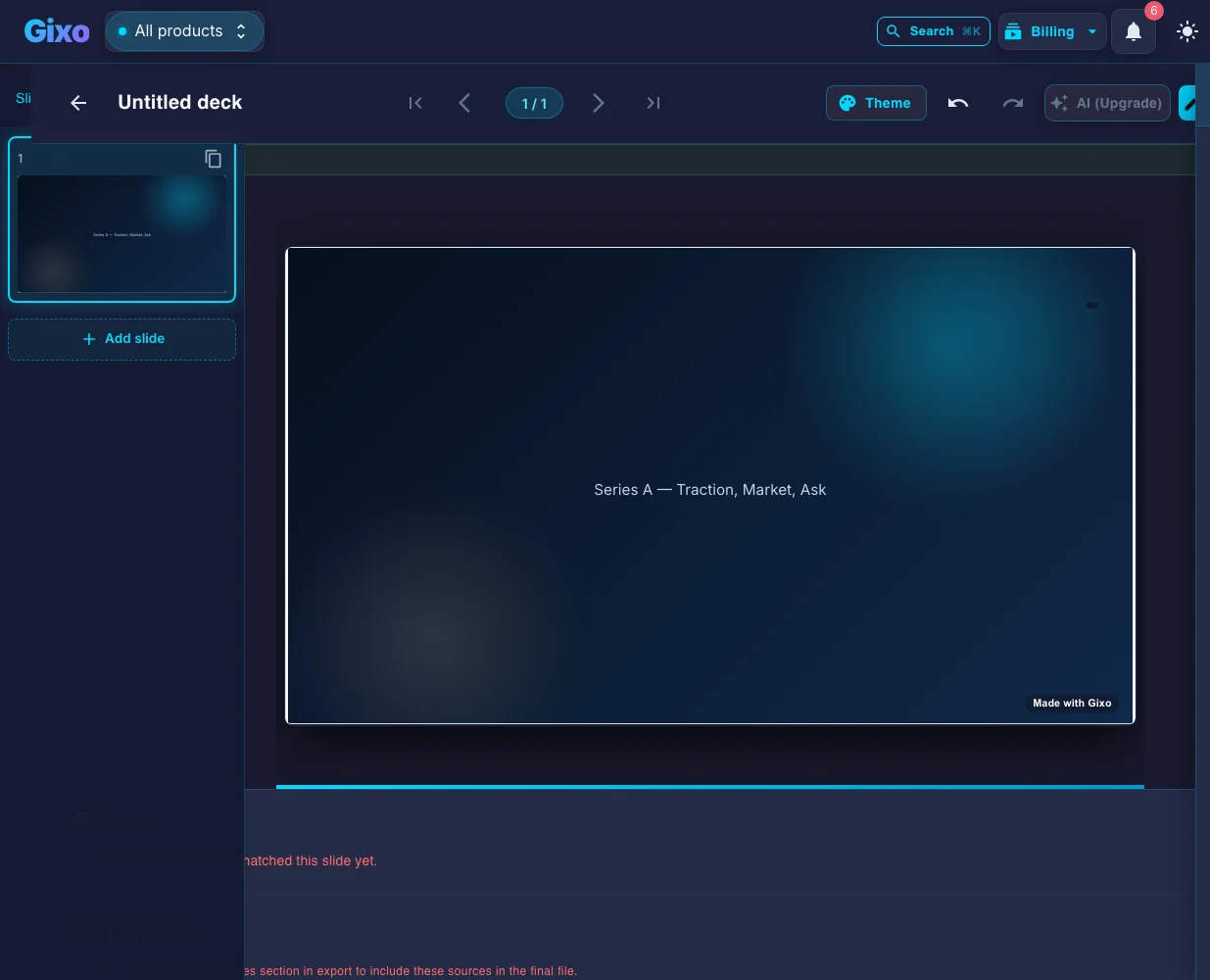
A useful reference: the sequence below is compatible with Sequoia Capital’s public pitch-deck template, but it is not a rigid formula. Change the emphasis for your stage and business model while preserving the logical chain from problem to proof to decision.
What is a pitch deck?
A pitch deck is a short, evidence-based presentation that helps an investor decide whether to continue a fundraising conversation. A strong pitch deck for investors usually does three jobs: it earns attention, reduces uncertainty about the opportunity and the team's ability to execute, and makes the next step clear.
Most startup pitch decks use roughly 10–15 core slides plus an appendix. The sequence works because it answers connected questions: Is the problem real? Is this solution valuable? Can the company reach a large enough market? Is there evidence? Can the model scale? Why will this team win? What decision is being requested?
A pitch deck presentation should not make the audience reconstruct the thesis from scattered facts. Put one important takeaway on each slide, support it with the minimum evidence needed, and make the transition to the next claim obvious. Design creates attention and hierarchy; credible evidence carries the argument.
Before making slides, write the investment case
The fastest way to create a coherent deck is to solve the argument in plain text first.
Define the audience, round, and next decision
A pre-seed angel, a Series A fund, a strategic investor, and a credit committee look for different proof. Write down who will read the deck, what they already know, what stage the company is in, and the precise next action you want: an introductory meeting, partner review, diligence, or a commitment.
Draft a one-page investment memo
Before opening a pitch deck template, explain the customer, problem, solution, market, business model, evidence, advantage, team, amount being raised, and milestones in one page. If the memo does not form a coherent argument, slide design will not repair it. The memo also becomes a source against which every slide can be checked.
Create an evidence ledger
For every material claim, record the claim, source, date, owner, and confidence level. Market estimates should show their method; traction should reconcile with operating data; customer quotes and logos should have permission; forecasts should label their assumptions. This small ledger prevents contradictions between the investor deck, financial model, and data room.
Investor pitch deck structure, slide by slide
These ten sections form a practical structure for a startup pitch deck. Combine or separate them when the story requires it, but keep the causal order intact.
Name the company, category, customer, valuable outcome, and distinctive mechanism in one clear positioning statement. Avoid generic claims such as “revolutionizing” a market; establish the frame the rest of the deck will prove.
Identify the specific customer, the job they are trying to complete, the cost of the current problem, and why it is urgent now. Use observed workflows, interviews, loss data, or benchmarks rather than broad statements that “everyone” has the problem.
Show how the product changes the customer's workflow and what outcome improves. A focused screenshot, short demo sequence, or before-and-after model is more persuasive than a feature list.
Define the reachable market from customers, pricing, and buying behavior. Explain the timing catalyst—technology, regulation, cost change, or new distribution—and show the method and source behind TAM, SAM, and SOM rather than presenting one unexplained large number.
Explain who pays, what they buy, pricing, gross margin, purchase frequency, and expansion potential. Use observed economics where available and label assumptions when the business is early.
Show how customers discover, evaluate, buy, and expand. Name the channels and sales motion, connect them to the buyer, and use conversion, sales-cycle, CAC, or pipeline evidence to show that the motion can become repeatable.
Present the strongest evidence appropriate to your stage: revenue and growth, retention, usage, paid pilots, signed contracts, validated performance, or a qualified pipeline. Use cohorts or time periods where they explain quality better than a cumulative total.
Include the current workaround as well as direct competitors. Compare the few criteria that drive a purchase, explain why customers switch, and show what compounds—data, distribution, workflow integration, cost advantage, brand, or network effects.
Connect each founder's relevant experience to the risks the company must solve. Add critical hires or partners when they make the execution plan more believable; a row of impressive but unrelated biographies does not.
State how much you are raising, the expected runway, the milestones the round funds, and what evidence should exist before the next financing. Tie use of proceeds to de-risking the plan rather than showing generic percentages.
Make every number in the investor deck defensible
A polished structure cannot compensate for a figure that fails a follow-up question: a market size with no method, a growth rate that does not reconcile with the data room, a customer logo used without permission, or a forecast presented as certainty. One unsupported claim can make the audience question otherwise sound evidence.
Use bottom-up market sizing where possible
Start with the number of reachable customers, realistic annual value, buying constraints, and expected penetration. Reconcile that bottom-up result with credible external research, explain what is included and excluded, and distinguish the total market from the segment your current product and distribution can actually serve.
Show traction as evidence, not decoration
Match the metric to the claim. Revenue proves willingness to pay; retention shows continuing value; usage frequency can support habit; conversion and sales cycle help validate go-to-market; signed pilots may reduce technical or procurement risk. A chart is useful only when the time period, cohort, denominator, and source are clear.
Make projections auditable
A financial model should reveal how the business could work, not predict the future with false precision. Show the drivers behind revenue, hiring, gross margin, acquisition cost, and runway. Separate historical results from the forecast and label important assumptions and scenarios.
An AI pitch deck generator can create plausible language around a number it was never given. Gixo Lumen's fundraising workflow is designed so traction, market-size, and funding claims come from you or your source material; when an ask or financial input is missing, the workflow flags the gap instead of supplying a figure. The software helps organize the deck, while the founder remains responsible for verification.
How pitch deck structure changes by stage and business model
An investor pitch deck template is a starting framework. Emphasize the evidence that reduces the biggest risk in your specific company.
| Company context | Emphasize | Evidence to prepare |
|---|---|---|
| Pre-revenue startup | Problem insight, founder-market fit, product progress, validation, and near-term learning milestones | Interviews, design partners, waitlist quality, prototypes, experiments, letters of intent |
| Enterprise software | Workflow pain, measurable ROI, security and integration, sales motion, retention, and expansion | Pilots, contract value, pipeline stages, sales cycle, deployment time, usage and renewal signals |
| Consumer subscription | Acquisition loop, activation, engagement, retention, monetization, and market behavior | Cohorts, conversion funnel, acquisition cost, payback, churn, organic or referral contribution |
| Marketplace | Which side starts the network, liquidity by segment, repeat behavior, unit economics, and defensibility | Match rate, time to match, take rate, repeat transactions, supply concentration, contribution margin |
| Regulated or technical product | Technical feasibility, regulatory path, adoption barriers, milestones, and capital plan | Test results, approvals, expert validation, pilot conditions, performance against baseline |
| Hardware or capital-intensive business | Manufacturing or deployment plan, margin path, capital schedule, demand proof, and operational risk | Unit cost, yield, suppliers, lead times, purchase commitments, project economics, financing stages |
What is an executive summary slide?
The slide most decks are missing, and the one a busy reader uses to decide whether to read the rest.
An executive summary slide states the whole argument on one page: what the company does, for whom, the evidence that it is working, the amount being raised, and what the money buys. It sits immediately after the title slide in a read-ahead deck, and it exists because the reader may give you ninety seconds before deciding whether the next twelve slides are worth their evening.
Treat it as a summary, not a teaser. Withholding the traction number to build suspense is a habit from sales decks that reads as evasion in fundraising. A working shape is five or six lines: the one-sentence thesis, the customer and problem, the strongest single proof point with its period, the business model in one clause, the raise and runway, and the milestone the round funds. Every one of those lines should be defended in more detail later in the deck; none should appear here for the first and only time.
Where it differs from the title slide and the ask slide
The title slide establishes the frame. The ask slide closes the argument with use of funds and milestones. The executive summary compresses both plus everything between them, which is why it is the last slide you should write and the first one a reader sees. If you cannot write it, the deck does not yet have an argument — and writing the summary early is the cheapest way to discover that.
The same slide does double duty outside fundraising. Board packs, consulting recommendations, and internal investment cases all benefit from a page that answers “what are you asking me to decide, and on what evidence” before the detail begins. In a live presentation you may skip past it quickly; in a document that will be forwarded, it is the slide that gets read.
Live pitch deck presentation versus read-ahead deck
A live deck supports a speaker. Use short headlines, one visual argument per slide, and enough evidence to make the spoken explanation credible. Put detailed definitions, calculations, and supporting tables in presenter notes or the appendix so the room can follow the narrative.
A read-ahead deck must survive without narration. Add the context needed to interpret charts, define time periods and acronyms, and make the conclusion of each slide explicit. An interactive pitch deck can add links, notes, or browser navigation, but the reader should not have to click around to discover the core investment case.
Many founders maintain one evidence base and produce two versions: a concise live pitch deck presentation and a slightly denser document for asynchronous review. Keep the underlying figures synchronized so the two versions never tell different stories.
Common pitch deck mistakes
- Writing a brochure instead of an argument: features and adjectives appear, but the customer, evidence, economics, and decision logic do not connect.
- Leading with a giant market number: the deck claims a category is large without showing a reachable segment or a credible path into it.
- Treating a logo grid as competition analysis: logos identify alternatives but do not explain buying criteria, switching behavior, or defensibility.
- Overloading every slide: multiple arguments, charts, and paragraphs compete for attention, so the audience cannot identify the takeaway.
- Using false precision: five-year projections appear exact while their operating assumptions remain hidden.
- Copying pitch deck examples too literally: a famous company's old deck reflects its own stage, market, and evidence—not yours.
- Assuming a template creates a fundable story: a pitch deck template supplies order and layout; it cannot supply customer insight, traction, or a credible plan.
- Adding slides instead of resolving uncertainty: more detail is useful only when it answers a material investor question.
How to create a pitch deck with Gixo Lumen
Gixo Lumen has a fundraising workflow for building a business pitch deck from a topic or your own source material, such as an investment memo, financial model, customer research, or the previous round's deck. The workflow maps that material into the problem-to-ask sequence and selects layouts suited to the evidence: big-number stats for traction, a comparison for differentiation, or a timeline for milestones.
Review the generated outline before polishing slides. Confirm that each headline states a takeaway, every important number is grounded in your sources, competition is represented fairly, and the ask connects to measurable milestones. Then edit the slides and export an editable PowerPoint. The no-card 14-day trial adds AI generation and clean hybrid export, and after the trial existing decks remain reviewable, presentable, and downloadable — hybrid PPTX/PDF export included.
When you compare pitch deck software, separate writing assistance from the full delivery job. Check whether the tool can accept your actual source material, preserve the argument from problem to ask, keep traction and market figures reviewable, support editing, and export a file the investor can open. The best AI pitch deck generator for a fundraising team is not the one that writes the most; it is the one that makes claims easy to trace, challenge, revise, and present.
Frequently asked questions
Updated