Deck Structure Check
Paste an outline, choose from 10 deck types, and get a 0-100 structure score with every expected section that is missing or out of order.
Lumen deck tools
Use the structure checker and planning resources to find missing sections, improve the outline, and choose the right workflow before generation or manual editing.
The deck structure checker is free with no account. It accepts outline text only, stores nothing, and makes no AI model call.
Answer first
Gixo Lumen publishes three free deck tools that run with no account, no card, and no AI model call: the Deck Structure Check, the Deck Contrast Auditor, and the Slide Legibility Checker. The structure check scores a pasted outline out of 100 against 10 deck types — 80 points for required-section coverage, 10 for expected order, 10 for optional sections — and flags every slide title longer than eight words; it accepts up to 50,000 characters or 2,000 lines. The contrast auditor grades 2 to 10 palette colours against WCAG AA (3.0:1 for large text, 4.5:1 for normal text) and returns a repaired hex for each failure, while the legibility checker converts font size, projected slide height, and viewing distance into arcminutes against a 16-arcminute comfortable-reading target. Generating, editing, citing, and presenting the deck itself happens in the Lumen workspace, which starts at $10 per month after a 14-day no-card trial — there is no free Gixo plan.
Plan, check, then build
Paste an outline, choose from 10 deck types, and get a 0-100 structure score with every expected section that is missing or out of order.
Check a background hex against 2 to 10 accent colours: measured contrast ratio per swatch, WCAG AA pass or fail at 3.0:1, and a repaired hex for each failure.
Turn font size, projected slide height, and viewing distance into arcminutes, with the minimum point size that clears the 16-arcminute comfortable-reading target.
Score a deck on five dimensions - narrative, evidence, clarity and design, audience resonance, and strategic alignment - on an explicit 1-5 scale.
Plan the story and section order before full generation, using the four-step outline-first workflow Lumen follows.
Move from topic or source material into outline review, slide editing, citations, presenter tools, and export.
Specification
Compare each tool's supported inputs, outputs, and practical limits before you begin.
| Tool | What you give it | What it returns | Sign-in | Input ceiling |
|---|---|---|---|---|
| Deck Structure Check | One slide title per line, plus one of 10 deck types | Score out of 100, band, every missing required section, an out-of-order warning, and each title over eight words | Not required | 50,000 characters or 2,000 lines |
| Deck Contrast Auditor | One background hex plus 2 to 10 accent hexes | Contrast ratio per swatch against the background and its own text, WCAG AA pass/fail, and a repaired hex | Not required | 10 palette colours |
| Slide Legibility Checker | Font size 6–160 pt, projected height 0.2–20 m, viewing distance 0.3–100 m | Angular size in arcminutes, estimated cap height in millimetres, recommended minimum point size, and a band | Not required | One measurement per run |
| Presentation quality scorecard | A finished or draft deck you review by hand | Five review dimensions scored 1–5: narrative, evidence, clarity and design, audience resonance, strategic alignment | Not required | Reading guide, not a running tool |
| Lumen deck workspace | a topic, notes, briefs, articles, and uploaded reference material | Generated deck, outline review, slide editing, citations, present mode, speaker notes, timer, and shareable delivery, and export to PPTX, PDF, HTML, and slide images | 14-day no-card trial, then a paid plan | $10–$99 per month |
Recommended order
The checker evaluates expected sections, ordering, and slide-title hygiene. A human still owns the evidence, judgment, visual quality, and final delivery decision.
Questions buyers ask
Yes. The Deck Structure Check, Deck Contrast Auditor, and Slide Legibility Checker are anonymous: no account, no card, and no AI model call. Gixo has no free plan for the deck workspace itself — AI generation and editing need an active 14-day no-card trial or a paid plan from $10 per month. Downloads of your ready decks remain available after trial or plan access ends, subject to download permission.
10 of them: pitch deck (fundraising), board or executive update, sales deck, conference talk or keynote, training or workshop, project proposal, marketing plan, product roadmap, case study, and webinar or thought-leadership deck. Each type carries its own expected sections and its own audience.
Out of 100: up to 80 points for the share of required sections found, 10 points if the sections that are present appear in the conventional order, and up to 10 points for optional sections. The bands are Ready at 80 or higher, Close at 60–79, Emerging at 40–59, and Not Ready below 40.
Up to 50,000 characters or 2,000 lines. Paste one slide title per line; leading numbers, bullets, and "Slide 4:" prefixes are stripped before matching, so you can paste straight from a notes file.
No. It is deterministic string logic: keyword matching against the expected sections for the deck type, plus an order comparison and a title-length rule. The same outline always produces the same score, and nothing is generated, charged, or sent to a model.
There is no universal point size, which is why the Slide Legibility Checker solves for your room. It assumes a 540-point (7.5-inch) slide design height and cap height at 70% of the nominal font size, converts that into the visual angle seen at your viewing distance, and returns the minimum point size that clears the 16-arcminute comfortable-reading target. Below 10 arcminutes it reports Marginal or Difficult.
WCAG AA: 3.0:1 for a chart colour against the slide background, which is the large-text threshold, and 4.5:1 for text sitting on that colour. It accepts 2 to 10 colours, reports the measured ratio for each, and returns a lightness-repaired hex wherever a swatch fails.
No deck, document, or account record is created. Each tool posts to a rate-limited endpoint, runs in process, and returns the result. The shared free-tool budget allows a burst of 30 requests and replenishes 15 per minute per visitor, which is well above normal review use.
No, and that is the point. Each of the three runs deterministic logic — keyword matching, a contrast ratio calculation, a visual-angle calculation — so the same input always returns the same answer, nothing is sent to a model, and nothing is metered. Most free AI presentation tools generate slides; these check the ones you already have. AI generation lives in the paid Lumen workspace after the 14-day no-card trial.
Widescreen 16:9 is the working default — 13.33 by 7.5 inches in PowerPoint, and 10 by 5.625 inches in Google Slides, which is the same shape at a different scale. The Slide Legibility Checker assumes that 7.5-inch (540-point) design height, so its point-size result applies to that design height. For a different canvas height, convert the font-size input to the equivalent fraction of a 540-point canvas before using the result. Legacy 4:3 decks are 10 by 7.5 inches: same height, so the type maths is unchanged, but a 16:9 projector will letterbox them.
Generation from a topic, notes, briefs, articles, and uploaded reference material, outline review, slide editing, citations and source review, present mode, speaker notes, timer, and shareable delivery, and export to PPTX, PDF, HTML, and slide images. Published plans run from $10 per month up to $99 for the Azure Marketplace and private-offer tier, after a 14-day no-card trial.
From source material to presentation handoff
Start a 14-day, no-card Starter trial to generate and review decks and evaluate clean hybrid PPTX and PDF exports. Existing decks remain reviewable after the trial; paid Lumen continues generation and unlocks the delivery paths shown in pricing.
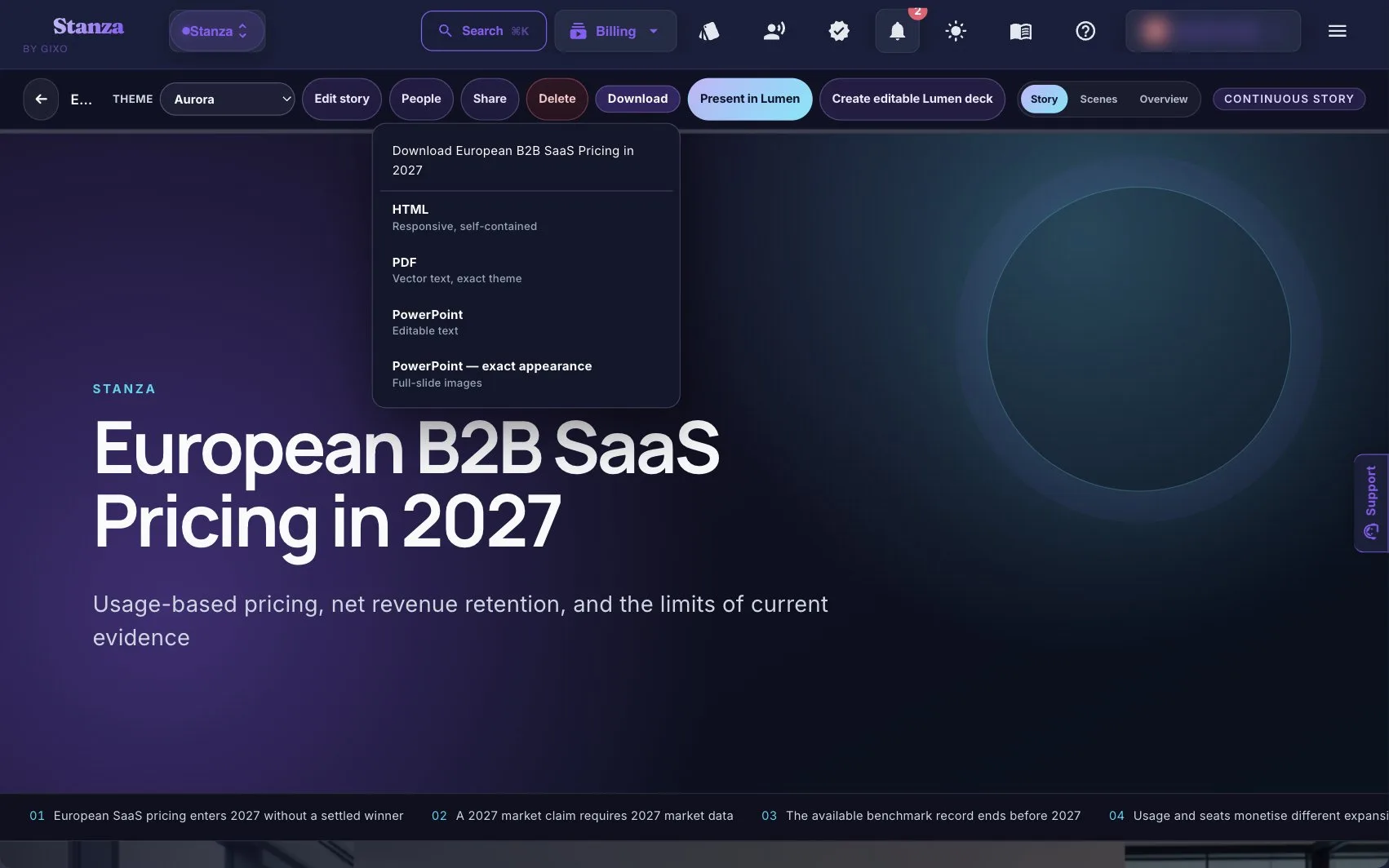
Lumen also includes Stanza, a responsive visual-story mode that turns the same sources into a scrolling web story instead of a slide deck. Start quickly, or plan first and approve the scene plan before generation. Stanza grounds sources through the same pre-authorized search path as Lumen decks, it ships under Lumen access, and a supported Lumen deck can be converted into a separate Stanza story. Review conversion warnings: the original theme and slide imagery are not copied automatically.