
Pitch deck checker for Gixo Lumen
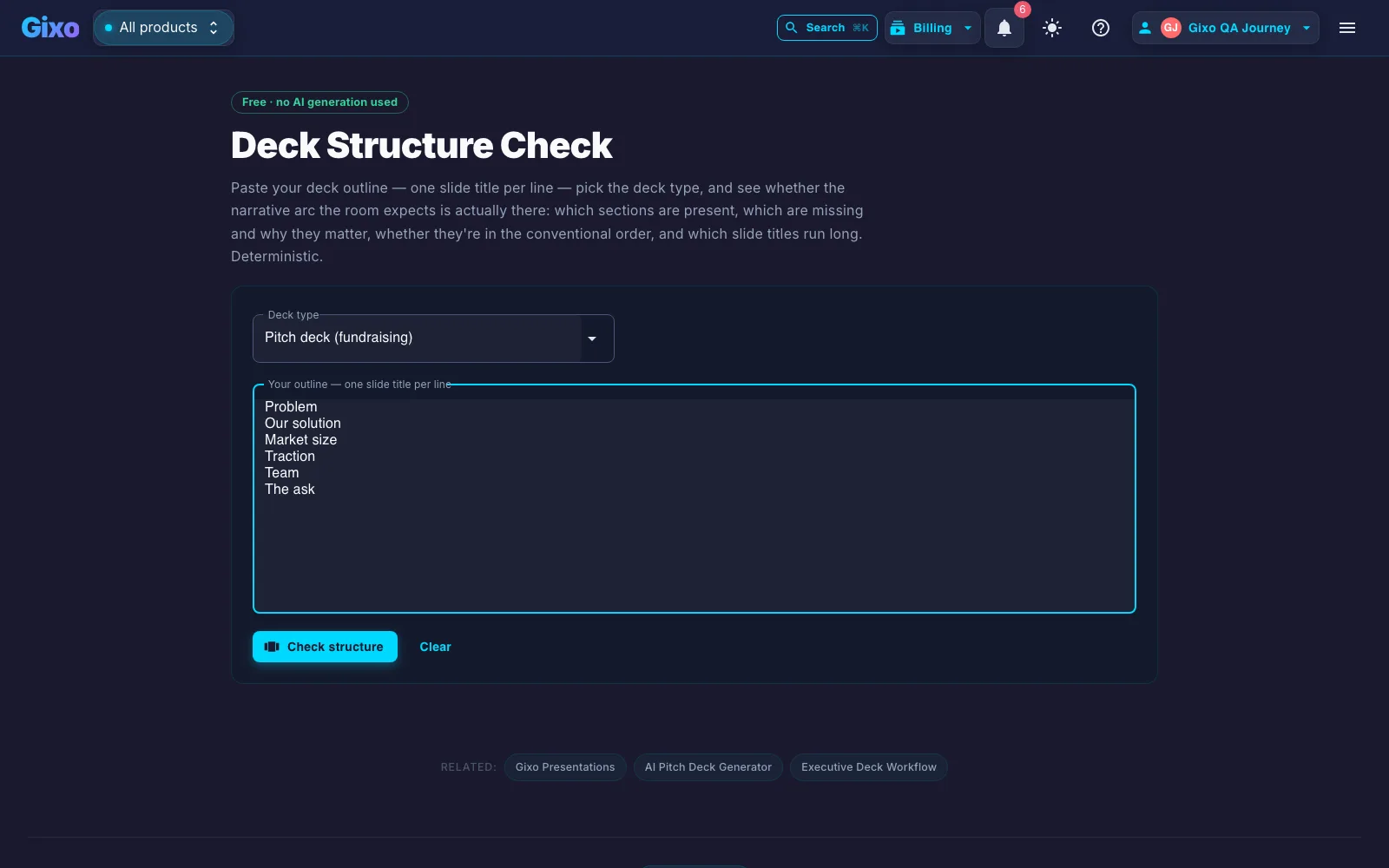
Before you polish slides, check the skeleton. Paste your outline — one slide per line — and see whether the narrative arc your audience expects is actually there: present, missing, or out of order. Works for fundraising pitch decks, board updates, and customer-facing sales decks.
How to use this tool
Who it is for
Founders, operators, and sales teams reviewing a pitch, board, or sales-deck outline before slide production.
Input
Choose a supported deck type and paste one slide title per line. Slide numbers and common bullet characters are tolerated.
How it works
Deterministic title matching checks required and expected sections, their conventional order, and overly long slide titles.
What the output means
The report shows structural coverage and ordering gaps. A present section means the title was recognized; it does not mean the underlying evidence or argument is strong.
Limitation
It does not review slide design, verify metrics, judge investment quality, predict fundraising outcomes, or inspect a PowerPoint file.
Data-handling boundary
Paste only an outline you are authorized to process. Do not include confidential metrics or customer details when section titles alone are sufficient; review the Privacy Policy for service-data handling.
Illustrative input
Illustrative pitch outline: Problem; Solution; Market; Business Model; Traction; Team; Ask. One title appears on each line.
Illustrative output
Illustrative: the checker can mark required sections as present, flag Use of Funds as missing, and identify an order issue. This is an example of report shape, not an evaluation of a real company.
Ask next: Does each present section contain supportable evidence, does the sequence fit this audience, and which claims need a human reviewer?
Three decks, three arcs
Each deck type is checked against the arc its room expects — the same sequencing Gixo Lumen builds decks with.
Outline first, slides second
Most weak decks aren't badly designed — they're badly sequenced. The fix is cheapest before any slide exists, which is why this checker takes an outline, not a file: one slide title per line, ten seconds of pasting. It matches your lines against the expected sections for the deck type, checks whether the sections you do have appear in the conventional order, and flags slide titles that run past eight words — the practical ceiling for titles a room can read at a glance.
The honest boundary: a complete arc doesn't make the content good. "Traction: Present" says nothing about whether your traction is impressive — that bar is yours to clear. Use the checker to catch configured structural gaps such as a missing use-of-funds section. Because the rules are deterministic, the score can work as a progress meter: rework the outline, re-run, and review which gaps closed.
When the outline is ready, Lumen turns the brief into a structured first pass for review. PowerPoint export is hybrid by design: stable layouts become editable text and shapes, while complex slides preserve fidelity as images. The active 14-day Starter trial includes clean export, and that export stays available after the trial ends — deck download is not gated.
Frequently Asked Questions
Updated