Skip to content
Workflow-specific products Content, decks, briefs, proposals, legal, and sales each have a clearer buying path.
Review before delivery Draft, edit, collaborate, approve, and export in the same workspace.
Security + procurement path Security policy, support, and Azure Marketplace buying are public.

Delivery contexts with a real workflow fit

Choose Lumen by the work being handed off—not by a generic industry label.

These entry points map to presentation jobs already supported by Lumen's workflow profiles, structure guides, editor, presenter tools, and hybrid export. They do not imply vertical expertise the product cannot verify.

Start from the room

Six contexts where the source, review, and delivery path are clear.

Each entry point links to an existing workflow or structure guide with a concrete audience and handoff—not a thin page with swapped industry nouns.

Consulting

Client strategy and transformation decks

Turn interviews, analysis, workshop notes, and source files into a recommendation-led client handoff.

Source
Briefs, interview notes, analysis, evidence packs
Review
Challenge the storyline, recommendation, and assumptions
Handoff
Editable PPTX/PDF for a client or steering group

Open the workflow

Agencies

Repeatable client narrative production

Use a consistent production path across accounts while preserving client context, proof, and brand direction.

Source
Client brief, campaign strategy, approved proof, brand material
Review
Account, strategy, creative, and client review
Handoff
Client-facing pitch, campaign, or review deck

Open the workflow

Startups

Fundraising and operating narratives

Organize market context, product, traction, business model, team, ask, and supporting evidence for review.

Source
Founder notes, metrics, market sources, financial assumptions
Review
Founder, finance, advisor, and investor-readiness review
Handoff
Investor deck, update, or internal operating presentation

Open the workflow

Sales

Buyer-facing commercial decks

Move from buyer pain and differentiated proof through objections, implementation, and a concrete next step.

Source
Discovery notes, product proof, approved claims, implementation context
Review
Sales, product marketing, legal, and account review
Handoff
Editable buyer narrative or sales presentation

Open the workflow

Finance

Investment and performance review decks

Build an evidence-first sequence for financial context, trends, decisions, risks, and forward actions.

Source
Operating metrics, financial tables, research, decision context
Review
Finance owner, executive sponsor, and data-source review
Handoff
Board, investment, or operating-review presentation

Open the workflow

Internal strategy

Executive decisions and roadmaps

Turn analysis into options, recommendations, phased workstreams, dependencies, ownership, and measures.

Source
Strategy memo, operating data, research, stakeholder notes
Review
Functional owners, leadership, and governance review
Handoff
Board, transformation, product, or planning deck

Open the workflow

Choosing between AI presentation tools

Which AI presentation tool fits your work?

Comparisons of the best AI tools for presentations tend to score everything on template count and speed. Neither predicts whether you will actually be able to hand the deck over, so here is a shorter test.

Question one

Does it start from your material, or only from a prompt?

Most AI presentation software takes a topic and writes a plausible deck about it. That is the right shape when the content lives in your head. It is the wrong shape when the content lives in a report, a set of interview notes, or a spreadsheet someone will check you against — then you want the tool reading your source, not improvising around the subject.

Question two

Can you see the structure before the slides exist?

A deck is an argument in a specific order. If the first thing an AI presentation tool shows you is forty finished slides, restructuring is expensive and most people do not bother — they present the order the model chose. Reviewing an outline first is the cheapest moment to fix a story, and it is the step that separates a usable first pass from a nicely formatted one.

Question three

Is the deck shaped for the room, or generically shaped?

A board readout, an investor pitch, a sales narrative and a transformation roadmap are different arguments with different obligations. AI tools for presentations that apply one generic template to all four leave the structural work with you. Lumen's workflow profiles are the reason this page is organised by delivery context rather than by industry noun.

Question four

What does the file look like when it lands?

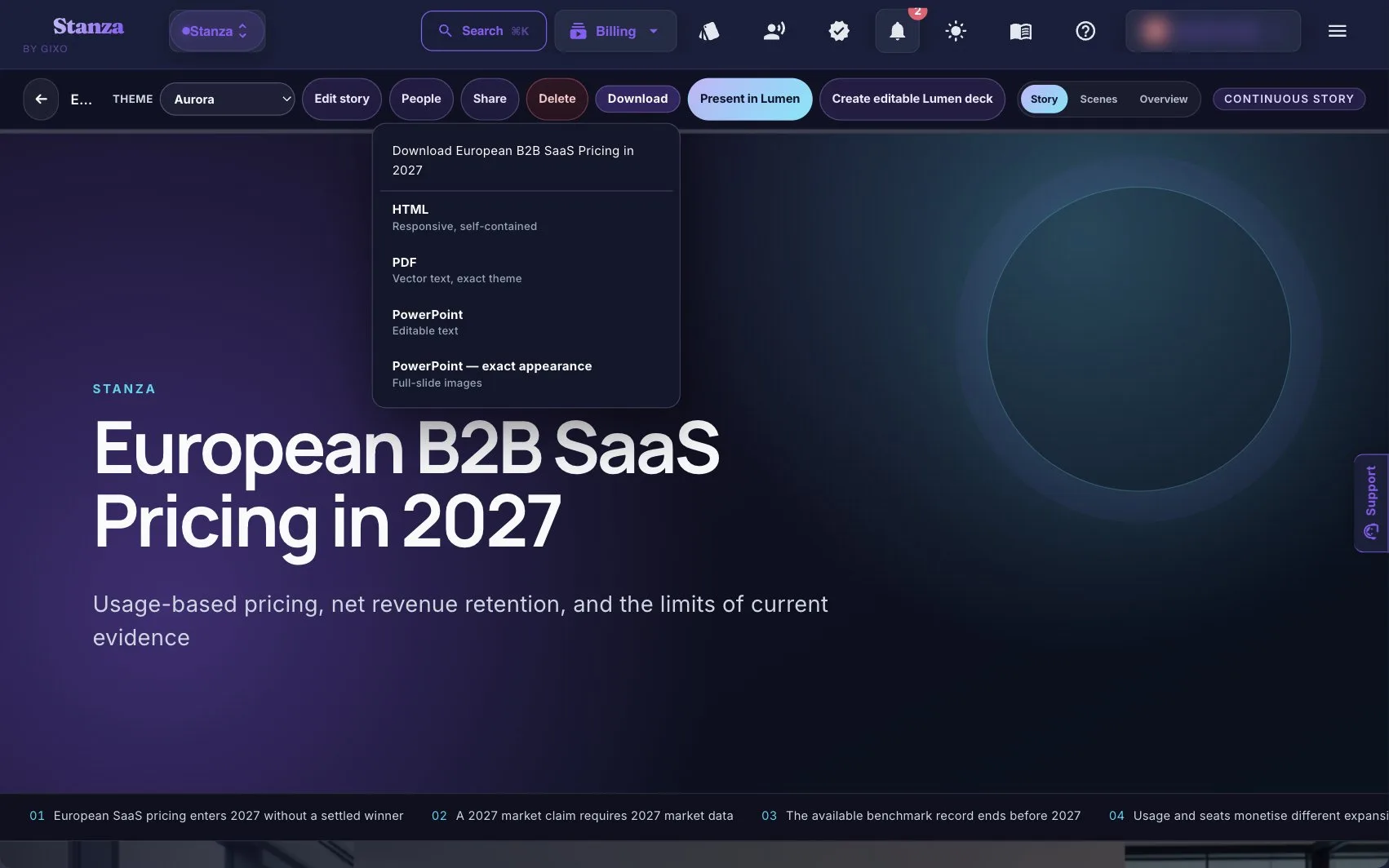
The last question is the one people ask too late. If the deliverable is a .pptx someone else will edit, a web-only deck is not a substitute however good it looks in a browser. Lumen exports hybrid PowerPoint and PDF: stable layouts arrive as editable text and shapes, complex slides preserve fidelity as images. Test that on your own material during the trial rather than taking anyone's word for it.

Common questions

AI presentation tools: what people ask before choosing one

What is the best AI tool for presentations?

There is no single answer, and any list that gives you one is ranking on the wrong axis. The useful question is what happens after generation: whether the tool can work from your own documents, whether you can review the structure before slides are built, and whether the exported file stays editable for whoever receives it. Score candidates on those three and the shortlist gets short quickly. Gixo Lumen is built for the case where all three matter — source-grounded decks, reviewed before delivery, handed off as a file.

Do I need a different AI presentation tool for a pitch deck and a board deck?

Not a different tool, but you do need a tool that knows they are different documents. A pitch deck argues for capital it does not have; a board deck reports against a plan it already has. The sequence, the tone and the evidence burden all change. Lumen handles that with workflow profiles rather than one template with different colours, which is why the entry points above are organised by the handoff rather than by the industry on your business card.

Are AI presentation tools good enough for client work?

For the draft, yes — and that is where the time goes. For the claims, no tool substitutes for review. Financial figures, customer claims, legal statements and market evidence still need an accountable human before anything reaches a client or a steering group. Lumen keeps sources and citations attached to the deck to make that review faster, not to remove it. Treat anything a model asserts about your numbers as a question, not an answer.

Is there a free AI presentation tool?

Some products run capped free tiers, and if free is a hard requirement that is where to look. Lumen is not one of them: it runs a no-card 14-day trial that includes AI generation and clean hybrid export, and after that generation and export require a paid plan. Existing decks stay reviewable either way. We would rather state that here than let you find it at the export button.

A deliberate boundary

Lumen structures the presentation workflow; it does not replace domain review.

Financial figures, customer claims, legal statements, market evidence, and executive recommendations still need an accountable reviewer. Use sources and citations to make that review easier—not to outsource judgment.

Review the evidence and governance resources

Current public contract

Current Gixo Lumen implementation at a glance

These figures are derived from the implementation catalogs used by the live product.
AspectCurrent behaviorWhy it matters
active themes33Derived from the active presentation-theme registry.
slide layouts26Derived from the implemented slide-layout guides.
workflow profiles7Consulting, finance, startup, sales, executive, product, and general business.
delivery formats4PPTX, PDF, HTML, and slide images

From source material to presentation handoff

Build the deck, review it, and evaluate the exported handoff in one workspace.

Start a 14-day, no-card Starter trial to generate and review decks and evaluate clean hybrid PPTX and PDF exports. Existing decks remain reviewable after the trial; paid Lumen continues generation and unlocks the delivery paths shown in pricing.