
Plan the reading order
Supply the audience, decision, source material and required coverage. Review the outline before generating. For a QBR, keep results, variance, risks and next decisions distinct instead of mixing them into a status collage.
A board deck is not a status report — it is a decision document. The structure below is the slide-by-slide sequence that experienced operators use to brief a board of directors: what each slide is for, how long it should run, and the order that keeps a busy board oriented. Use it as a template, then build the deck in minutes with Gixo Lumen.
Open an actual exported deck, then compare its outline, source constraints and slide choices with the job you need to finish.
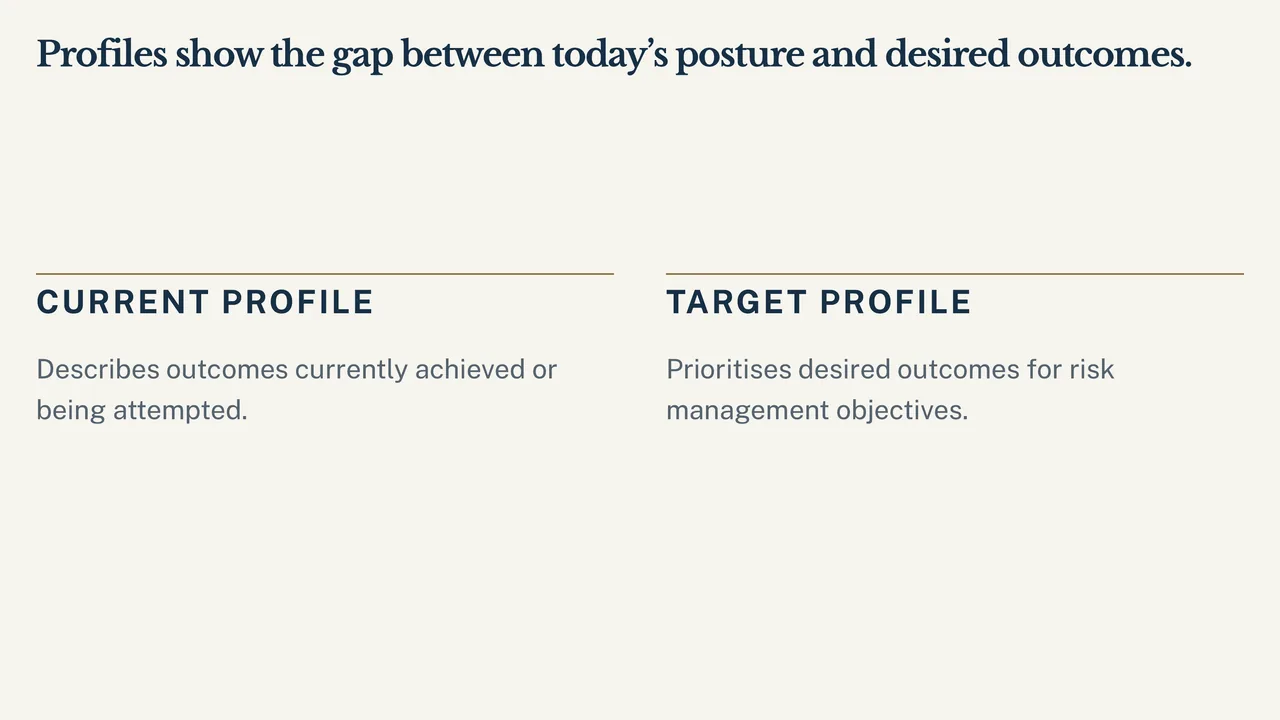
A 10-slide briefing for an organisation’s leaders on NIST’s Cybersecurity Framework 2.0, built only from the framework document: the six Functions as a set with Govern at the centre, what Govern covers, questions leaders can ask their teams, how Current and Target Profiles show the gap to close, and the four Tiers. It describes no company, so it has no performance data.
A briefing for the executive leadership of an organisation of any kind; no company is named and none is described. Cover, in this order: what the framework is and why leaders should care; the six Functions, shown together as a set with Govern at the centre, with no numbering or order because the document says they are addressed concurrently; what the Govern Function covers, using the document's own list of Govern topics; questions leaders can ask their teams, in the document's own terms; what Current and Target Profiles are and how comparing them shows the gap to close; the four Tiers by name; and what to ask for next. Do not show any process as numbered steps. Say executives, leaders or the organisation wherever the document does: it mentions boards of directors only as readers, so do not give a board any role the document does not give it. Give at most one slide to how different kinds of organisation use the framework. Use only the supplied document. Where it gives no figure, date or finding, do not supply one: use no placeholders, no illustrative numbers and no made-up status data. Pictures should show technology, infrastructure or abstract subjects, not people. Workflow: Corporate executive. 10 slides requested. Document supplied as text (NIST, "The NIST Cybersecurity Framework (CSF) 2.0, NIST CSWP 29 (26 February 2024)", https://nvlpubs.nist.gov/nistpubs/CSWP/NIST.CSWP.29.pdf).
A separate reviewer agent read the deck’s 70 claims, slides and speaker notes, against the framework document: 62 are supported, 8 loosen or go a little beyond its wording, and none is missing from it or contradicts it. 19 of the 70 are advice the deck gives, and all 19 are supported. It is not a person’s review.
Supply the audience, decision, source material and required coverage. Review the outline before generating. For a QBR, keep results, variance, risks and next decisions distinct instead of mixing them into a status collage.
Edit structured slide fields, preview field alternatives or review a whole-slide rewrite. Ask Lumen can propose wider changes; inspect and select the changes before applying them to the saved deck.
Check charts, speaker notes, images and contrast in presentation view and the downloaded file. A new-period deck is a separate draft with changed values and sources to review.
Choose a creation mode and workflow profile, supply source material and review the planned coverage. Slide fields have layout-specific budgets. Field assistance offers alternatives with rationale and word counts; whole-slide refinement shows field-level changes. Ask Lumen can propose wider structural edits, which require a reviewed preview before application.
Paste spreadsheet rows, choose header handling and preview replacement chart data. Where offered, select Business metrics explicitly and inspect their source receipt. Review changes in values and sources before accepting a next-period draft. Theme controls cover brand colors, type, logo placement, background and contrast choices; a custom theme still needs visual review.
Inspect full-screen and audience views, speaker notes, next-slide preview, navigation and timer. Check PDF and PowerPoint separately. Supported elements can become native editable shapes or charts; complex visuals can use a flattened fallback. Speaker notes and per-slide handoff choices should be inspected in the actual file.
PowerPoint export is hybrid: supported content may remain editable while complex visuals can be flattened. Conversion between a responsive story and slides requires a preview; it is not lossless.
Board members read dozens of decks a year. They arrive with limited time, a fiduciary duty, and one core question: is the business on track, and where do they need to weigh in? The most common failure is treating the board meeting like an internal all-hands — wall-to-wall operational detail, no clear narrative, and the actual decisions buried on slide 34. A well-structured board deck answers the board's question fast, then earns their attention for the few topics that genuinely need it.
Good board decks follow a predictable arc: orient, then prove, then discuss, then decide. You open with where things stand, back it with metrics and financials, surface the risks honestly, and reserve the back half for the strategic discussion and the specific asks. Predictable structure is a feature, not a weakness — a board that knows where it is in the deck pays better attention to what you are saying. The sequence below is a 9-section template you can adapt to your stage and cadence.
Keep the core deck tight — roughly 15 to 25 slides for the live discussion, with everything else pushed to an appendix. Send the deck as a pre-read 48 hours ahead so the meeting is a conversation, not a recital. The goal is that nobody is seeing the numbers for the first time when the meeting starts.
Nine sections, in order. Treat each as one to a few slides — not a fixed count.
Company, meeting date, and a one-line purpose for this session. Add the agenda and the list of decisions you will ask the board to make, so the room knows what "success" for the meeting looks like before slide two. This is also where you confirm the prior minutes and any consent-agenda items being approved without discussion.
The single most important slide. In 60 seconds of reading, the board should know whether the business is ahead, on, or behind plan, what changed since last meeting, and the one or two things you need from them today. Lead with the headline, not the build-up. If a director read only this slide, they should still be able to govern.
Your north-star metric and 4–6 supporting KPIs, each shown against plan and against the prior period. Boards care about trajectory, not vanity numbers — show the trend line and the variance to target. Use a consistent scorecard every meeting so directors can track movement quarter over quarter instead of relearning your metrics each time.
P&L summary, cash position, monthly burn, and runway, with budget-versus-actual called out. State the runway in months and the date you would need to raise or reach breakeven. If you missed plan, explain why and what you are doing about it on the same slide — directors trust candor far more than a clean-looking chart that hides a problem.
Restate the 3–5 priorities the board agreed to last meeting, and mark each one on-track, at-risk, or off-track with a sentence of evidence. This closes the loop on prior commitments and is the single best way to build board confidence over time. Accountability to your own stated goals is what separates a credible operator from an optimistic one.
The health of the revenue machine: pipeline coverage, win rates, net revenue retention, and the unit economics (CAC, payback, LTV) that show the model is working. This is where the board pressure-tests whether the plan is fundable and whether growth is efficient or bought. Show the leading indicators, not just last quarter's bookings.
Name the top three risks to the plan and what you are doing about each. Boards exist partly to help with exactly this — hiding bad news until it becomes a crisis is the fastest way to lose their trust. A candid risk slide invites the board to add value where they actually can: introductions, judgment, and pattern-matching from other companies.
The reason you called the meeting. Frame one or two strategic topics for genuine discussion, and state each decision or ask explicitly: what you need, the options, your recommendation, and the deadline. Give the board the back half of the meeting here — this is where their input is worth the most, so do not rush it after spending 40 minutes on the read-out.
Detailed financials, cohort and retention tables, org and hiring plan, product roadmap, and any supporting exhibits. The appendix lets you keep the core deck tight while still answering the deep-dive question a director asks. Build it as a reference, not a presentation — nobody walks through the appendix live, but everyone is glad it is there.
These are the slides people search for by name. Three of them earn their place in a board deck. One of them mostly does not.
Company or team name, the words “Board Meeting”, the date, and nothing else. A title slide is a wayfinding device, not a design showcase — its whole job is to sit on screen while people join and confirm they are in the right meeting. The one addition worth making is a version or draft marker, because board packs circulate and the wrong version turns a discussion into a correction.
A board agenda slide should list the sections and flag which ones need a decision, with a rough time against each. That is the difference between an agenda slide and a table of contents: the board can see, before slide three, where the hour goes and where they are being asked to vote. Put consent-agenda items in their own line so nobody spends live minutes on something already approved in writing.
The highest-value slide in the deck, and the one most often written last and worst. A good executive summary slide is four lines: where the business stands against plan, what changed since the last meeting, the one or two things that need the board today, and the headline risk. If you want an executive summary slide template, that four-line shape is it — resist expanding it to a summary of every section, because the point is that a director who reads only this slide can still govern.
A decorative thank-you slide is the default ending in most template packs, and it is close to worthless in a board meeting: it leaves the room looking at the word “Thanks” during the most valuable minutes of the session. Close on a next-steps slide instead — the decisions taken, who owns each one, and the date they are due — and say thank you out loud. If your deck circulates afterwards as a PDF, the same slide doubles as the record of what was agreed. A thank-you slide for a presentation earns its place at a conference talk or a client pitch, where the last frame stays up during questions and can carry your contact details. In a board pack, the closing slide should carry commitments.
Lumen knows this structure. Start from your numbers and notes and get a structured, editable board deck — then refine every slide before you present.
Keep decks grounded to source material and approved web research when needed. Gixo extracts key claims, highlights what needs verification, and surfaces citations, attribution, and trust status inside the deck viewer.
8 workflow profiles across consulting, finance, startup, sales, executive, product, training, and general business decks. The board/executive workflow shapes the deck around the decision-document arc above — not a generic slide template.
Build from a topic, notes, briefs, articles, and uploaded reference material. Drop in last quarter's numbers and notes and Lumen drafts the metrics, financials, and progress slides for you to edit.
Create a client-handoff presentation in one workspace, with outline planning, workflow-specific structure, slide editing, citations, presenter tools, and export attached to the same deck.
present mode, speaker notes, timer, and shareable delivery. Deliver live or export to PPTX, PDF, HTML, and slide images to send as the board pre-read.
The job is not to generate slides once. The job is to hand off a deck another person can actually open, review, and use.
The deck starts from a consulting, finance, fundraising, sales, executive, product, or general-business workflow instead of generic slide filler.
Structure stays reviewable before full generation, so the first pass is shaped like a real deck instead of a prompt experiment.
Theme switches, layout swaps, slide edits, and regeneration all happen after the deck exists without forcing a rebuild.
Decks are grounded in your sources, and evidence — citations, trust checks, source review — has a built-in home in the workspace instead of being bolted on after generation.
Speaker notes, present mode, shareable delivery, and exports stay on the same finished deck when it is time to ship.
Add your KPIs, financial summary, and notes on the quarter. The more context you provide, the closer the first draft is to your reality.
Lumen drafts the deck in the board sequence — executive summary, metrics, financials, priorities, risks, and the discussion section — in a clean, professional theme.
Replace placeholders with your actual figures, sharpen the narrative, and attach citations to the claims that matter. You own every slide.
Export to PDF for the 48-hour pre-read, then present live with speaker notes and present mode when the board convenes.
Updated