
Plan the reading order
Supply the audience, decision, source material and required coverage. Review the outline before generating. For a QBR, keep results, variance, risks and next decisions distinct instead of mixing them into a status collage.
A transformation roadmap deck has to do two hard things at once: make the case for disruptive change, and make a multi-year journey feel credible and sequenced. Lead with why, show a phased roadmap with milestones and value, and never skip the people side — where most transformations actually fail. Here is the slide-by-slide structure, plus how to build it in Gixo Lumen.
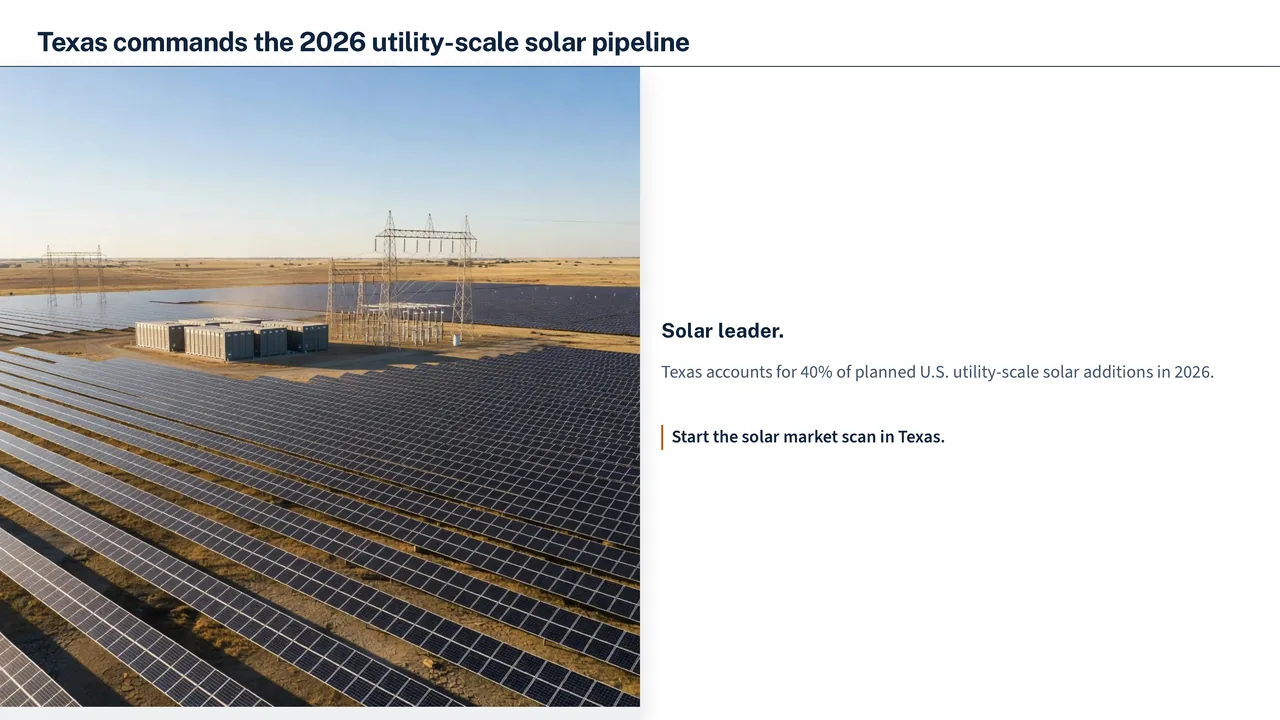
Open an actual exported deck, then compare its outline, source constraints and slide choices with the job you need to finish.
A 12-slide client strategy deck on where planned U.S. solar and battery storage additions concentrate in 2026, built only from two EIA articles: the national buildout, the leading states for solar and for storage, the named projects, and a recommended order of attention. It reaches its answer at the end.
A consulting-style handoff for the leadership team of an electricity business that is deciding where to look first as new solar and battery storage capacity is built; no client is named and none is described. Frame the situation, the analysis the supplied pages support, a recommendation and an action plan. Every figure must come from the supplied pages. The client's own numbers are not known, so recommend in terms of what the pages show, and use no placeholders and no made-up client metrics. Workflow: Consulting and strategy. 12 slides requested. Documents supplied as text (EIA, "Solar, battery storage to lead new U.S. generating capacity additions in 2025 (Today in Energy)", https://www.eia.gov/todayinenergy/detail.php?id=64586; EIA, "New U.S. electric generating capacity expected to reach a record high in 2026 (Today in Energy)", https://www.eia.gov/todayinenergy/detail.php?id=67205).
A separate reviewer agent read the deck’s 74 claims, slides and speaker notes, against the two EIA articles: 53 are supported, 5 loosen or go a little beyond their wording, 16 are in neither article and none contradicts one. All 16 are advice or a judgement about which market to take first, such as “Start the solar market scan in Texas.” It is not a person’s review.
Supply the audience, decision, source material and required coverage. Review the outline before generating. For a QBR, keep results, variance, risks and next decisions distinct instead of mixing them into a status collage.
Edit structured slide fields, preview field alternatives or review a whole-slide rewrite. Ask Lumen can propose wider changes; inspect and select the changes before applying them to the saved deck.
Check charts, speaker notes, images and contrast in presentation view and the downloaded file. A new-period deck is a separate draft with changed values and sources to review.
Choose a creation mode and workflow profile, supply source material and review the planned coverage. Slide fields have layout-specific budgets. Field assistance offers alternatives with rationale and word counts; whole-slide refinement shows field-level changes. Ask Lumen can propose wider structural edits, which require a reviewed preview before application.
Paste spreadsheet rows, choose header handling and preview replacement chart data. Where offered, select Business metrics explicitly and inspect their source receipt. Review changes in values and sources before accepting a next-period draft. Theme controls cover brand colors, type, logo placement, background and contrast choices; a custom theme still needs visual review.
Inspect full-screen and audience views, speaker notes, next-slide preview, navigation and timer. Check PDF and PowerPoint separately. Supported elements can become native editable shapes or charts; complex visuals can use a flattened fallback. Speaker notes and per-slide handoff choices should be inspected in the actual file.
PowerPoint export is hybrid: supported content may remain editable while complex visuals can be flattened. Conversion between a responsive story and slides requires a preview; it is not lossless.
Transformation decks fail in two opposite ways. Some never earn the mandate — they jump to a Gantt chart of initiatives without first establishing why the organization must change now. Others win the room on vision but collapse under scrutiny because the journey looks like a fantasy: no phasing, no milestones, no sense of how a sprawling program actually gets executed. Your deck has to clear both bars — emotional conviction and operational credibility.
So the structure moves deliberately: open with the case for change and the future-state vision, then earn credibility with a phased roadmap that sequences the work into horizons with clear outcomes and quick wins. Ambition and realism are not in tension — a believable roadmap makes a bold vision fundable.
And it must address people. The majority of transformations that miss their goals fail on adoption and change management, not technology. A roadmap deck that talks only about systems and ignores the operating model, governance, and how the organization will actually absorb the change is incomplete — and steering committees know it. The nine-section sequence below builds all three dimensions: why, how, and who.
A practical note on the roadmap slide itself: resist the urge to show a precise multi-year Gantt chart. Two or three horizons — often framed as roughly the next two quarters, the following year, and the longer-term end state — communicate sequence and ambition without committing you to dates you cannot yet defend. Make the near horizon concrete and the far horizon directional; nobody believes a day-level plan for month thirty, and pretending otherwise costs you credibility. The detail belongs in the appendix and in the program plan, not on the executive slide. What the steering committee needs to see is the shape of the journey, the outcomes each horizon delivers, and the quick wins that prove momentum early — the granular schedule is a working document, not a board artifact.
Nine sections from the case for change to the business case. Each is one to a few slides.
The transformation's name, the executive sponsor, the audience, and the decision this session seeks. Naming the program and its sponsor signals that this is a governed initiative with ownership, not a slideware exercise. State up front whether you are seeking approval, funding, or alignment.
The whole story on one slide: why we must change, where we are going, the shape of the journey, the expected value, and the ask. A sponsor should be able to repeat the transformation's logic from this slide alone. Lead with the destination and the value, not the activities.
Why now? The market shifts, competitive threats, customer expectations, or internal pain that make the status quo untenable, and the cost of inaction quantified. This is the emotional core that earns the mandate — change is hard, and people need a reason worth the disruption. Make the cost of doing nothing concrete.
A vivid picture of the destination — what the organization, customer experience, and capabilities look like when the transformation is done. Make it concrete enough to be motivating and measurable, not a slogan. The vision is the north star every phase of the roadmap will ladder up to.
What stands between today and the vision — the capability, technology, process, and people gaps — and the principles that will guide how you close them (for example, customer-first, build-to-scale, quick wins before big bets). Principles keep hundreds of downstream decisions aligned when you are not in the room.
The heart of the deck: the journey broken into phases or horizons, each with a theme, the outcomes it delivers, key milestones, and a timeline. Show quick wins early to build momentum and bigger bets later once capability exists. A roadmap with phases and outcomes — not just dated tasks — is what makes a multi-year program feel achievable.
The parallel tracks that run across the phases — technology, process, data, and people — and the major initiatives within each. Show how the workstreams interlock and where the dependencies are. This is where executives test whether the program is coherent or just a list of projects with a shared logo.
Who runs the transformation, how decisions and funding flow, and — critically — how the organization will adopt the change: communication, training, incentives, and capability building. Transformations fail on adoption far more than on technology, so a credible deck treats change management as a first-class workstream, not a footnote.
The value the transformation creates, the investment required, the KPIs you will track, the major risks and mitigations, and the specific decisions or funding you need now. Tie the value back to the case for change so the numbers close the loop. End on the ask — the reason the steering committee is in the room. Detailed plans go in an appendix.
Almost everyone reaches for a PowerPoint Gantt chart at this point, and for the executive version of the deck it is usually the wrong instrument. A Gantt chart in PowerPoint is a plan of tasks and dates. What a steering committee is deciding is whether to fund a journey — and that decision turns on sequence, outcomes, and dependencies, not on the start date of workstream 3B.
The failure mode is specific. Month-level bars stretched across three years are a promise you cannot keep, and every experienced executive in the room knows it, so the chart meant to demonstrate rigour reads as false precision instead. Worse, it invites the meeting to litigate dates rather than the case for change, and you lose the room on the one slide that was supposed to make the program feel achievable.
Use the horizon view on the executive slide: two or three phases, each with a theme, the outcomes it delivers, and a handful of named milestones. Make the near horizon concrete and the far one directional. Then, if a detailed schedule is genuinely wanted, put it in an appendix or leave it in the program plan where it lives and gets maintained. A PowerPoint Gantt chart template is a reasonable artifact for a delivery review; it is a poor one for winning a mandate.
Start from your vision, gaps, and initiatives and get a structured, editable roadmap deck — case for change through business case — then refine every phase.
Keep decks grounded to source material and approved web research when needed. Gixo extracts key claims, highlights what needs verification, and surfaces citations, attribution, and trust status inside the deck viewer.
8 workflow profiles across consulting, finance, startup, sales, executive, product, training, and general business decks. The workflow drafts the case-for-change-to-roadmap arc above rather than a generic slide template.
Build from a topic, notes, briefs, articles, and uploaded reference material. Bring your vision and initiative list and Lumen drafts the case, vision, and phased-roadmap slides for you to refine.
Create a client-handoff presentation in one workspace, with outline planning, workflow-specific structure, slide editing, citations, presenter tools, and export attached to the same deck.
present mode, speaker notes, timer, and shareable delivery. Export to PPTX, PDF, HTML, and slide images for the pre-read and the program record.
The job is not to generate slides once. The job is to hand off a deck another person can actually open, review, and use.
The deck starts from a consulting, finance, fundraising, sales, executive, product, or general-business workflow instead of generic slide filler.
Structure stays reviewable before full generation, so the first pass is shaped like a real deck instead of a prompt experiment.
Theme switches, layout swaps, slide edits, and regeneration all happen after the deck exists without forcing a rebuild.
Decks are grounded in your sources, and evidence — citations, trust checks, source review — has a built-in home in the workspace instead of being bolted on after generation.
Speaker notes, present mode, shareable delivery, and exports stay on the same finished deck when it is time to ship.
Add the case for change, the future state, and your initiative list. Lumen uses it to draft the deck in the case-to-roadmap sequence.
Get a draft with the case for change, vision, phased roadmap, workstreams, change management, and business case in a clean theme.
Shape the horizons, sequence quick wins, detail the change plan, and quantify the business case. Attach citations to the claims that need backing.
Present to the steering committee with speaker notes, then export to circulate as the program's reference document.
Updated