
AI Presentation Quality Scorecard
A business deck should be reviewed before it reaches the room. This scorecard gives teams a practical way to evaluate narrative, evidence, clarity, audience fit, and strategic alignment, then use AI as a reviewer without surrendering human judgment.
What the slide deck scorecard is for
Most presentation feedback arrives too late and too vaguely: "make it sharper", "add more data", "make it executive-ready". A scorecard turns that vague review into a repeatable check. It asks whether the deck has a clear story, whether the claims are supported, whether the slide design reduces cognitive load, whether the audience will care, and whether the proposed action is aligned with the business goal.
The score is not the product. The purpose is better decisions before the meeting: which slides need revision, which numbers need verification, which sections should move to the appendix, and which objections should be handled before someone else raises them. AI can accelerate this review by summarizing gaps and running pre-mortems, but it should not be treated as the final judge.
In Lumen, this pairs naturally with 8 workflow profiles across consulting, finance, startup, sales, executive, product, training, and general business decks, source material, citations, editable slides, and export. You can generate or refine a first draft, score it against the five dimensions below, and finish a deck that is easier to defend.
The five dimensions of a business deck: what makes a good presentation deck
Evaluate the deck as a decision artifact, not just as a set of good-looking slides.
The deck has a clear beginning, middle, and end. It explains the situation, the insight, the tension, and the recommended action without forcing the audience to assemble the story themselves.
Decks can cite uploaded source material and approved web research, with a built-in citation, trust-check, and source-review surface for reviewers before handoff. The important numbers, quotes, benchmarks, and source claims should be traceable and directly relevant to the slide's message.
The slide layout makes the message easier to understand. Headlines do real work, charts are readable, and the visual hierarchy shows what matters first.
The deck fits the audience's knowledge level, incentives, concerns, and decision rights. A board deck, sales deck, and technical review should not use the same level of detail.
The recommendation connects to the business goal. The deck says what should happen next, why that action matters, and what tradeoffs the audience is being asked to accept.
Ask the uncomfortable question before the meeting: if this presentation failed, what caused it? AI can help list possible failure modes, but the owner decides what to fix.
Score each dimension on a 1-5 scale
The exact numbers matter less than consistent standards. Use the score to focus revision energy.
| Dimension | Score 1: Critical flaw | Score 3: Competent | Score 5: Strong | Review prompt |
|---|---|---|---|---|
| Narrative | The deck is a list of updates. The audience cannot tell what changed or what decision is needed. | The flow is understandable, but the through-line needs sharper transitions and stronger headlines. | The story is clear, memorable, and easy to retell after the meeting. | Can someone summarize the argument in three sentences? |
| Evidence | Claims are unsupported, stale, or disconnected from the recommendation. | Most key claims are backed, but sources and assumptions still need spot-checking. | Every important number and claim is traceable, relevant, and placed in context. | Which three claims would be challenged first? |
| Clarity | Slides are crowded, chart choices confuse the point, or the headline repeats the chart title. | The audience can follow the slide, though some text, visual hierarchy, or chart labels need tightening. | The audience sees the takeaway quickly and the design supports the message. | What is the one thing this slide should make obvious? |
| Audience fit | The deck is written for the creator, not the room. It uses the wrong detail level or misses obvious objections. | The audience is recognizable, but the narrative still needs more context, proof, or decision framing. | The deck anticipates the audience's questions and gives them what they need to decide. | What does this audience already know, doubt, and need? |
| Strategic alignment | The deck has activity, but no clear "so what" or next step. | The ask exists, but the tradeoff, timing, and strategic link need sharpening. | The recommendation is explicit, aligned to the business goal, and supported by evidence. | What decision or action should happen after this deck? |
How to run the scorecard in Lumen
Name the audience, the meeting type, and the decision the deck must support. Lumen's workflow-specific structure helps separate a board update, pitch deck, QBR, sales deck, and consulting story.
Bring the notes, briefs, spreadsheets, prior decks, and uploaded reference material that should constrain the facts. This gives the review something concrete to verify.
Work through the five dimensions and record the weak spots. A low score is useful if it points to a fix: rewrite the headline, cite the claim, simplify the chart, move detail to the appendix, or make the ask explicit.
Ask what could make the deck fail: unclear ask, unsupported number, wrong audience frame, hidden risk, or too much detail. Treat AI as a red-team assistant, then apply human judgment to the revision list.
Citations, source review, present mode, and PPTX, PDF, HTML, and slide-image exports stay attached to the same deck. Use export as the handoff step after the deck owner has checked the claims and sharpened the narrative.
Common review mistakes
- Treating the score as the goal. The score should trigger specific revisions, not become a vanity metric.
- Letting AI approve the deck. AI can find patterns and gaps, but the business owner remains accountable for what is presented.
- Scoring visuals without scoring logic. A clean deck can still be strategically weak if the story, evidence, or ask is unclear.
- Ignoring audience context. A deck that works for an internal team may fail with investors, executives, buyers, or a board.
Deck check, deck rater, or scorecard? Pick the one that matches the question
People arrive here looking for three different things. Only one of them is a number.
| What you want | What it actually is | Where it helps | Where it stops |
|---|---|---|---|
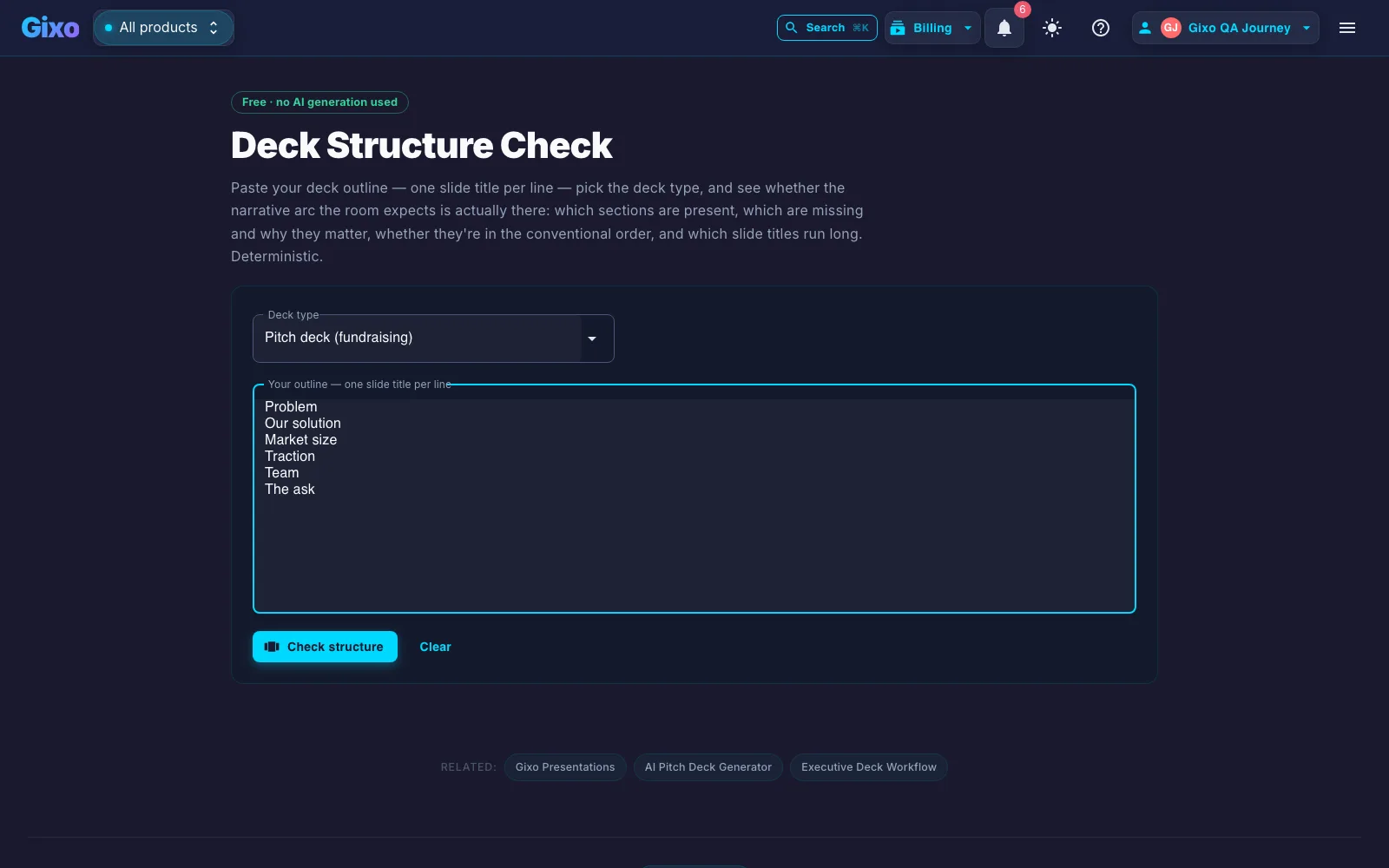
| A deck check | A mechanical pass over the slide deck: is the expected section missing, is the outline out of order, is a slide carrying more words than anyone will read. | Catching structural omissions in seconds, before a human reviewer spends time on them. Gixo's free Deck Structure Check does exactly this and scores a pasted outline out of 100. | It cannot tell you whether the argument is true or whether the audience will care. |
| A deck rater | A single score for the whole presentation deck, usually produced by a model reading the slides. | A rough triage signal across many decks — useful when you are looking at a stack, not one deck. | A composite number hides which dimension failed, which is the only part you can act on. Two decks scoring 3.4 can need opposite fixes. |
| A scorecard | Separate 1-5 scores across narrative, evidence, clarity, audience fit, and strategic alignment, each attached to a review prompt. | Deciding what to revise before the meeting, and giving reviewers a shared standard instead of "make it sharper". | It still needs an owner. The scorecard organises judgment; it does not replace it. |
Why the scorecard is not a rating
- Ratings compress; scorecards separate. The point of five dimensions is that the weak one tells you what to fix. Averaging them back into one number throws that away.
- Presentation skills are a separate axis. A deck can score well and still lose the room because the delivery buried the ask. Review the artifact and rehearse the delivery — the scorecard covers the first.
- Run the mechanical check first. Structural gaps are cheap to catch with a tool and expensive to catch in a review meeting. Do the deck check, then spend human attention on the dimensions a tool cannot judge.
Why use Lumen for scorecard-driven deck review
The job is not to generate slides once. The job is to hand off a deck another person can actually open, review, and use.
Workflow fit
The deck starts from a consulting, finance, fundraising, sales, executive, product, or general-business workflow instead of generic slide filler.
Outline first
Structure stays reviewable before full generation, so the first pass is shaped like a real deck instead of a prompt experiment.
Editability
Theme switches, layout swaps, slide edits, and regeneration all happen after the deck exists without forcing a rebuild.
Evidence
Decks are grounded in your sources, and evidence — citations, trust checks, source review — has a built-in home in the workspace instead of being bolted on after generation.
Delivery
Speaker notes, present mode, shareable delivery, and exports stay on the same finished deck when it is time to ship.
Frequently asked questions
Updated