
Frame the decision
Name the audience, requested decision and source pack. Review imported tables and extracted text; record gaps instead of allowing a polished narrative to conceal them.
Prepare a renewal brief from the account history, supplied usage/risk evidence, expansion assumptions and stakeholder context you hold. Business attempts source-based number reconciliation and requests citation markers. Check unrepaired figures, currentness and source support before the CS team uses the draft in a renewal discussion.
An AI renewal brief generator organizes selected account context, churn-risk material, expansion assumptions, competitor evidence and stakeholder notes into an editable draft. Business attempts number reconciliation and requests numbered source markers where supported. These checks can be incomplete; review the account evidence and proposed actions before exporting the saved brief for the renewal meeting.
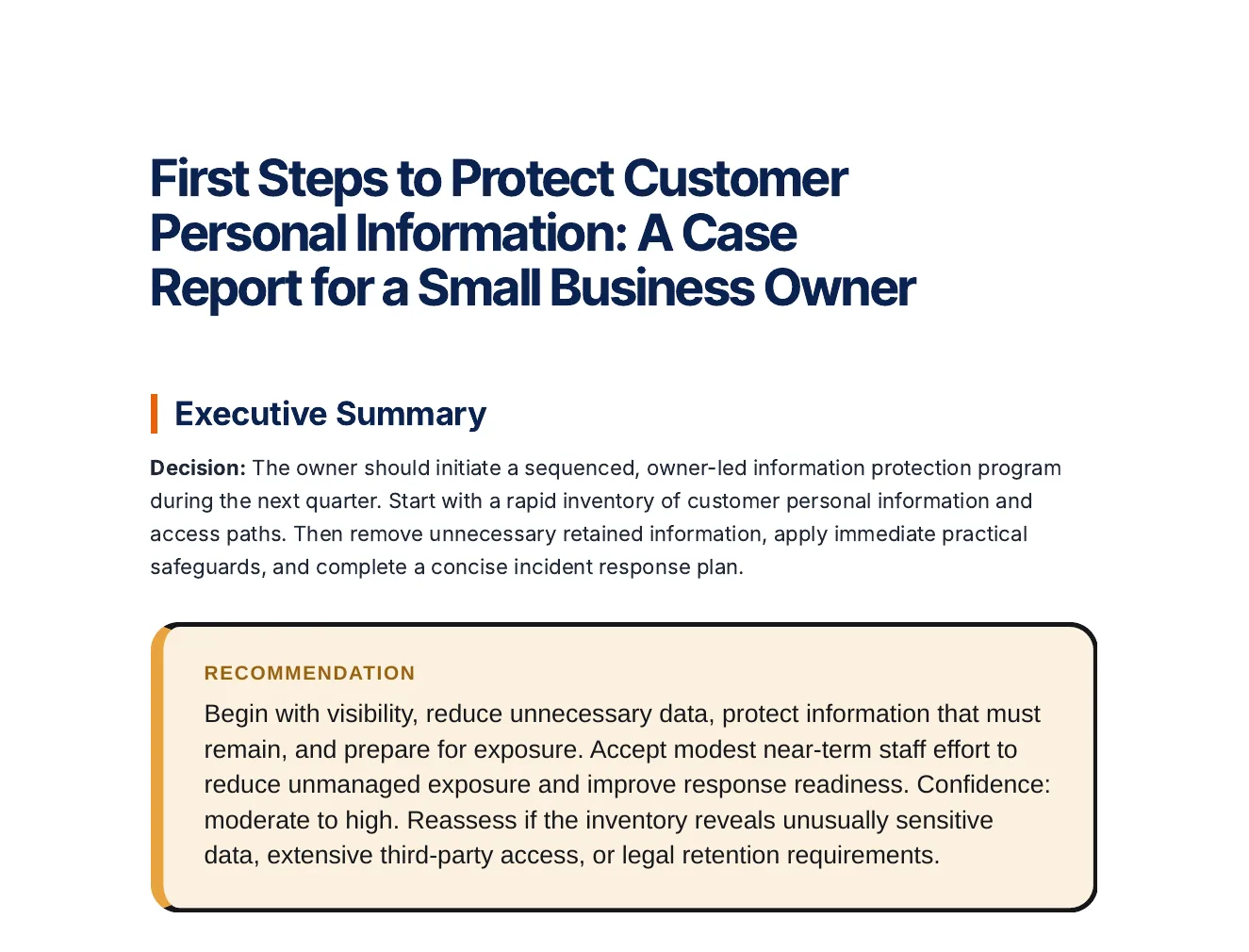
Inspect an actual Business report. A readable decision brief needs the question, supplied evidence, options, assumptions and next decision—not just a shorter source document.
A decision, options compared on stated criteria, risks and a roadmap, with statements in the analysis labelled Fact, Inference or Assumption. The decision, lists and some summary sentences carry no label.
Business question: Which actions should a small business that stores customer personal information take first to protect it and to be ready if it is exposed? Decision maker: The owner of a small business. Timeframe: The next quarter. Context: A small business collects customer personal information and keeps it in paper files and on computers. It has no dedicated security staff. Refer to it as 'the business' throughout and do not give it a name. Options: Take stock of the personal information it keeps and where it is stored; Reduce what it keeps to what the business needs; Lock down the information it keeps with practical safeguards; Prepare a plan for responding to a data breach. Criteria: How much personal information at risk it removes or protects; How realistic it is for a small team without security specialists; How well it limits the harm if information is exposed. Constraints: No dedicated security staff; Limited time and budget.
Open the full export and compare its statements with the cited sources before reuse.
Name the audience, requested decision and source pack. Review imported tables and extracted text; record gaps instead of allowing a polished narrative to conceal them.
Separate supplied facts, calculated values, assumptions and recommendations. For variance work, reconcile the period, unit, baseline and actual value before interpreting the direction of a difference.
Use options, trade-offs, risks and named next actions. Review the final artifact and, when using Analyst calculations, inspect the calculation evidence separately from the narrative.
Select source documents, case context, working notes, assumptions, options and decision constraints before generation. Inspect claims, metrics, exact quotations, source tables and conflicting figures. Review decisions are scoped to the source or artifact and can become stale after evidence changes; unresolved evidence should stay visible.
Keep investment, recurring costs, benefits, delays, growth, discount assumptions and scenario probabilities explicit. Inspect deterministic cash flow and the available return, payback and sensitivity outputs. Compare scenarios before selection, and inspect the formula workbook or calculation receipt separately from the narrative recommendation.
Inspect the dossier's source tables, working rows and columns, calculation ledger and workbook handoff. Metric packs retain reviewable calculation and source context. Preview source replacements for a new period before accepting them. Execution records distinguish an action owner, baseline, target, measured value, data source and the reason for a status change.
A calculation can be replayable while the supplied inputs remain wrong. A generated report is decision support, not independent diligence, audit assurance or investment advice.
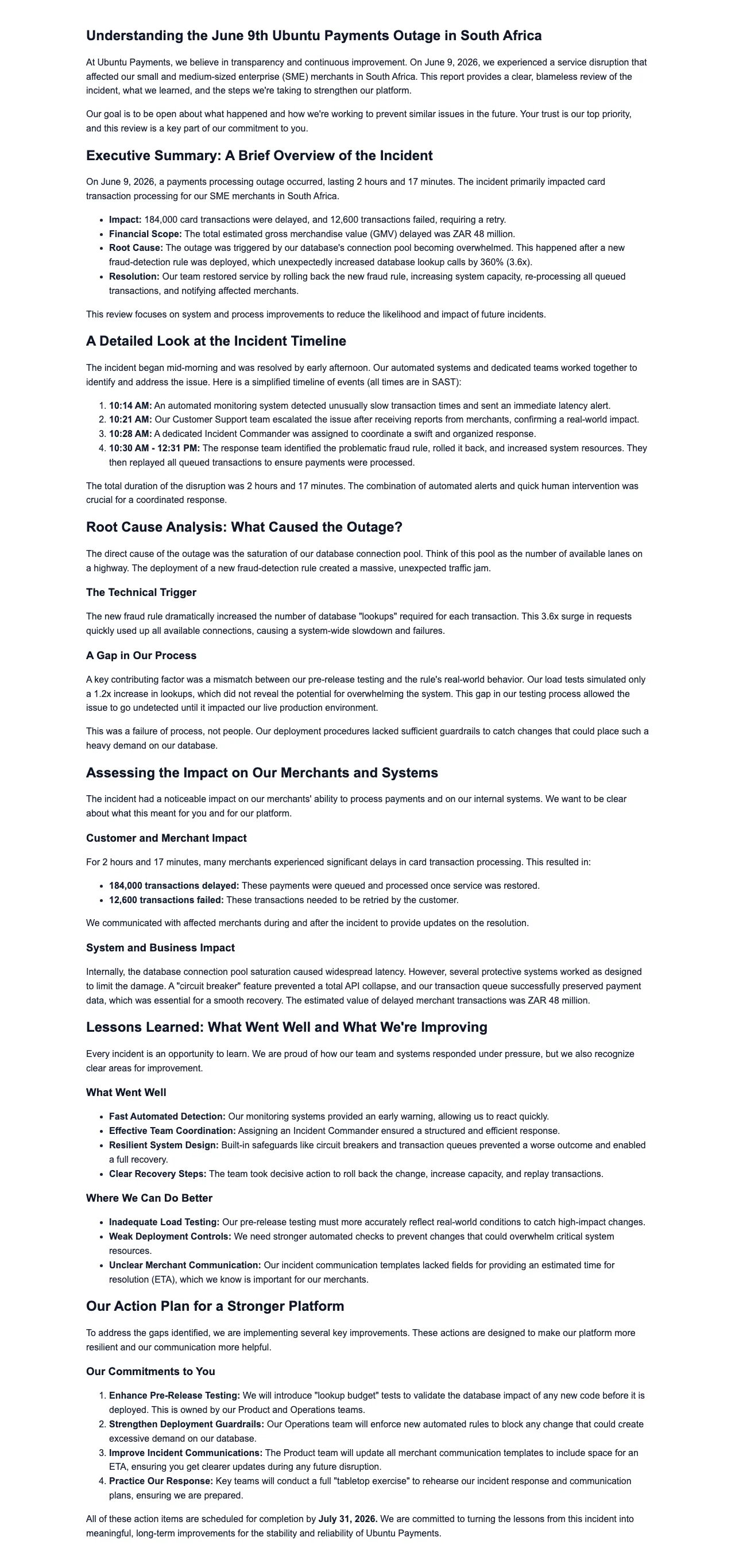
Draft a structured renewal pre-read from the account history, risk indicators and expansion assumptions you supply. Review the original sources, material figures and citation markers before the conversation; the document does not guarantee readiness or a renewal outcome.
Surface the full picture: account history, contract value, product usage trends, and key stakeholders. The AI structures everything in KPI and Comparison Table blocks so your team sees the complete relationship at a glance.
Organize supplied usage changes, satisfaction findings, support trends and competitor signals into proposed churn-risk sections. Business attempts source-based number reconciliation and requests citation markers; it does not calculate a live customer-health score or validate a risk prediction. Have the account owner review dates, context and proposed mitigation before use.
Discover upsell paths, cross-sell options, and usage-based expansion triggers. Gixo structures each opportunity with revenue projections and likelihood scores so you can prioritize the highest-impact plays during renewal conversations.
Describe the competitor alternatives, pricing evidence and switching assumptions your customer is discussing. Use the draft to organize those points, then check source dates and whether each reference supports the claim. Model-generated markers do not validate current competitor data or an objection response.
Get clear renew, expand, or discount logic with pricing strategy guidance and negotiation positioning. Use Quick AI for instant rewrites or Power Edit for full AI dialog to tailor recommendations to each account's unique situation.
Identify decision makers, champions, detractors, and influence paths within the account. The AI maps organizational dynamics so you know exactly who to engage and how to navigate the renewal approval process.
Enter account details, contract terms, usage data, and any known risks or opportunities. The AI tailors the renewal analysis to your specific customer relationship.
Choose what matters most -- risk assessment, expansion analysis, competitive positioning, stakeholder mapping, or a comprehensive renewal brief covering all dimensions.
Business drafts the renewal sections from selected account evidence and the reviewed outline, with supported terminology and structure checks. It attempts source-based number reconciliation and requests numbered references; original values and missing markers can remain. Review revenue definitions, churn periods, sources and proposed account actions before use.
Edit with 20+ semantic blocks including KPIs, Pros/Cons, and Comparison Tables. Save to a workspace for team collaboration, then export to PDF for your renewal meeting.
Compare Gixo's AI-generated renewal briefs with existing customer success tools and manual processes.
| Evaluation area | Gixo Business | What to check in Gainsight, ChurnZero and CRM reporting workflows |
|---|---|---|
| Account inputs | Draft from the account records and source material you supply. | Check current CRM/product-data integrations and which account fields update automatically. |
| Renewal narrative | Organize account context, risks, alternatives and proposed next steps. | Test current AI summary/reporting options on the same account evidence. |
| Expansion claims | Review supplied opportunity values and assumptions; no validated automatic expansion score is promised. | Inspect how opportunity scores are calculated, refreshed and reviewed. |
| Source support | Review citations, dates and source-reconciliation findings. | Check whether users can trace a material statement to its underlying account data. |
| Delivery | Edit the saved brief and review its export. | Confirm which workflow manages operational renewal tasks and distribution. |
| Brief Component | What It Covers | Output Format |
|---|---|---|
| Account Context Summary | Account history, contract value, usage trends, key stakeholders | KPI + Comparison Table blocks |
| Renewal Risk Assessment | Churn signals, competitive threats, satisfaction scores, support ticket trends | Pros/Cons blocks with [1],[2] citations |
| Expansion Opportunities | Upsell/cross-sell paths, usage-based triggers | Revenue-projected, likelihood-scored |
| Competitive Intelligence | Competitor positioning, pricing comparisons, switching cost analysis | Cited, grounded blocks |
| Recommendation Engine | Renew/expand/discount logic, negotiation positioning | Quick AI or Power Edit revisions |
| Stakeholder Mapping | Decision makers, champions, detractors, influence paths | AI-generated org map |
| Number checks | Your revenue figures and churn metrics checked against your sources | Multi-stage pipeline, auto citations |
| Export | Final brief for the renewal meeting | PDF, workspace collaboration |
For a brief written from sources you upload or from the search results web research drew on, the Evidence tab under Checks in the brief editor lists up to five sentences or table cells whose wording or figures it could not match to those sources, for you to check. It matches wording and exact figures, not meaning: a faithful paraphrase, or $8.1M where the source says 8,100,000, can fail to match while being true, so an unmatched sentence is a place to look, not an error, and a matched one is not confirmed either, because this is a comparison with your own sources, not a fact-check. It reads only part of a long source (24 passages of up to 1,600 characters) and at most 12 sources, files first. Of web research it reads the title and snippet of each search result, not the page, so a figure taken from the page alone does not match, and if it could not read every result the list is advisory. It reads a table cell with its row and column, and a total the table works out from its own cells passes when the arithmetic holds. It checks the draft as generated, not your later edits.
Updated