
Frame the decision
Name the audience, requested decision and source pack. Review imported tables and extracted text; record gaps instead of allowing a polished narrative to conceal them.
Turn diligence files, management notes and market reports into a reviewable investment brief. Compare the investment case, conflicting evidence and unresolved questions in one document; verify the underlying facts before an investment decision.
Compare Business plans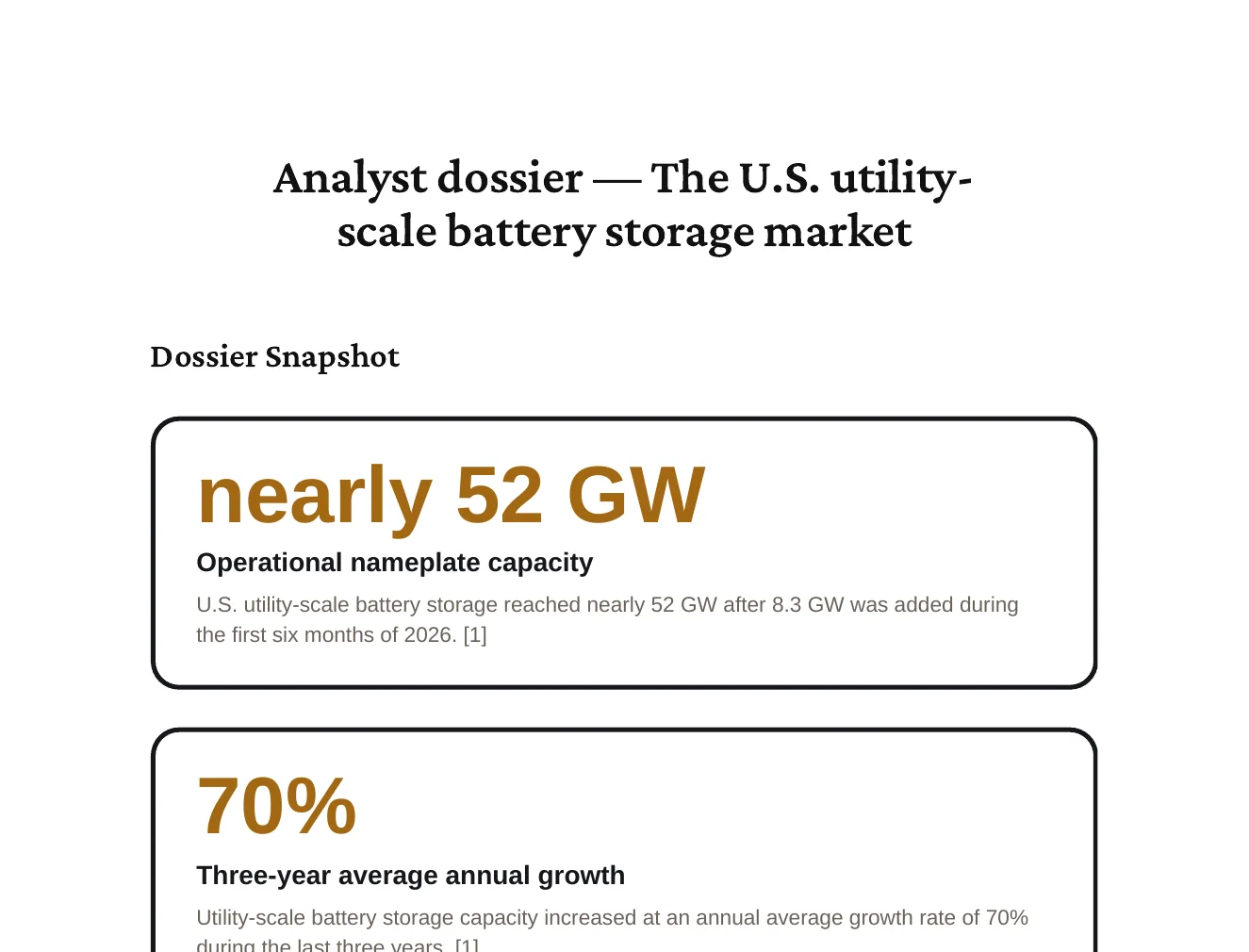
Inspect an actual Business report. A readable decision brief needs the question, supplied evidence, options, assumptions and next decision—not just a shorter source document.
A dossier built from four public EIA pages: a snapshot of figures, an executive summary, market size and growth, key drivers and trends, the competitive landscape, segments and buyers, an outlook, recommendations and a sources appendix, ending with the product's own faithfulness review of the text.
Research target: The U.S. utility-scale battery storage market. Focus: How fast U.S. utility-scale battery storage capacity has grown, what is planned for 2025 and 2026, and how battery storage compares with the other kinds of generating capacity being added. Describe a trend, ranking or comparison only where a source states it, and say where the sources are silent.
Open the full export and compare its statements with the cited sources before reuse.
Name the audience, requested decision and source pack. Review imported tables and extracted text; record gaps instead of allowing a polished narrative to conceal them.
Separate supplied facts, calculated values, assumptions and recommendations. For variance work, reconcile the period, unit, baseline and actual value before interpreting the direction of a difference.
Use options, trade-offs, risks and named next actions. Review the final artifact and, when using Analyst calculations, inspect the calculation evidence separately from the narrative.
Select source documents, case context, working notes, assumptions, options and decision constraints before generation. Inspect claims, metrics, exact quotations, source tables and conflicting figures. Review decisions are scoped to the source or artifact and can become stale after evidence changes; unresolved evidence should stay visible.
Keep investment, recurring costs, benefits, delays, growth, discount assumptions and scenario probabilities explicit. Inspect deterministic cash flow and the available return, payback and sensitivity outputs. Compare scenarios before selection, and inspect the formula workbook or calculation receipt separately from the narrative recommendation.
Inspect the dossier's source tables, working rows and columns, calculation ledger and workbook handoff. Metric packs retain reviewable calculation and source context. Preview source replacements for a new period before accepting them. Execution records distinguish an action owner, baseline, target, measured value, data source and the reason for a status change.
A calculation can be replayable while the supplied inputs remain wrong. A generated report is decision support, not independent diligence, audit assurance or investment advice.
An AI brief for investors is a draft investment memo, market assessment or diligence summary built around a defined deal question. Gixo Business organizes your supplied material into a brief with financial context, risks and a recommendation for review. Where the reviewed plan and evidence policy calls for citations, the model can cite uploaded files with numbered markers. Missing citations, unsupported interpretations and wrong source data still need an analyst to resolve.

Specify the transaction, stage, geography, valuation date and decision: proceed to diligence, request more evidence or decline. A market overview and an investment recommendation need different supporting material.
Attach the dated operating model, management presentation, customer or cohort data and market research you are entitled to use. Explain differences in reporting period, currency and definitions. A revenue spreadsheet and a management slide are not interchangeable evidence.
For example: does reported growth reflect recurring revenue, a price increase or one customer? Put those questions into the brief instructions so the draft has to address them rather than fill the space with sector commentary.
Review the thesis, options, financial assumptions, downside risks and requested decision. Keep management assertions separate from independently checked evidence and from your own judgement.
Check numbered markers and open the source files they refer to. Use the Evidence tab to locate sentences that need attention, then edit the brief itself. A passed wording match does not validate the valuation model or the management forecast.
Gixo does not supply an investment opinion, validate ownership of an asset or replace commercial, financial and legal diligence. If the source pack omits churn, debt covenants or a customer concentration schedule, request that evidence instead of treating a fluent paragraph as the answer.
Illustrative source: A supplied pilot report says: “18 of 24 invited teams completed the four-week pilot. No commercial renewal decision has been made.”
Draft sentence to inspect: “18 teams completed the pilot [1], demonstrating strong renewal demand.” The marker can lead to the report, but the report does not support the renewal conclusion. Keep the observed completion count; replace the unsupported inference with “Renewal intent remains untested.”
In Checks → Evidence: Inspect the claim-matching and citation findings, open the source, and edit the sentence in the brief. A missing-marker finding does not insert a reference for you. Even a matched sentence needs review of its meaning. This is a worked review example with invented data, not a customer result or a claim that this exact draft was generated.
See the Business editor and Evidence workflow · Review the product and plan boundaries
Use this due diligence report template as a starting outline for an investment or vendor review. Define the decision, scope and reporting date, then supply the source material you are permitted to use. It is an annotated structure for the reviewer to adapt, rather than a certification or a promise that a generated dossier will cover every diligence issue. Missing records stay open questions.
| Section | What to supply or record | What the reviewer checks |
|---|---|---|
| Decision and scope | The proposed investment or vendor decision, alternatives, period and review owner. | What is in scope and which decision the report can actually support. |
| Materials examined | Source names, dates, versions, relevant passages and missing requested documents. | Whether the material is current, complete enough and applicable to the entity under review. |
| Business and commercial evidence | Customer, product, market and operating records, with observations separated from management estimates. | Unsupported conclusions, contradictory records and questions for the company or supplier. |
| Financial observations | Periods, units, supplied statements and reviewed working-table calculations. | Comparable reporting bases, source-cell mappings, calculation assumptions and any unverified external model result. |
| Risks and open diligence | Issue, supporting material, impact assumption, owner and next evidence needed. | Which specialist, legal, tax, security or accounting work remains outside this document review. |
| Recommendation and next checks | The proposed next step, conditions, unresolved questions and review responsibilities. | Whether the conclusion follows the available evidence and which conditions must be settled first. |
Business Analyst can prepare a dossier from current supplied material and retain its AI faithfulness review. That review compares the draft with the same evidence; it is not independent verification of the business. Inspect the original records and material citations. A prior dossier is continuity context, while the next review needs current evidence. This workflow does not replace a licensed research database, a transaction data room or specialist due diligence.
When you use an approved Business Case as a source, select the particular approved revision and facts. Those facts and access are checked again when the supported Analyst workbook or reviewed output is saved or exported. Author-attested figures remain distinct from server-recomputed scenario results; neither approves a new investment conclusion.
Review the Analyst workflow · Compare Business brief and recommendation structures · See the source and review controls
Updated