Use this page as a buyer-evaluation guide for Clio and Gixo Lex. It starts with how the two differ in category, document scope and boundaries, gives Lex's own prices, then gives the method to verify it. Statements about Lex describe its available workflow and limits; statements about Clio describe the public product information linked from this page and should be rechecked before purchase.
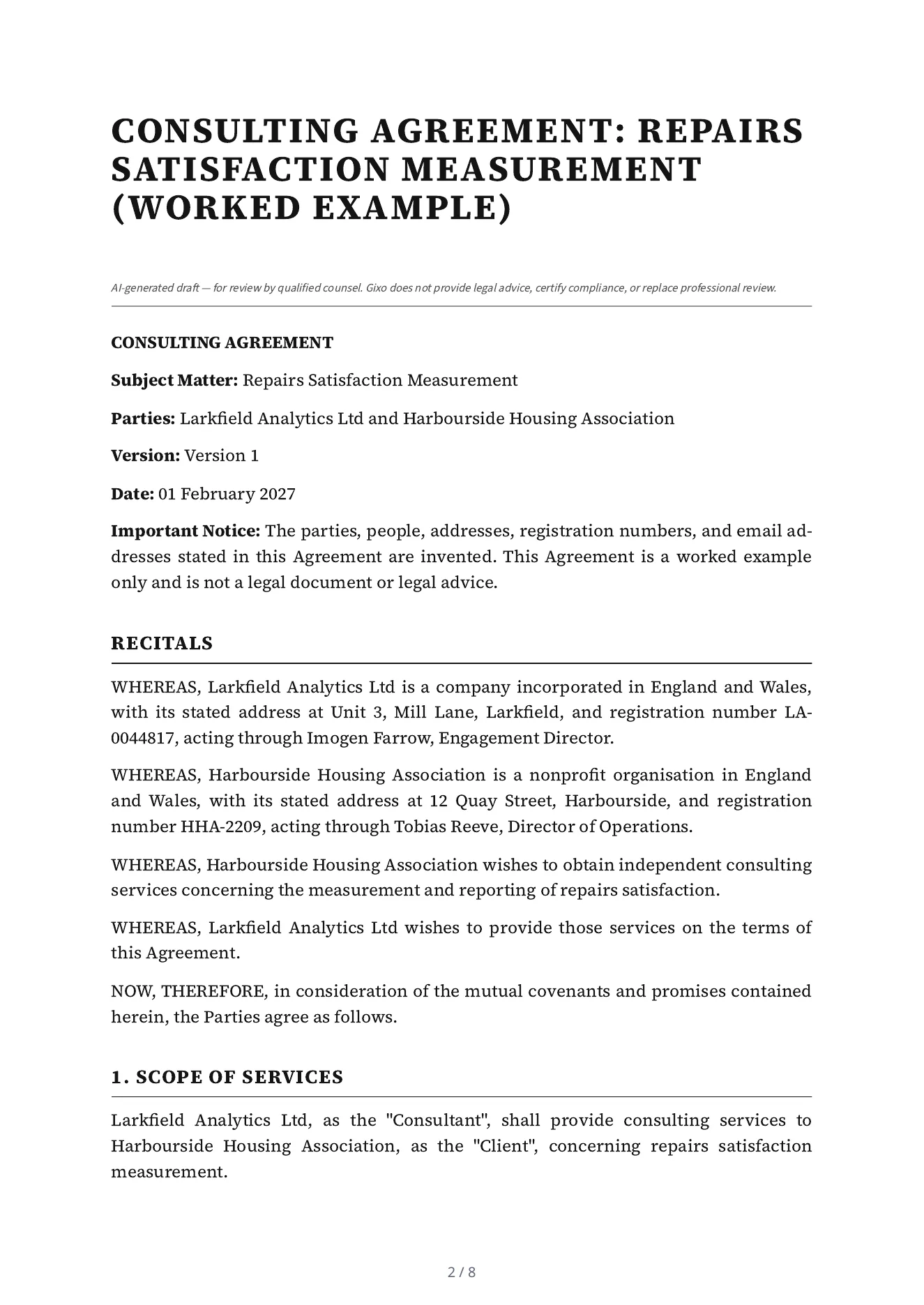
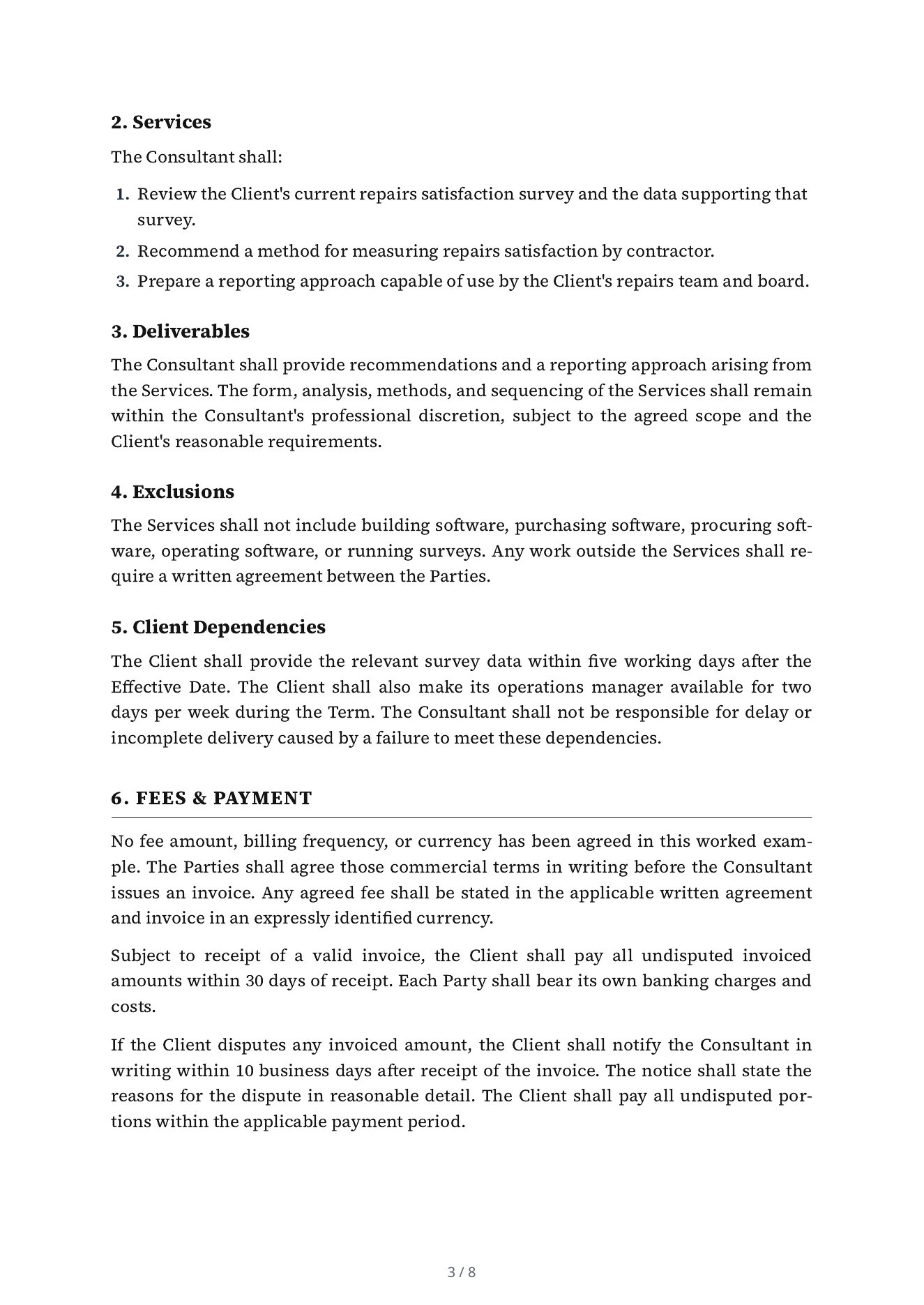
Lex drafted each agreement on 3 October 2026 from the intake shown and exported it as a PDF and a Word file without editing. The parties, people and addresses are invented, and the first page of every file says so. These are specimens, not legal documents.
A consulting agreement of 26 numbered clauses between two invented parties: scope, services, deliverables, exclusions, fees and expenses, intellectual property, confidentiality, liability, termination, notices, governing law and signature blocks. Its first page says the parties, people and addresses are invented and that it is a worked example, not a legal document.
The intake Lex was given
Draft a Consulting Agreement: repairs satisfaction measurement between Larkfield Analytics Ltd (Consultant) and Harbourside Housing Association (Client). Governing law: England and Wales. Effective date: 2027-02-01. Term: Ten weeks from the effective date. Confidentiality: Three years after the engagement ends. The Consultant will review the Client's current repairs satisfaction survey and the data behind it, recommend a method for measuring repairs satisfaction by contractor, and leave the Client with a reporting approach that the repairs team and the board can use. Excluded: building or buying software, and running surveys. Dependencies: the Client provides the survey data within five working days of the effective date and two days a week of its operations manager's time. State on the first page that the parties, people and addresses in this agreement are invented and that it is a worked example, not a legal document. Keep the agreement short and plain. The notice email address of Larkfield Analytics Ltd is notices@larkfield-analytics.example and of Harbourside Housing Association is notices@harbourside-housing.example (both invented).
Read mechanically against the intake, not by a lawyer: all 12 facts the intake gave (names, registration numbers, addresses, representatives, the effective date and the governing law) are in the draft, nothing is left as a placeholder, and it states two terms the intake did not give, 30 days and 10 business days, which Lex chose.
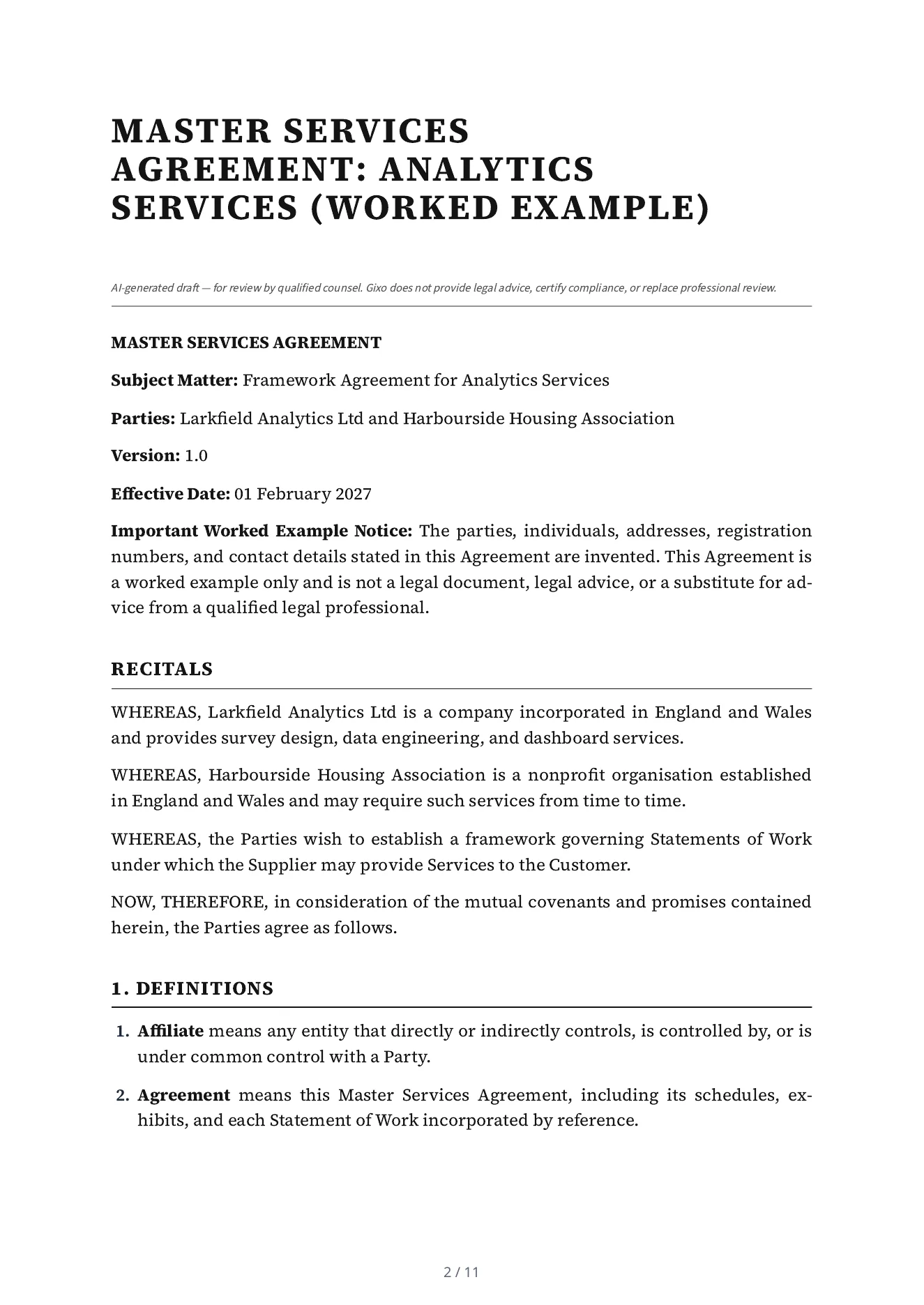
Master services agreement · 11-page PDF · 2,876 words
A master services agreement of 17 numbered parts: definitions, scope of services, service levels and change orders, fees, intellectual property, confidentiality, data protection, warranties, indemnification, limitation of liability, force majeure, term and termination, transition assistance, governing law, general provisions and schedules. Its first page says it is a worked example, not a legal document.
The intake Lex was given
Draft a Master Services Agreement: analytics services between Larkfield Analytics Ltd (Supplier) and Harbourside Housing Association (Customer). Governing law: England and Wales. Effective date: 2027-02-01. Term: Two years from the effective date, renewable by written agreement. Confidentiality: Five years after the agreement ends. The Supplier provides survey design, data engineering and dashboard services to the Customer under statements of work agreed in writing. Excluded: any service not set out in a signed statement of work. Dependencies: the Customer provides access to its systems and a named contact for each statement of work. State on the first page that the parties, people and addresses in this agreement are invented and that it is a worked example, not a legal document. The notice email address of Larkfield Analytics Ltd is notices@larkfield-analytics.example and of Harbourside Housing Association is notices@harbourside-housing.example (both invented).
Read mechanically against the intake, not by a lawyer: 10 of the 12 facts the intake gave are in the draft (the two registration numbers are not printed), nothing is left as a placeholder, and it states two terms the intake did not give, 30 days and 10 Business Days, which Lex chose.
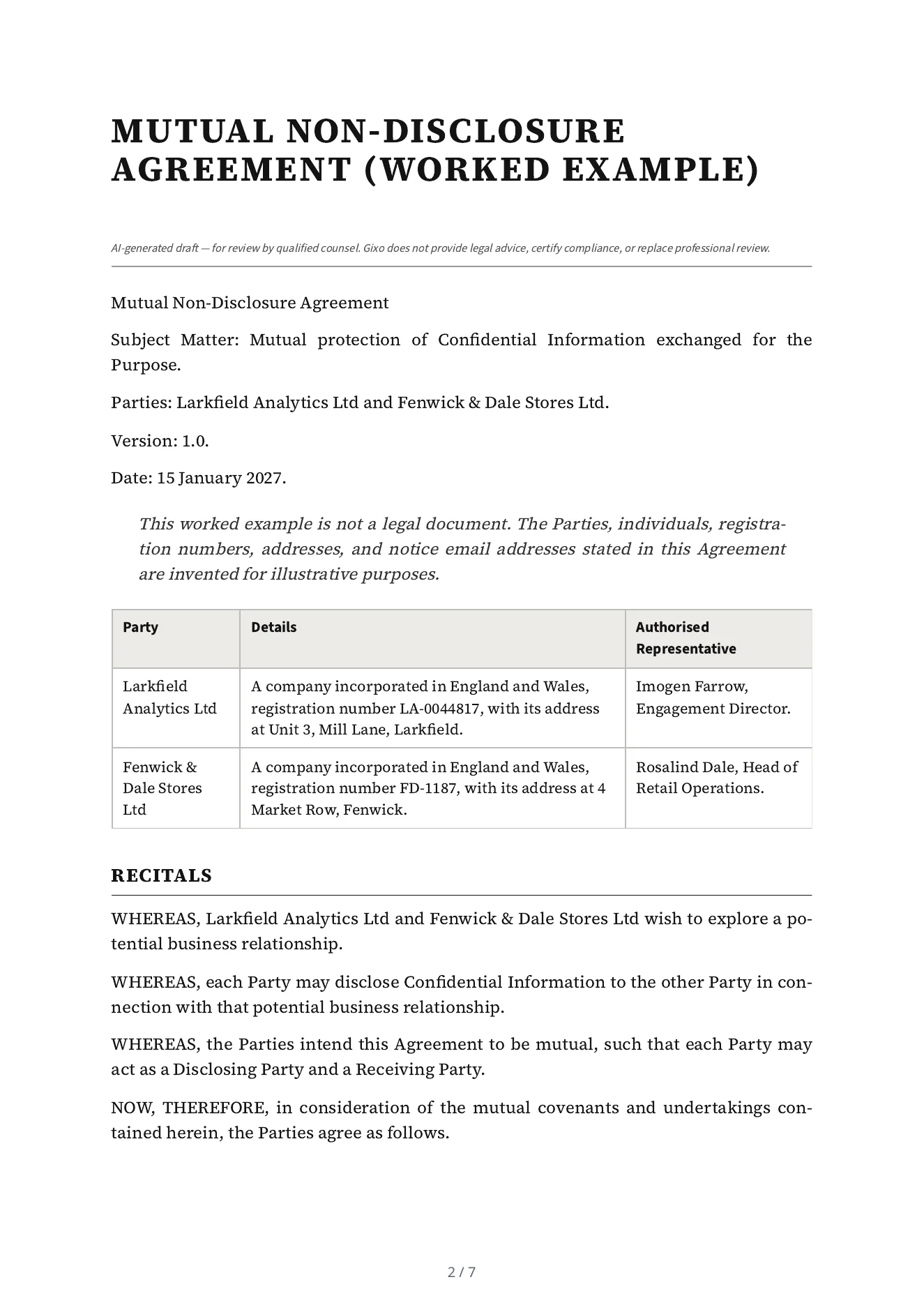
Mutual NDA · 7-page PDF · 1,592 words
Mutual Non-Disclosure Agreement (worked example)
A mutual non-disclosure agreement of 14 numbered clauses between two invented parties: definitions, what counts as confidential information, exclusions, the receiving party's obligations, permitted disclosures, return of materials, remedies, term, survival, governing law, notices and signature blocks. Its first page says it is a worked example, not a legal document.
The intake Lex was given
Draft a Mutual Non-Disclosure Agreement between Larkfield Analytics Ltd (Party A) and Fenwick & Dale Stores Ltd (Party B). Governing law: England and Wales. Effective date: 2027-01-15. Term: Two years from the effective date. Confidentiality: Three years after disclosure. A mutual agreement: each party may disclose and receive confidential information. State on the first page that the parties, people and addresses in this agreement are invented and that it is a worked example, not a legal document. The notice email address of Larkfield Analytics Ltd is notices@larkfield-analytics.example and of Fenwick & Dale Stores Ltd is notices@fenwick-dale.example (both invented).
Read mechanically against the intake, not by a lawyer: all 12 facts the intake gave are in the draft, nothing is left as a placeholder, and it states no term the intake did not give.
Each draft was read mechanically against its intake, not by a lawyer. Verify every draft with qualified counsel before use.
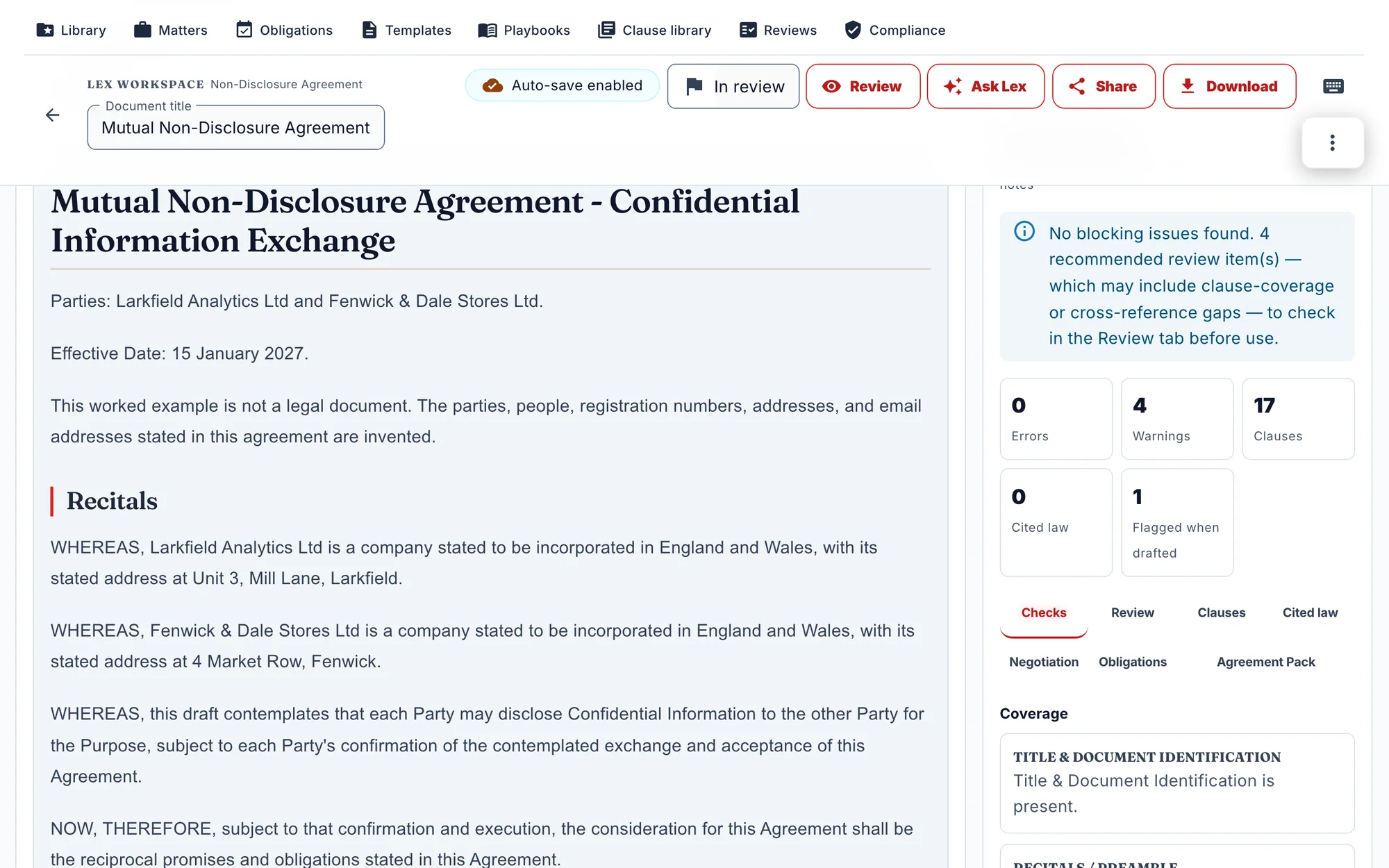
A labeled Gixo Lex workspace capture showing a Mutual NDA (England and Wales), after a round of edits, with Draft Checks beside the draft. The panel reports no blocking issues and lists four review items a reviewer works through before anyone relies on it. Draft for review, not a final or certified document.
Clio is a practice management platform — billing, time tracking, matters, client intake, and IOLTA trust accounting. Its site, read on 6 November 2026, also describes Clio Work, which analyzes a matter, researches the law with cited sources, and drafts documents, from court forms and firm templates to bespoke first drafts, so test its drafting on your task as well. Gixo Lex is a drafting workspace: it captures parties, governing law, terms, and reference files, then prepares a structured first draft clause by clause. Lex covers 29 named draft workflows plus custom drafting (guided confidentiality/IP, services, corporate/equity, employment, real-estate, finance, and general legal documents, including custom drafting), multi-party agreements for up to 10 parties, and compliance work product (checklists, evidence matrices, working papers, filing support notes, and policy drafts), exporting in PDF, DOCX, HTML, and TXT, on per-seat plans of $29–$229 per seat per month. Lex does not do billing, time tracking, firm practice management or trust accounting; it does provide guided document intake and a personal matter office. Evaluate whether one product or a documented handoff fits your own practice.
Clio and Lex at a glance
The products can appear together in a legal-operations stack, but they answer different buyer questions.
Primary job
Clio: practice management across matters, billing, time, intake, and related operations, with Clio Work adding AI research, analysis and drafting on the matter.
Lex: prepare and review structured legal drafts and compliance artifacts.
Document workflow
Clio: Clio Work describes bespoke drafts from a prompt, document automation from firm templates, and court forms, working from the matter already in Clio (its site, 6 November 2026).
Clio: a firm choosing a system to run its practice.
Lex: billing, time tracking and trust accounting are outside its scope. Its personal matter office organizes sources, findings, tasks and reviewed work products; it is not a firm practice-management system. The reviewed draft can be handed into the firm's existing system.
What can this page verify about Lex?
Lex provides structured drafting, an AI contract review with deterministic first-pass checks, reviewer dispositions, versioned playbooks, bounded clause edits, versions, and tracked-change DOCX handoff. Use the official vendor link and the same proof-of-work to verify every capability or integration you need outside that current Lex surface.
When is each tool the better fit?
Choose Gixo Lex when
You want a drafting and review workspace without moving your practice into a new system, especially for multi-party agreements, governing-law-sensitive drafts, and compliance artifacts.
Choose Clio when
You need practice management: billing, time, matters, intake, and trust accounting. Clio is the stronger choice when running the practice matters more than improving the drafting workflow. If Clio already runs your practice, test Clio Work's drafting on the same task before adding a second tool.
Consider both when
You want Clio to keep running the practice while Lex improves the drafting step. That is a reasonable split when the bottleneck is document quality rather than matter management.
Use the Same Evidence Standard
This is a website-experience comparison, not a product-feature verdict. Treat every untested capability, price, rating, commercial term, and security control as unknown until you verify it. It rests on what each vendor publishes, not on a test of the other product, so treat any fit note on this page as a starting point for your own test.
Inspect the Current Official Vendor Page
Open Clio's official site from the link above. Capture the date and URLs for relevant product, pricing or contact, privacy, and security pages. If an item is not public, record it as unknown — not absent.
Run the Same Workflow
Use the same representative legal task and source pack in every product you can access. Record the inputs, review steps, output, and export or handoff. Do not infer product behavior from marketing copy alone.
Verify Current Commercial and Security Terms
Confirm current pricing, contract terms, minimums, and trial conditions directly with each seller. Review current privacy, security, data-retention, and subprocessor information before sharing client material.
Buyer Evaluation Worksheet
Use the same task, evidence, and scoring rubric for every product you can access.
1. Define Pass Conditions
Write down the document type, source materials, required reviewer controls, acceptable export or handoff, and legal or security constraints before opening either product.
2. Record Observed Evidence
Keep dated screenshots, URLs, written seller answers, and notes from the same proof-of-work. Separate what you observed from what a marketing page promises.
3. Keep Unknowns Explicit
Do not convert missing public information into a negative claim. Ask the vendor, document the answer, and re-check material terms immediately before purchase.
What This Page Can Verify About Gixo Lex
The statements below describe Lex as it works today. Test the live product as part of your evaluation because Lex can change too.
Current Evaluation Paths
The buttons on this page link to the current 14-day Lex trial path and the current Lex plan section. Re-check both before relying on an offer or plan.
Labeled Product Evidence
The sample drafts and the image above are labeled Gixo Lex output: exported files and a workspace capture with its Draft Checks review panel. They are product evidence, not evidence about Clio.
Professional Review Boundary
Gixo helps prepare regulated work. It does not provide legal advice, certify compliance, or replace professional review.
Matters, review, approvals and signing in Lex today
A Lex matter holds up to 200 documents. You can pick a whole folder of up to 2,000 files; Lex sets aside system files and types it cannot import, lists them with the reason, and imports the rest up to the matter limit. It reads PDF, Word, spreadsheets, slides, images (by OCR), audio and video (transcribed), emails (.eml, Outlook .msg and .mbox) and WhatsApp chat exports. Lex lists documents that the matter sources refer to but the matter does not hold. It can draft pleadings for a named forum after researching that forum rules, and research case law for and against an issue, with each passage checked against the judgment it quotes; that research is not a citator. Choose where to begin in Lex.
Every contract in Lex, whether Lex drafted it or you imported it, gets an AI contract review that reports each expected clause as present, weak or absent, lists up to 25 risks with the party each falls on and replacement wording, and checks every quotation against the contract text. There is no single risk score, and you decide each finding before approval.
Approvers can be named in order, with two rules that add an approver when they apply: one for high-risk findings and one for a liability cap above an amount you set. Once approvers are set, the drafter cannot approve the contract, each approval is tied to the exact version, and the next approver is notified in Gixo and by email. Signing supports up to 10 signers, an optional signing order, an emailed code each signer enters, automatic reminders to signers who have not signed, and a completion certificate appended to the signed PDF. It is a simple electronic signature, not a qualified or certificate-based one.
After signing, an agreement can be amended, terminated or marked expired. A renewals view lists agreements whose expiry or last day to give notice to stop renewal falls in the next 90 days, obligation owners get reminders, and confirmed dates export as a calendar file. See what Lex added after the product tour.
Frequently Asked Questions
Is this a feature-by-feature verdict on Clio?
No. This is an editorial website-experience evaluation guide, not a claim-level report or a relative-superiority verdict. Use the dated official-site link above and direct vendor answers to verify current information.
How should I compare Clio with Gixo Lex?
Define one representative legal workflow, use the same inputs and acceptance criteria in every product you can access, and record what you directly observe. Keep untested capabilities and unavailable information marked as unknown.
How does Clio compare with Smokeball?
Clio and Smokeball are both cloud-based legal practice-management platforms built around matter management, billing, and time tracking for law firms — this page does not run a head-to-head evaluation of the two. If you are weighing them against each other, apply the same evidence standard above: open each vendor's current official site, run the same representative matter through both, and verify current pricing and terms directly. A legal drafting and compliance workspace for structured first drafts from guided facts and reference material, with professional review before action. Gixo Lex is a legal drafting and compliance-artifact workspace, not a practice-management system: it has no billing, time tracking, or trust accounting. Because of that, Lex is typically evaluated alongside a practice-management platform like Clio or Smokeball, not as a replacement for one.
How should I compare current pricing and security?
Inspect each seller's current official materials and request current written commercial, privacy, security, retention, and subprocessor terms. Re-check them immediately before purchase or before sharing client material.
What does this page verify about Gixo Lex?
It links to the current Lex trial and plan surfaces, shows sample drafts and a labeled Lex workspace capture, and states the professional-review boundary. Verify the live Lex workflow and terms during your own evaluation.
Does Gixo Lex replace Clio?
No. Clio is a practice management platform — billing, time, matters, intake, trust accounting. Lex is the drafting workspace you use when you need stronger first drafts and a cleaner review loop around the document itself. On practice management they do not overlap. On drafting they can, because Clio Work also drafts, so test both on the same document.
Is Clio Draft the same as Gixo Lex document generation?
They are separate products from separate vendors. On 6 November 2026 clio.com/draft led to the Clio Work drafting page, which describes bespoke drafts from a prompt, document automation from firm templates, and court forms. Lex prepares drafts from structured intake, uploaded reference files, and governing-law context, supporting up to 10 named parties with distinct roles. Run the same non-routine document through both and compare the draft and the review trail.
Can Gixo Lex handle billing and time tracking?
No. Lex does not include billing, time tracking, case management, client intake, or trust accounting. If you need those, Clio is the appropriate tool. Lex is focused on document drafting and compliance work product.
Can I use Gixo Lex alongside Clio?
Yes. If Clio keeps running the practice, Lex exports in PDF, DOCX, HTML, and TXT, so finished drafts can be stored in Clio's document management. The overlap to test is drafting, because Clio Work also drafts.
Is Clio's per-user pricing expensive for document generation alone?
It depends on what you are buying. Clio prices a full practice suite per user, so it is not a drafting-only purchase. If first-draft quality and review workflow are the actual problem, price that job on its own: Gixo Lex is a per-seat drafting subscription at $29 Solo Pilot (support-routed), $99 Solo, $149 Small Firm, $179 Growing Firm, or $229 Marketplace per seat per month, with a 14-day no-card trial and no free plan. Check Clio's current published per-user prices directly.
What can a Gixo Lex matter hold?
A matter holds up to 200 documents, and you can pick a whole folder of up to 2,000 files; Lex sets aside files it cannot import and lists them with the reason. It reads PDF, Word, spreadsheets, slides, images by OCR, audio and video by transcription, emails in .eml, Outlook .msg and .mbox form, and WhatsApp chat exports. A matter is a personal workspace for the person who created it, and qualified counsel still reviews every finding and draft.
Can Gixo Lex route approvals and collect signatures?
Yes. Approvers can be named in order, with two rules that add an approver for high-risk findings or for a liability cap above an amount you set. Once approvers are set, the drafter cannot approve, and the next approver is notified in Gixo and by email. Signing supports up to 10 signers, an optional signing order, an emailed code for each signer, automatic reminders and a completion certificate. It is a simple electronic signature, not a qualified one.
Official information checked 6 November 2026: Clio Work describes matter analysis, cited legal research and drafting. Its drafting page, where clio.com/draft now leads, describes bespoke drafts from a prompt, document automation and court forms. Evaluate the specific product and plan; Clio is broader than practice management alone.