
Frame the decision
Name the audience, requested decision and source pack. Review imported tables and extracted text; record gaps instead of allowing a polished narrative to conceal them.
Generate comprehensive market analysis briefs with AI. Research market size, industry trends, competitive landscapes, customer segments, and growth opportunities — all structured into professional, citation-backed reports.
An AI market analysis tool organizes a draft covering market sizing, competitors, customer segments and growth opportunities from supplied material. Business can attempt number reconciliation and request numbered source-file markers, with editable KPI, comparison and pros-and-cons sections. Repair can retain original figures, markers can be missing, and dates, definitions and interpretation need review. Turnaround and research scope vary; the tool does not replace a commissioned analyst or research-firm engagement.
Inspect an actual Business report. A readable decision brief needs the question, supplied evidence, options, assumptions and next decision—not just a shorter source document.
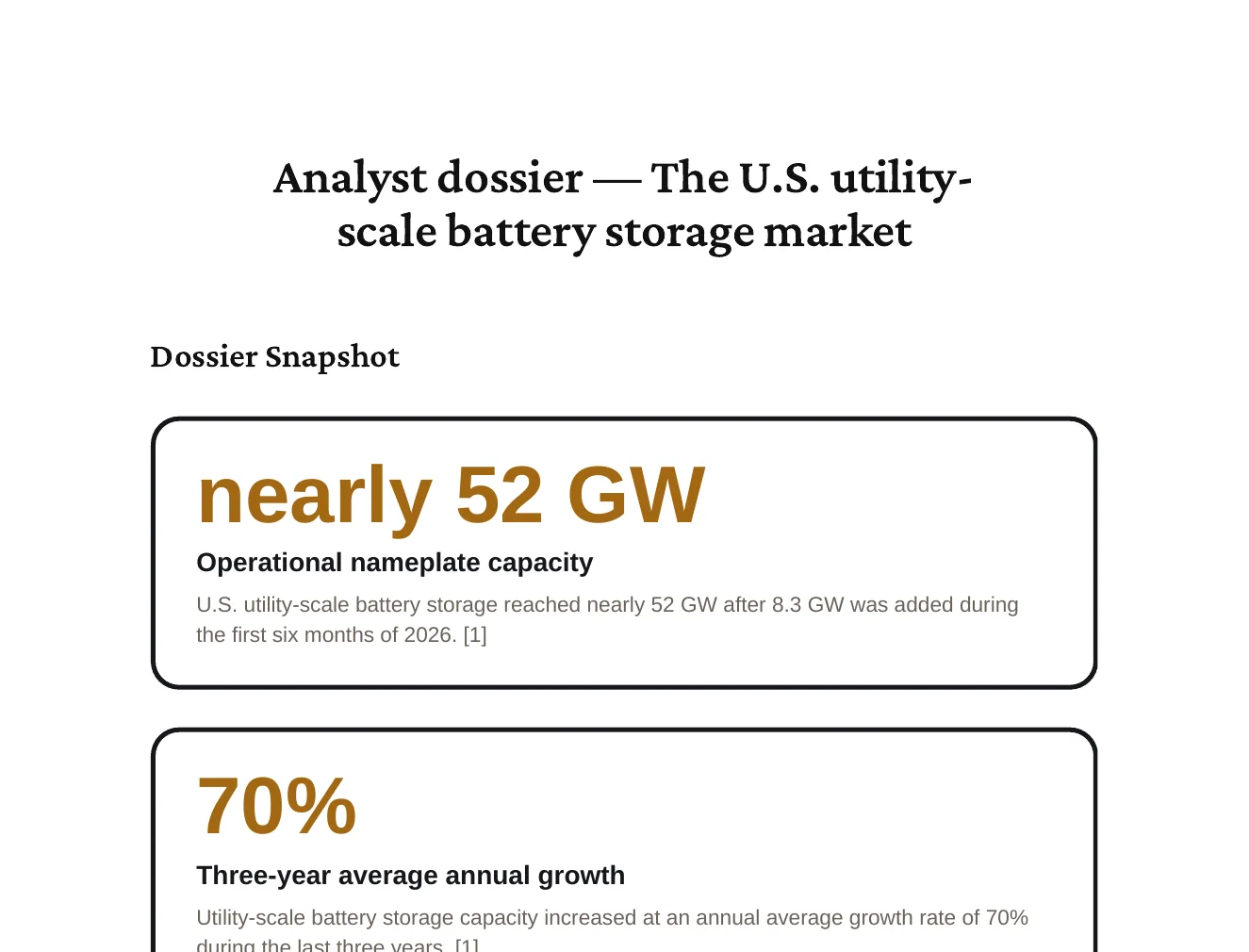
A dossier built from four public EIA pages: a snapshot of figures, an executive summary, market size and growth, key drivers and trends, the competitive landscape, segments and buyers, an outlook, recommendations and a sources appendix, ending with the product's own faithfulness review of the text.
Research target: The U.S. utility-scale battery storage market. Focus: How fast U.S. utility-scale battery storage capacity has grown, what is planned for 2025 and 2026, and how battery storage compares with the other kinds of generating capacity being added. Describe a trend, ranking or comparison only where a source states it, and say where the sources are silent.
Open the full export and compare its statements with the cited sources before reuse.
Name the audience, requested decision and source pack. Review imported tables and extracted text; record gaps instead of allowing a polished narrative to conceal them.
Separate supplied facts, calculated values, assumptions and recommendations. For variance work, reconcile the period, unit, baseline and actual value before interpreting the direction of a difference.
Use options, trade-offs, risks and named next actions. Review the final artifact and, when using Analyst calculations, inspect the calculation evidence separately from the narrative.
Select source documents, case context, working notes, assumptions, options and decision constraints before generation. Inspect claims, metrics, exact quotations, source tables and conflicting figures. Review decisions are scoped to the source or artifact and can become stale after evidence changes; unresolved evidence should stay visible.
Keep investment, recurring costs, benefits, delays, growth, discount assumptions and scenario probabilities explicit. Inspect deterministic cash flow and the available return, payback and sensitivity outputs. Compare scenarios before selection, and inspect the formula workbook or calculation receipt separately from the narrative recommendation.
Inspect the dossier's source tables, working rows and columns, calculation ledger and workbook handoff. Metric packs retain reviewable calculation and source context. Preview source replacements for a new period before accepting them. Execution records distinguish an action owner, baseline, target, measured value, data source and the reason for a status change.
A calculation can be replayable while the supplied inputs remain wrong. A generated report is decision support, not independent diligence, audit assurance or investment advice.
Gixo Business supports the written-analysis side of market research. Bring industry reports, analyst PDFs, survey exports and internal figures, then review the proposed scope and resulting draft. Reconciliation is best effort and model-generated markers need checking. Business does not provide a live market-data feed, surveys or panels; source completeness and the conclusion remain review responsibilities.

Get the market research that would take an analyst team weeks — structured, sourced, and ready for strategic planning.
Draft an analysis of the TAM, growth rates and emerging trends described in the evidence you supply. Business attempts source reconciliation, but missing evidence can leave an unverified figure in the draft. It does not validate the market definition. Check dates, denominators and unrepaired values before using the market-sizing brief.
Identify target segments, buyer personas, and purchasing patterns with Comparison Table blocks for side-by-side segment analysis. Brand compliance applies your Brand Dictionary's preferred and banned terms, so the output uses your organization's terminology; voice is yours to review.
Map key competitors, their market positions, strengths, and weaknesses using Pros/Cons blocks. Competitive claims taken from your uploaded sources carry [1], [2] citations, so stakeholders can trace them back to those sources.
Discover untapped opportunities and emerging niches with CTA blocks for recommended actions. Describe the market question and intended audience, add the sources you want to use, and review the proposed outline and missing evidence before generating.
Findings from uploaded sources can include numbered markers and a Sources section where the workflow supports them. Inspect missing references and verify each cited passage. Source-based number reconciliation can retain original figures, so check the evidence and proposed market interpretation before presenting stakeholders with the brief.
Market analysis briefs use the block-based editor with 20+ semantic blocks including KPIs, Comparison Tables, and CTAs. Edit any section with Quick AI for instant rewrites or Power Edit for full AI dialog.
Enter the market, industry, or sector you want to analyze. Be as specific or broad as needed — from "global SaaS market" to "organic pet food in North America."
Choose what aspects to emphasize — market sizing, competitive landscape, customer segments, trends, regulatory environment, or a comprehensive analysis.
The multi-stage pipeline generates content, attempts to reconcile your figures against the source documents you uploaded, requests model-generated [1], [2] citation markers, applies your Brand Dictionary terms, and checks word count and structure. Number reconciliation can retain original figures when repair does not finish. Inspect citation markers and source passages before sharing the draft.
Edit with 20+ semantic blocks including KPIs, Comparison Tables, and CTAs. Use Quick AI for instant rewrites or Power Edit for full AI dialog. On Business Professional or higher, authorized colleagues can comment on and review the saved brief. Check current source dates, resolve save conflicts and export the reviewed version.
What does Gixo's AI market analysis tool include? Compare AI-generated market intelligence with traditional research methods.
| Evaluation area | Gixo Business | What to check in manual market research and consulting workflows |
|---|---|---|
| Job and inputs | Organize supplied market definitions, segments, sizing assumptions and evidence gaps into a draft. | Test the current product or scoped service against the same question, sources and deliverable. |
| Evidence review | Inspect source coverage, uploaded-file citation markers and generated-draft Evidence and citation findings. | Check source support and current research capabilities; a citation alone does not confirm the conclusion. |
| Revision and delivery | Edit the brief, retain saved versions and review the final export. | Test the actual review, collaboration, version and export workflow you need. |
| Timing and responsibility | Generation time varies with the job and source pack; accountable people review the result. | Compare the agreed scope and review responsibilities rather than assume fixed speed or price. |
"Market research tool" covers two different products. Knowing which one you are shopping for saves a wasted trial.
One half of the category supplies evidence: survey and panel platforms that field questionnaires, traffic and audience estimators, syndicated report libraries, and industry databases. The other half turns that evidence into something a decision-maker can actually read — a market research report with a stated scope, sized assumptions, a competitive picture, and references. Gixo is the second kind. It is a market research tool in the sense that it produces the market research deliverable, not in the sense that it sells you market data.
The split matters most when you compare prices. A data subscription is priced against the panel, sample, or database behind it, and you still have to write the analysis afterwards. An analysis tool is priced against the structuring and writing work, and you still have to bring the evidence. Plenty of teams end up paying for one of each, which is a reasonable stack as long as neither is expected to do the other's job.
Supply the industry reports, survey or analytics exports, collected pricing/filing evidence and internal sales figures you want used. Business drafts the market-analysis sections, attempts source-based number reconciliation and requests numbered markers, then provides supported terminology and layout controls. Inspect original figures, missing citations and the proposed interpretation before editing or exporting. Comments and named sharing require Business Professional or higher and the current content role; resolve save conflicts before distribution.
It is not a live market-data provider. It does not field surveys, run consumer panels, license syndicated data, estimate a competitor's traffic or market share on its own, or conduct interviews and other primary research. A figure that is not in the sources you supplied is not a sourced figure, and the number checks stage reconciles claims against your uploads rather than confirming the underlying data is correct. Review every source, number, inference, and recommendation before the brief informs an investment or operating decision.
Ask which half of the problem is actually blocking you. If the answer is "we cannot get the number," buy a data tool — this page will not solve it. If the answer is "we have the numbers in six files and nobody has written the analysis," that is the gap an AI market research tool closes, and it is the difference between a 1-2 week analyst turnaround and a first draft you can review the same afternoon.
Updated