
AI lease agreement drafting workflow for reviewable lease first drafts
Use Gixo when the team needs a lease draft shaped by property details, rent economics, operating obligations, renewal logic, jurisdiction context, and reviewer handoff before legal review.
Workflow and clause coverage reviewed 2026
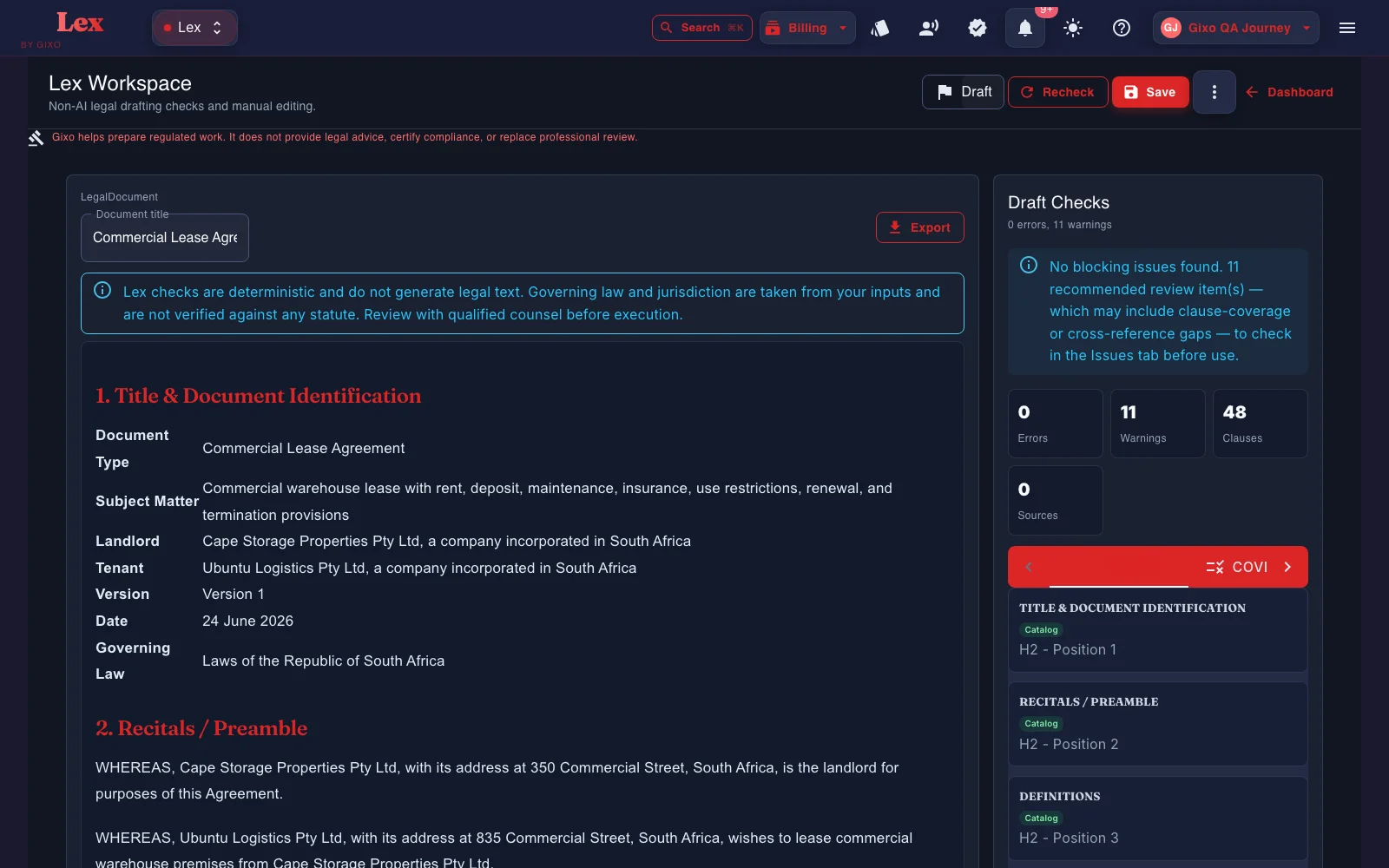
An AI lease agreement generator is a structured drafting workflow — not a single prompt — that turns lease intake, precedent, clause requirements, risk notes, and review comments into a reviewable first draft. In Gixo, that means capturing property, parties, rent economics, maintenance allocation, and renewal terms up front, running a draft analysis pass (clause inventory, missing-clause coverage, defined-term consistency, cross-reference validation), and exporting a PDF, DOCX, HTML, or TXT artifact for counsel to review. The output is a reviewable artifact, not a final legal instrument — Gixo does not provide legal advice, negotiate the lease, or replace professional review.
What makes an AI lease agreement draft useful?
A lease workflow is useful when it captures the business deal, makes missing facts visible, and gives counsel a draft they can review clause by clause.
Start with the lease type, property use, party roles, and occupancy scenario before the draft is generated.
Capture the economic terms, deposits, pass-throughs, and escalation assumptions reviewers will need to inspect closely.
Shape the draft around who is responsible for what, instead of relying on generic lease language that hides the operational split.
Bring renewal mechanics, notice periods, termination assumptions, and sublease logic into the first draft.
Reference files and governing context can shape the draft. Lex does not show clause-level source provenance, so reviewers should verify authority and supporting facts independently.
Before review, Gixo Lex runs a draft analysis pass: clause inventory, missing-clause coverage, defined-term consistency, cross-reference validation, and execution-readiness checks.
How does the AI lease agreement drafting workflow work?
The strongest AI lease workflow is not a prompt that produces a wall of text. It is a sequence that turns intake, precedent, clauses, risk notes, review, and export into one reviewable artifact.
Capture parties, property description, premises, permitted use, lease dates, governing law, rent model, deposits, services, maintenance split, and known attachments.
Use the lease type and business context to shape the first draft around a residential, commercial, sublease, renewal, or custom structure instead of starting from a generic form.
Bring in rent escalation, operating expense, repair, insurance, indemnity, assignment, sublease, renewal, holdover, default, cure, and termination logic where the reviewer expects it.
Surface missing clauses, inconsistent defined terms, unusual obligations, jurisdiction-sensitive assumptions, and open facts that need counsel or business-owner confirmation.
Keep reviewer notes, fallback positions, and open questions attached to the draft so the team can prepare for negotiation without treating the AI output as final.
Keep edits and review inside the workspace, then export in PDF, DOCX, HTML, and TXT once the draft is ready for external review, signature tooling, or downstream storage.
Lease scenarios where structured drafting matters more than a rental agreement format in Word
Lease language breaks down when the economics and operating model are more complicated than a template assumes. These are the situations where structured intake and visible open issues matter most.
Triple-net and operating-expense structures need careful treatment of taxes, insurance, maintenance, pass-throughs, caps, exclusions, reconciliation, and audit rights.
Retail leases often need base rent, breakpoint logic, gross-sales definitions, exclusions, reporting duties, and audit language reviewed together.
Portfolio teams need a consistent structure while keeping state, province, country, property-use, and mandatory local-law assumptions visible for counsel.
Longer-term arrangements need special attention to improvements, financing rights, casualty, condemnation, transfer, default, and end-of-term ownership issues.
Renewal options, notice windows, rent reset mechanics, holdover consequences, and termination rights should be structured before the reviewer starts redlining.
Prior leases, landlord forms, tenant markups, side letters, exhibits, and business deal summaries can guide the next draft while keeping unsupported facts visible.
Mistakes to avoid in AI lease drafting
The failure mode is not that AI cannot draft words. The failure mode is a plausible lease draft that hides missing facts, unsupported assumptions, or jurisdiction-sensitive risk.
A lease needs defined business inputs before drafting: premises, parties, rent, use, term, services, insurance, repairs, renewal, default, and governing law.
A clause that worked in one lease may be wrong for a different property, jurisdiction, tenant profile, or economic model. Reference files should guide, not blindly replace review.
Unconfirmed items should stay visible as open notes or placeholders. That is safer than letting a model guess notice addresses, payment timing, insurance limits, or local-law language.
Lease terms carry legal and financial consequences. The draft should make counsel and business reviewers faster, not optional.
What does the Gixo AI lease agreement workflow include?
| Stage/Capability | What it covers |
|---|---|
| 1. Intake and data structuring | Parties, property description, premises, permitted use, lease dates, governing law, rent model, deposits, services, maintenance split, attachments |
| 2. Template and draft selection | Residential, commercial, sublease, renewal, or custom structure based on lease type and business context |
| 3. Clause integration | Rent escalation, operating expense, repair, insurance, indemnity, assignment, sublease, renewal, holdover, default, cure, termination logic |
| 4. Risk and compliance review | Missing clauses, inconsistent defined terms, unusual obligations, jurisdiction-sensitive assumptions, open facts needing confirmation |
| 5. Negotiation prep | Reviewer notes, fallback positions, open questions kept attached to the draft |
| 6. Finalization and export | PDF, DOCX, HTML, TXT export once the draft is ready for review or handoff |
| 7. Signature and obligations | Simple electronic signature from the Agreement Pack, .ics export of confirmed obligation dates, and in-app and email reminders once execution is recorded |
| Not included | CLM portfolio management, legal advice, negotiation with counterparty, witnessing, notarization, or qualified signatures |
How does Gixo's AI lease agreement generator compare to templates or general AI?
| Capability | Gixo | Template libraries | General AI | Outside counsel |
|---|---|---|---|---|
| Main job | Structured first-draft preparation | Static forms | Prompt output | Custom drafting |
| Commercial or sublease structure | Yes | Basic | Inconsistent | Yes |
| Economic and operational split | Structured | Generic | Inconsistent | Yes |
| Reference-file input | Yes | Rare | Paste only | Yes |
| Risk and open-issue visibility | Built into review handoff | Manual | Inconsistent | Professional |
| E-signature or CLM management | Simple e-signature and obligation reminders; not a CLM | Sometimes | No | External process |
| Legal advice | Not included | No | No | Professional |
Frequently Asked Questions
Updated