
Prepare multi-party agreement drafts without collapsing into generic two-party logic
Use Gixo when the draft needs multiple parties, defined roles, obligation mapping, and governing-law context before review. The goal is a workable first draft, not a magical final agreement.
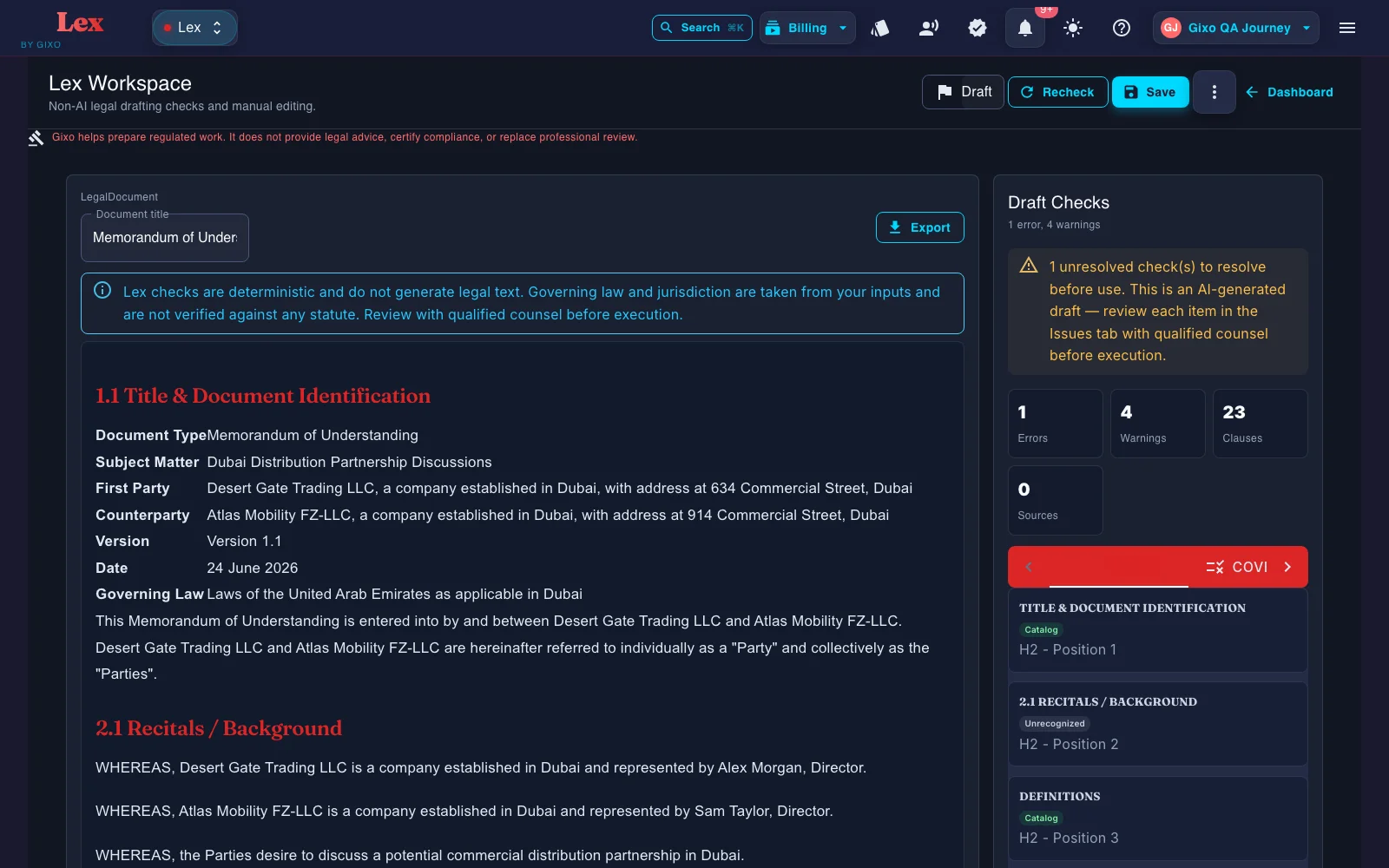
A multi-party agreement generator is a drafting tool that captures three or more parties and their distinct roles up front, then surfaces the obligation web from the draft it produces, then produces a structured first draft that keeps the obligation web — governance, liability, and exit terms — intact instead of collapsing everyone into generic two-party template logic. Gixo's version adds jurisdiction-aware context and optional reference-file input so the draft reflects prior agreement language, then keeps review, comments, and export attached to the same document. It supports up to 10 parties and exports to PDF, DOCX, HTML, and TXT. It prepares a reviewable draft, not legal advice — a qualified reviewer still has to sign off. Reviewed 2026.
What matters most in a multi-party agreement draft?
The job is not to ask AI for a legal answer. The job is to prepare a draft or artifact that a qualified reviewer can actually work with.
Capture each party’s role and identity explicitly so the draft can map rights and obligations correctly.
Support mixed party types without collapsing them into generic placeholders.
Use structured roles to prepare a draft that is closer to the real transaction logic than a template or prompt-only answer.
Reference files and governing context can shape the draft. Lex does not show clause-level source provenance, so reviewers should verify authority and supporting facts independently.
Use prior agreements and transaction documents if you want the next draft to reflect existing language and structure.
After the first draft, Lex can run a deterministic contract review: clause coverage against a versioned playbook, clause-conflict detection, and defined-term and cross-reference checks. Findings, tracked-change DOCX redlines, comments, review state, assignees, due dates, and version history all stay attached to the same document. A contract imported from Word can go back as that same DOCX, with the Lex edits shown as Word tracked changes; where Lex cannot track an edit faithfully, such as inside a field, an existing revision, a header or a footer, it refuses the export instead of altering the document. Reviewers still verify every clause and conclusion.
How it works
Start with the document job and define the parties, roles, and representative details that matter to the draft.
Bring the dispute and jurisdiction assumptions into the intake before generation starts.
Supply reference files as drafting input, then verify the output against established language and clause patterns.
Keep the review on the same draft, then export in PDF, DOCX, HTML, and TXT when it is ready.
What does Gixo's multi-party agreement generator include?
| Capability | Gixo | Template sites | General AI | Manual drafting |
|---|---|---|---|---|
| Party limit | Up to 10 parties | — | — | — |
| Multi-party drafting | Yes | Often limited | Manual | Yes |
| Structured role mapping | Yes | Basic | Prompt only | Yes |
| Reference-file input | Yes | Rare | Paste only | Yes |
| Jurisdiction-aware draft | Yes | Template dependent | Unreliable | Yes |
| Export formats | PDF, DOCX, HTML, and TXT | — | — | — |
| Legal advice | Not included | No | No | Professional |
How to draft a multi-party agreement: the core steps
Three or more parties is a different exercise than a two-party contract — obligations form a web, not a straight line. These are the steps that keep a multi-party draft from collapsing into generic two-party logic, and Gixo's intake is built around them.
Full legal name, entity type, and address for each party — "Smith Corporation, a Delaware corporation," not "Smith Corp." Ambiguity about which entity holds which right is the most common, and most damaging, error.
The "whereas" recitals are not filler; they record why the parties are here and frame how an ambiguous clause should later be read. Follow with a purpose clause stating what is in and out of scope.
Move from "Party A will provide support" to specific, measurable obligations per party. Map who contributes what — capital, equipment, IP, expertise — so no obligation is left unassigned.
With several parties, decide how decisions get made: a steering committee, voting rights (equal or weighted), quorum, which decisions need unanimity, and a tie-breaker for deadlock.
Funding, revenue or profit sharing (often a payment "waterfall"), and how risk is allocated through representations, warranties, and indemnification. Plan the exit — termination, buy-out, and what happens to shared assets and IP — at the start, not the end.
What is the difference between several, joint, and joint-and-several liability?
How liability is shared is often the most consequential choice in a multi-party deal. Spell out which form applies to which obligation — it is rarely all-or-nothing.
Each party is responsible only for its own obligations. If one defaults, the others carry no liability for that default. Generally preferred by individual parties because it limits their exposure.
All parties are collectively responsible for the obligations. A claimant pursues the group as a whole rather than any single member alone.
The broadest form: a claimant can pursue all parties together, or any one party for the full amount, leaving that party to seek contribution from the others. Maximum protection for the counterparty, greatest risk for each signatory — which is why consortium members often accept it externally but re-allocate by fault internally.
Why three parties is not just one more than two
Add parties and the relationships multiply far faster than the headcount: two parties have one relationship to manage, three have three, and ten have forty-five. A two-party template cannot model that web — these are the dimensions a multi-party draft has to add.
Parties are rarely equal. Define a lead party, sponsoring parties, and contributing parties — each with distinct rights and obligations, not one generic "Party" role.
How are decisions made — unanimous, simple majority, or a steering committee with weighted votes? And what breaks a deadlock? With several parties this has to be built from the ground up.
"One party indemnifies the other" explodes: does each party indemnify all others, or does one group indemnify another? Is liability several, or joint and several?
"Confidential" is no longer simple. You may need tiers of information, or "clean rooms" that only a subset of the parties can access.
What happens if one party breaches or goes bankrupt — can the others continue? Plan removal and re-allocation of a party's rights and obligations at the start, not the end.
A true multi-party agreement binds everyone under a single framework where the parties owe obligations to each other — not a hub-and-spoke set of separate two-party contracts.
This page is general information, not legal advice. The right structure depends on jurisdiction, industry, and the specific parties — confirm with qualified legal counsel. Gixo helps prepare regulated work. It does not provide legal advice, certify compliance, or replace professional review.
Frequently Asked Questions
Updated