
Why AI Summaries Fail for Business Context
A generic chat summary may be useful for a quick overview, but it does not automatically carry your decision, evidence standard, review owners, or source history with it. See how Gixo Business can structure those checks around a reviewable brief, and where human validation remains necessary.

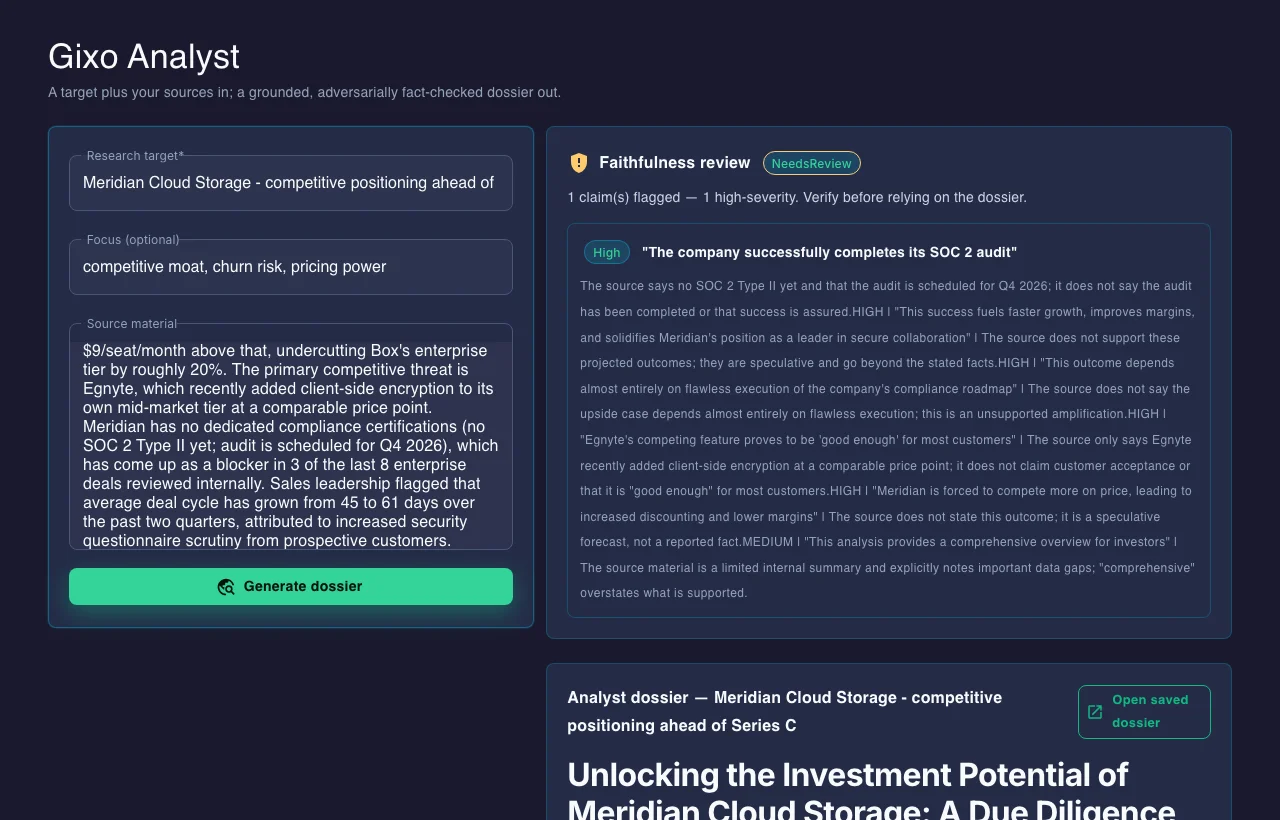
Business briefs begin with a defined decision, source scope, output structure, and review path. The configured pipeline can run generation, checks, citation handling, and validation, including comparing supplied figures with uploaded source documents where the recipe supports it. The result is still a draft: missing evidence, interpretation, and final approval remain with your team. Compare workflows on the same material rather than treating a stage count as proof of correctness.
Why Do AI Summaries Fail for Business Context?
The gap between a ChatGPT summary and a board-ready brief is enormous. Here are the six critical failures that make generic AI output unsuitable for business decisions.
A chat response may not preserve the sources or decision context you need. When the selected Business recipe supports it, the pipeline can add inline [1],[2] references and a Sources section; reviewers still confirm each reference.
Business can compare supplied figures with the source documents you uploaded where the recipe supports that check. A mismatch becomes a review item; the workflow does not make unsupported numbers true.
ChatGPT output is a wall of paragraphs. Gixo structures briefs with 20+ semantic blocks -- KPIs, Checklists, Steps, Pros/Cons, CTAs, Comparison Tables -- that match how executives actually consume information. Each block maintains formatting in PDF exports.
Business describes a multi-stage pipeline covering generation, checks, citation handling, and validation. Which checks apply depends on the recipe and supplied sources; the output still needs a human review pass.
Fixing ChatGPT output means re-prompting and losing context. Gixo's Quick AI provides six instant actions on any block -- summarize, expand, simplify, formalize, shorten, rephrase. Power Edit opens a full AI chat dialog for deeper rewrites without losing your citations and source-checked figures.
Business can apply your Brand Dictionary's preferred and banned terms to the draft; it does not apply formatting or tone guidance. Reviewers still check the wording, exceptions, and audience fit; a recipe or brand rule does not establish that a brief is correct.
The Real Cost of Zero Pipeline Stages
A summary becomes hard to use in a business decision when its source scope, evidence standard, and reviewer are unclear. A polished paragraph still leaves the team to answer where a figure came from, which assumptions were used, and what remains unresolved. Business gives those questions a place in the brief: source checks, citation handling, structured blocks, and review ownership where the selected workflow supports them.
The cost of an ad hoc summary is the follow-up work: locating sources, checking figures, turning prose into decision sections, and recording what still needs approval. A structured workflow can reduce that reconstruction, but it does not remove the need for a finance, legal, or subject-matter reviewer.
Why 20+ Semantic Blocks Beat Flat Paragraphs
Executives do not read documents linearly. They scan KPI blocks for metrics, jump to Pros/Cons blocks for decision analysis, check Steps blocks for processes, and glance at Comparison Table blocks for alternatives. A flat AI summary forces every reader to parse a wall of text and mentally organize the information. Gixo's 20+ semantic blocks eliminate that burden by presenting information in the structured format decision-makers already expect. Quick AI provides six instant actions for rapid refinement, Power Edit opens a full AI chat dialog for deeper edits, and saved workspaces preserve your setup for recurring reports. Choose from 59 curated recipes to match your business context. Real-time collaboration lets multiple team members contribute simultaneously.
How Does Gixo Fix What Generic AI Summaries Get Wrong?
Choose the decision, source scope, required sections, and reviewer before generation. A stage count is useful only when the workflow checks the questions your document actually needs to answer.
Where the recipe supports it, the pipeline compares figures with uploaded sources and surfaces citation or evidence items for review. Confirm the source, date, denominator, and interpretation before relying on the result.
Structure briefs with KPI blocks, Checklists, Steps, Pros/Cons, CTAs, Comparison Tables, and more. Each block type matches how executives actually consume information. ChatGPT gives you a wall of text. Gixo gives you structured intelligence.
Use Quick AI, Power Edit, collaboration, and saved workspaces to refine the document. The team still owns the conclusions, commitments, and final approval.
Where Structured Briefs Make the Difference
Teams across industries rely on Brief Mode in Gixo Business when generic AI output is not enough.
What is the structural difference between generic AI summaries and Gixo's structured briefs?
| Dimension | Generic AI Summaries | Gixo Structured Briefs |
|---|---|---|
| Pipeline stages | Prompt-dependent | Configured multi-stage workflow |
| Number checks | Depends on the supplied workflow | Can compare against uploaded sources |
| Source citations | Depends on the mode and sources | Available where the recipe supports them |
| Document structure | Flat paragraphs | 20+ semantic blocks |
| Brand compliance | Prompt or workspace dependent | Brand Dictionary terms applied to the draft |
| Editing workflow | Re-prompt from scratch | Quick AI (6 actions) + Power Edit |
| Normative references | Not supported | Appendix of the provisions you name |
| Saved workspaces | No persistence | Reusable templates |
| Collaboration | Single user | Real-time with remote cursors |
| Recipes | Prompt engineering | 59 curated recipes |
Write Documents People Actually Trust
Whether you are transitioning from generic AI or starting fresh, these practices elevate your business document quality.