
Frame the decision
Name the audience, requested decision and source pack. Review imported tables and extracted text; record gaps instead of allowing a polished narrative to conceal them.
Independent consultants, boutique advisory teams, and fractional executives rarely need another blank AI writer. They need a way to turn messy client notes, source packs, meeting transcripts, and board questions into reviewable decisions with evidence, gaps, and trade-offs visible.
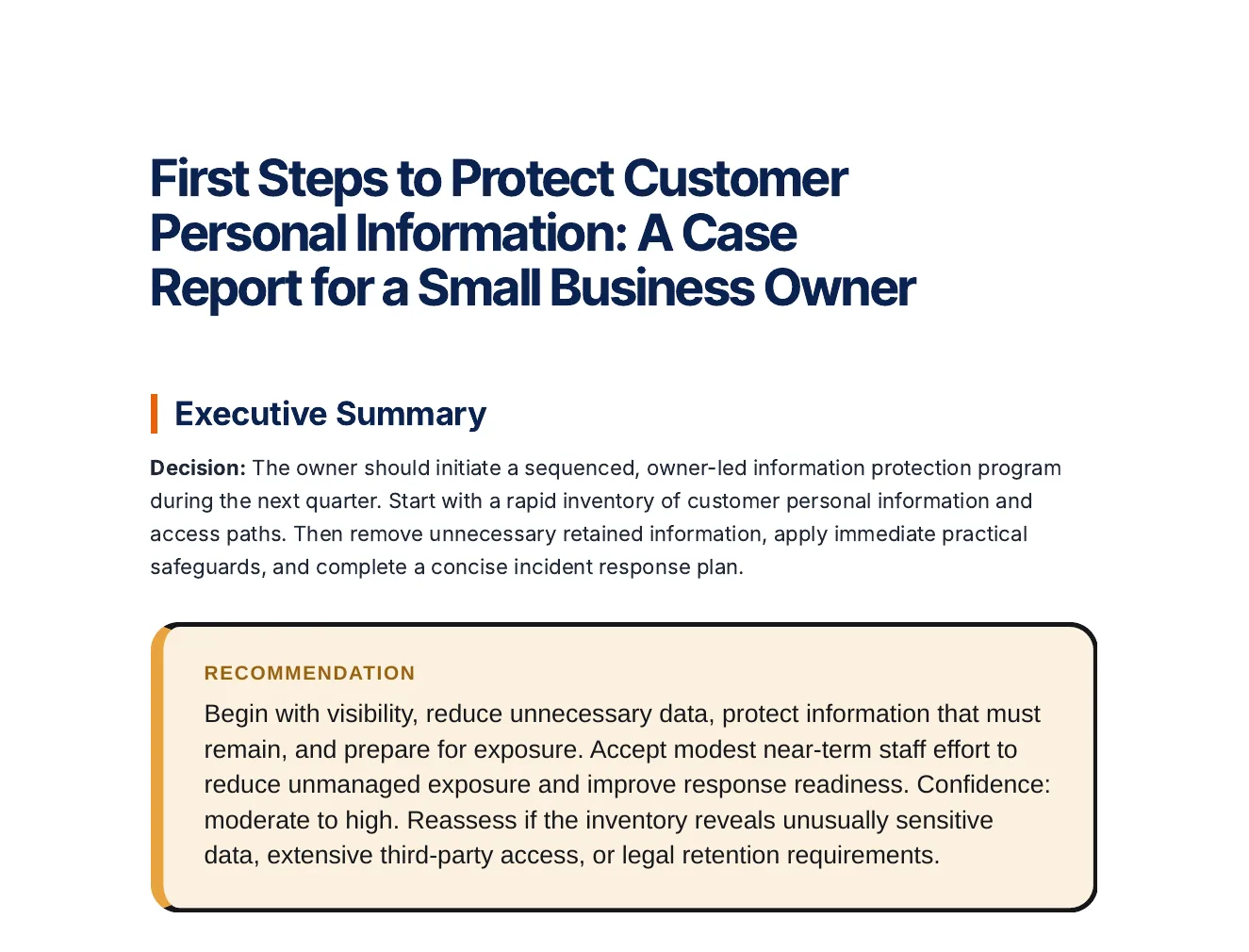
Inspect an actual Business report. A readable decision brief needs the question, supplied evidence, options, assumptions and next decision—not just a shorter source document.
A decision, options compared on stated criteria, risks and an implementation roadmap, with statements labelled Fact, Inference or Assumption and attached consistency and decision-discipline reviews.
Business question: Which actions should a small business that stores customer personal information take first to protect it and to be ready if it is exposed? Decision maker: The owner of a small business. Timeframe: The next quarter. Context: A small business collects customer personal information and keeps it in paper files and on computers. It has no dedicated security staff. Refer to it as 'the business' throughout and do not give it a name. Options: Take stock of the personal information it keeps and where it is stored; Reduce what it keeps to what the business needs; Lock down the information it keeps with practical safeguards; Prepare a plan for responding to a data breach. Criteria: How much personal information at risk it removes or protects; How realistic it is for a small team without security specialists; How well it limits the harm if information is exposed. Constraints: No dedicated security staff; Limited time and budget.
Open the full export and compare its statements with the cited sources before reuse.
Name the audience, requested decision and source pack. Review imported tables and extracted text; record gaps instead of allowing a polished narrative to conceal them.
Separate supplied facts, calculated values, assumptions and recommendations. For variance work, reconcile the period, unit, baseline and actual value before interpreting the direction of a difference.
Use options, trade-offs, risks and named next actions. Review the final artifact and, when using Analyst calculations, inspect the calculation evidence separately from the narrative.
Select source documents, case context, working notes, assumptions, options and decision constraints before generation. Inspect claims, metrics, exact quotations, source tables and conflicting figures. Review decisions are scoped to the source or artifact and can become stale after evidence changes; unresolved evidence should stay visible.
Keep investment, recurring costs, benefits, delays, growth, discount assumptions and scenario probabilities explicit. Inspect deterministic cash flow and the available return, payback and sensitivity outputs. Compare scenarios before selection, and inspect the formula workbook or calculation receipt separately from the narrative recommendation.
Inspect the dossier's source tables, working rows and columns, calculation ledger and workbook handoff. Metric packs retain reviewable calculation and source context. Preview source replacements for a new period before accepting them. Execution records distinguish an action owner, baseline, target, measured value, data source and the reason for a status change.
A calculation can be replayable while the supplied inputs remain wrong. A generated report is decision support, not independent diligence, audit assurance or investment advice.
Unlike consulting software focused on time tracking, billing, or staffing schedules, Gixo Business turns unstructured client context — call notes, source packs, rough options, diligence findings, KPI pulls, and stakeholder constraints — into reviewable decision memos and recommendation reports with evidence gaps kept visible.
Turn engagement notes into decision memos and recommendation reports, plus briefing decks with a Gixo Lumen plan and decision or framework artifacts with a Gixo Prism plan, without hiding source gaps or uncertain assumptions.
Create board updates, operating reviews, vendor comparisons, launch readouts, and escalation memos from the same source pack you use to manage the business.
Keep a repeatable decision-support workflow across clients: route first, forecast evidence quality, build the artifact, then review the verification stack.
Gixo Business is not an enterprise strategy suite, FP&A system, CRM, ERP, autonomous strategy agent, or replacement for professional judgment. It is the grounded decision-support layer between messy evidence and the artifact a client, board, founder, or operator can review.
Updated