
Sign In Try Free
Workflow-specific products Content, decks, briefs, proposals, legal, and sales each have a clearer buying path.
Review before delivery Draft, edit, collaborate, approve, and export in the same workspace.
Security + procurement path Security policy, support, and Azure Marketplace buying are public.

Business diagnostics

Five structured assessments that score the questions investors, boards, and operators actually ask — product-market fit, fundraising readiness, launch readiness, decision quality, operational maturity, and due-diligence readiness. Each scores five weighted dimensions and ends with a 0–100 banded result plus the specific gaps holding it down.

Run the PMF diagnostic Check fundraising readiness Read the scoring methodology
Runs inside the Gixo Business journey. Deterministic scoring — fixed dimensions, fixed weights, reproducible results.

The five diagnostics

Every diagnostic scores 5 dimensions at equal weight. Each answer maps to a fixed score — no AI judgment, no surprise re-grades.
Product-Market-Fit Signal
A deterministic assessment of whether demand, retention, usage, customer pain, and expansion signals indicate credible product-market fit — including whether sales are push or pull and whether retention is measured or anecdotal.
Dimensions: demand · retention · usage · pain · expansion
Fundraising Readiness
A deterministic assessment of whether the narrative, metrics, market case, economics, and diligence base are ready for investor scrutiny — from problem narrative and use of funds to data-room status.
Dimensions: story · traction · market · economics · diligence
GTM / Launch Readiness
A deterministic check of whether positioning, audience focus, channel motion, sales enablement, and launch operations are ready for market contact — including whether channel hypotheses are ranked and the launch has a single owner.
Dimensions: positioning · audience · channels · sales · operations
Decision Quality Audit
A deterministic red-team for pending business decisions, based on inversion, base rates, reversibility, pre-mortems, and process hygiene — has the worst case been written down, is there a kill criterion, who owns the rollback plan.
Dimensions: inversion · base-rates · reversibility · premortem · process
Due-Diligence Readiness
A deterministic check of whether corporate, financial, commercial, legal, and security materials can withstand external review — corporate records, reconciled financials, contract quality, known legal risks, and a documented security baseline.
Dimensions: corporate · finance · commercial · legal · security
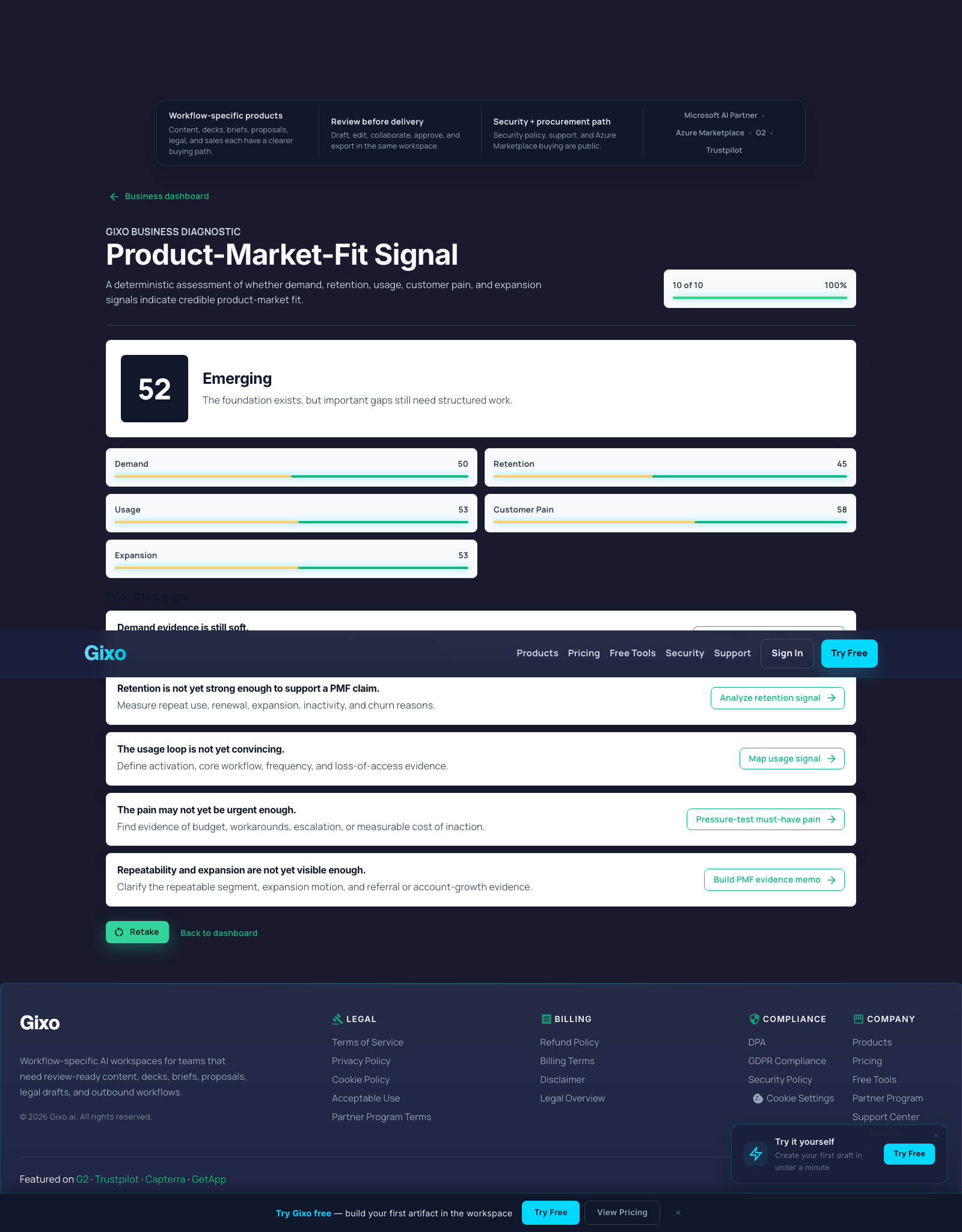
Gixo Product-Market-Fit Signal diagnostic result showing a banded score, five dimension scores, and a gap list with recommended next steps

A real diagnostic result: banded overall score, per-dimension breakdown, and the gap list — each gap mapped to a concrete next step.

How scoring works

Each diagnostic asks roughly ten questions across five dimensions, and each dimension carries equal weight — 20% of the overall score. Every answer option maps to a fixed value: "retention is measured by cohort" scores higher than "retention is anecdotal," every time, for everyone. Your overall result lands in one of four bands — Not Ready (0–39), Emerging (40–59), Close (60–79), Ready (80–100) — and comes with a gap list: the specific dimension-level weaknesses that pulled the score down, each mapped to a concrete next step.

Because the scoring is deterministic, the diagnostic works as a progress instrument, not a one-time quiz. Fix the data room, re-run Due-Diligence Readiness, and the score moves because the facts moved — not because a model felt differently today. Teams use the same property to get aligned: when two founders answer differently, the disagreement itself is the finding.

One honest caveat: these are self-assessments. The instrument is fixed, but the answers are yours — it measures readiness as honestly as you answer. The value is not a verdict; it is the structured list of what to fix next inside the Business workspace.

Read the full scoring methodology for the exact score bands, gap-routing rules, and repeat-run use cases.

Four operating playbooks

Checklists with critical items flagged and progress tracking — open one before the meeting, not after.

Frequently Asked Questions

How do the diagnostics fit into Gixo Business?
They are deterministic instruments inside the Business journey. The same answers always produce the same result, and each gap points to the next source pack, playbook, brief, or decision material to create in the Business workspace.
Is this an AI evaluation of my business?
No. Each diagnostic is a fixed instrument: defined questions, fixed answer scores, equal dimension weights. The same answers always produce the same result — that's what makes it usable for tracking progress between runs.
What do I get at the end of a diagnostic?
A 0–100 score with a band (Not Ready, Emerging, Close, Ready), per-dimension scores, and a gap list — the specific weaknesses that lowered the score, each tied to a recommended next step. Many gaps map to a Gixo brief recipe that produces the missing document.
How do the diagnostics connect to Gixo's paid product?
Diagnostics find the gap; the Business workspace writes the document that closes it — board updates, market deep dives, financial summaries, and 50+ other recipes generated from your uploaded files with claims bound to sources. You can generate briefs during your free 14-day trial (no card required); after the trial, generation requires a paid plan.

Ten minutes to a gap list

Pick the diagnostic that matches your next hard conversation — investor, board, launch, or diligence — and walk in knowing what they'll find.

Start with product-market fit