
Product-market-fit assessment
"Do we have product-market fit?" is a measurable question. This assessment scores the five signal families that actually answer it — demand, retention, usage, pain, and expansion — on a deterministic 0–100 scale, and tells you which signals are real and which are still hope.
A product-market-fit assessment scores whether you have PMF by measuring five signal families — demand, retention, usage, pain, and expansion — each worth 20% of a deterministic 0–100 score, not a vibe check. Fixed questions and fixed answer values mean the same answers always produce the same score, and the result places you in one of four bands: Not Ready (0–39), Emerging (40–59), Close (60–79), or Ready (80–100). The output that matters most isn't the number — it's the gap list naming exactly which weak signals pulled the score down and what to do about each one.
What five dimensions does a PMF assessment score?
Each dimension is worth 20% of the score. Every answer option has a fixed value — the instrument can't be charmed.
What does a product-market-fit assessment measure?
| Dimension | Weight | What it asks | Highest-scoring state |
|---|---|---|---|
| Demand | 20% | Strongest evidence: nothing, expressed interest, paid customers, or inbound pull? | Inbound pull — customers chasing you |
| Retention | 20% | Is retention unmeasured, anecdotal, or measured in cohorts? | Measured retention + systematic churn learning |
| Usage | 20% | Is the activation path known/reliable? Is the product critical, partial, or optional to the customer's workflow? | A workflow the customer considers critical |
| Pain | 20% | Is the problem nice-to-have, important, or urgent? Do customers show must-have behavior (react strongly to price/feature changes)? | Urgent problem + must-have behavior |
| Expansion | 20% | Does winning one customer make the next easier — unknown, early signs, or repeatable? | Repeatable expansion within a segment |
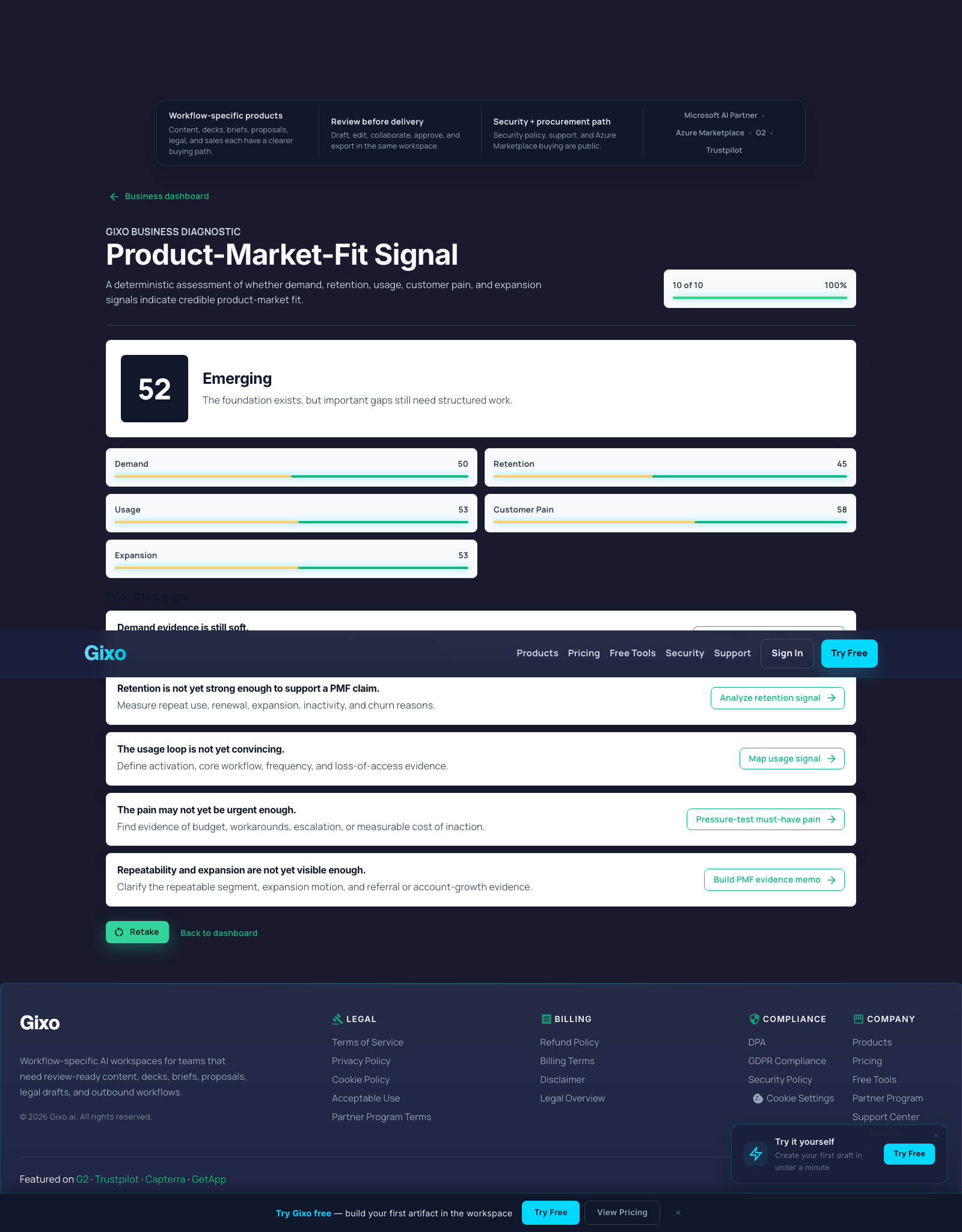
A real PMF Signal result: the banded score, all five dimension scores, and the gaps that pulled it down — each with a recommended next step.
Why is a deterministic PMF score better than a vibe check?
Most PMF conversations fail the same way: the founder cites enthusiasm, the investor hears anecdotes, and nobody agrees on what would count as evidence. This assessment forces the question into measurable states. "Retention signal: none / anecdotal / measured" is not a feeling — you either have cohort data or you don't. The famous benchmarks (the Sean Ellis 40% "very disappointed" test, cohort retention curves) are things you go measure; this instrument tells you whether your evidence base is built enough for those numbers to mean anything.
Because scoring is fixed, the assessment also works between people. Have each founder run it separately: where the answers differ, you've found the actual disagreement — usually "is retention measured or anecdotal" — and that's a more useful conversation than debating the score itself.
It's a self-assessment, so it measures readiness as honestly as you answer. The output that matters isn't the number; it's the gap list — the shortest written path from where your evidence is thin to where it would hold.
Frequently Asked Questions
Updated