
Fundraising readiness assessment
Investors run the same audit on every deal: story, traction, market, economics, diligence. This assessment runs it first — scoring all five on a deterministic 0–100 scale and handing you the gap list while it's still cheap to fix, not three weeks into a partner process.
A fundraising readiness assessment is a deterministic, 10-question audit that scores a startup on the same five dimensions investors check anyway — story, traction, market, economics, and diligence — each weighted 20%, producing a 0–100 score in one of four bands: Not Ready (0–39), Emerging (40–59), Close (60–79), or Ready (80–100). It runs before you talk to investors so the gap list — the specific weak dimension and the document that fixes it — surfaces while it's still cheap to fix, not three weeks into a partner process.
What five dimensions does a fundraising readiness assessment audit?
Each dimension is worth 20% of the score. Every answer maps to a fixed value — the instrument scores the evidence, not the pitch.
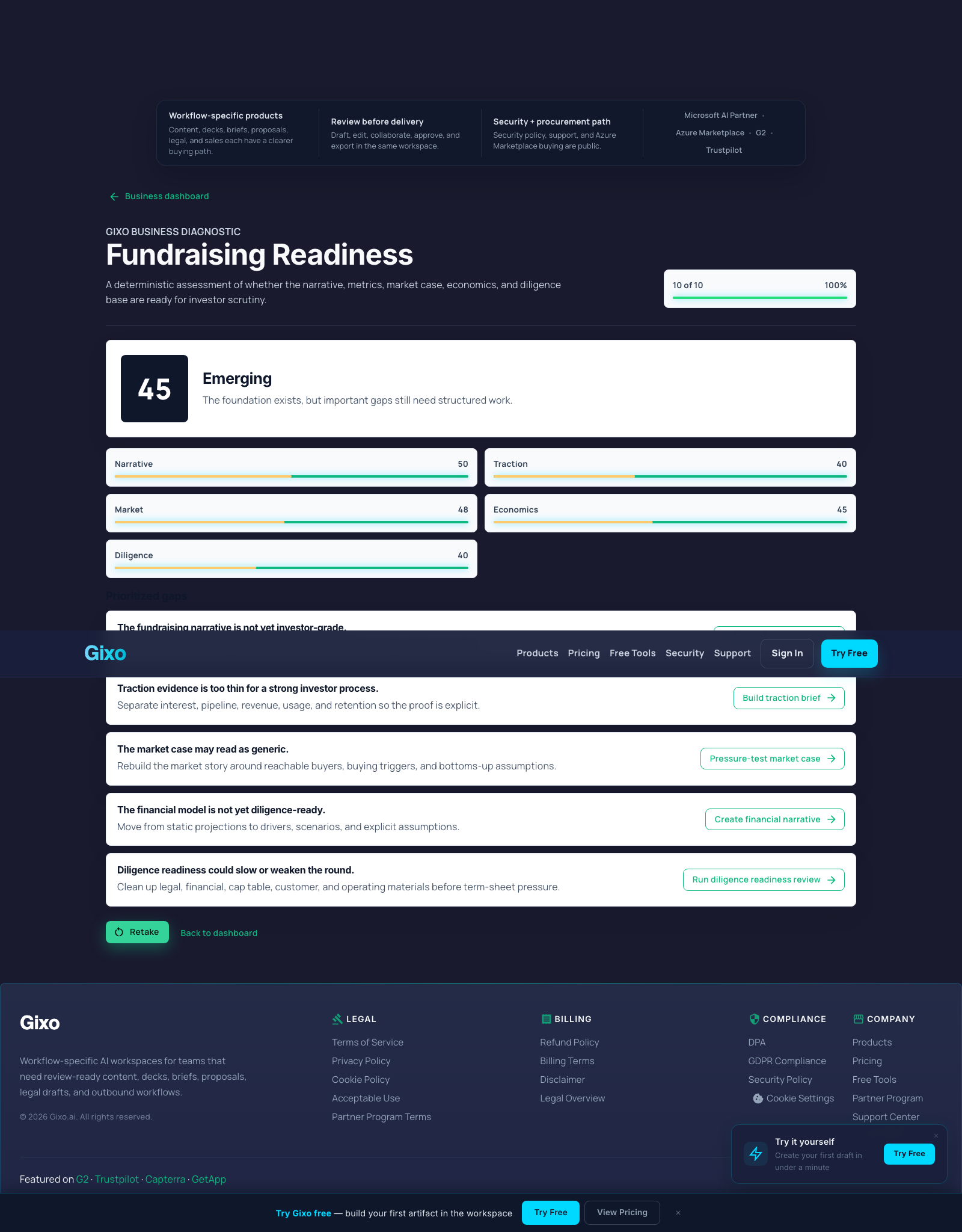
A real Fundraising Readiness result: the banded score, all five dimension scores, and the named gaps to fix before investor contact.
What does the fundraising readiness assessment score?
| Dimension | Weight | What it checks | Best answer state |
|---|---|---|---|
| Story | 20% | Problem narrative clarity + use-of-funds specificity | Coherent narrative, milestone-shaped use of funds |
| Traction | 20% | Strongest traction metric + retention evidence | Repeatable revenue, measured retention |
| Market | 20% | Market sizing method + ICP focus | Bottoms-up sizing, focused ICP |
| Economics | 20% | Financial model type + unit-economics clarity | Driver-based model, measured unit economics |
| Diligence | 20% | Data room state + legal/finance record cleanliness | Investor-ready data room, clean records |
| Score bands | — | 0–100 total mapped to 4 bands | Ready (80–100): materials would survive diligence as-is |
Why run a fundraising readiness assessment before pitching investors?
Fundraising readiness fails quietly. The deck gets polished for weeks while the data room stays a scattered folder, the model stays static, and the use of funds stays "18 months of runway." Investors notice in reverse order: the unglamorous dimensions — diligence, economics — are where processes stall after a promising first meeting. This assessment weights all five equally precisely because founders don't.
The scoring is deterministic: "data room: scattered" maps to the same value for every founder, every time. That makes the result a progress meter you can re-run monthly during raise prep — and a shared instrument for co-founders, who frequently discover they'd answer "legal cleanliness" differently. That disagreement is a finding; better to have it now than in a diligence call.
The output is a gap list, and most gaps are documents: a milestone-based use-of-funds plan, a bottoms-up market sizing, a retention evidence summary, an organized data room. That's the paid side of Gixo — the Business workspace generates those briefs from your own uploaded files with claims bound to sources (start with a 14-day free trial, no credit card), and the Data-Room Checklist playbook gets the folder structure right before you generate a single document.
Frequently Asked Questions
Updated