
Make the intake specific
Supply the parties, document kind, jurisdiction, obligations, dates and reference material. Review imported content and retain its source identity before using it in a new matter.
A SOC 2 program rests on a written information-security policy set — access control, incident response, change management, risk assessment, and more. See what each policy covers, then generate tailored drafts you adapt and review. Policies are the starting point, not the whole audit.
A SOC 2 policy template is a starting-point draft for one of the written information-security policies a SOC 2 program is expected to maintain — such as an information security policy, access control policy, incident response plan, or change management policy. SOC 2 itself is an attestation, performed by a licensed CPA firm against the AICPA Trust Services Criteria; the written policies document how your organization intends to meet those criteria. A template gives you structure and standard clauses, but it is not compliance on its own: you have to adapt each policy to how your organization actually operates, and SOC 2 also requires that you implement the controls and produce the evidence the auditor tests. Treat every generated policy as a draft a qualified reviewer must edit and approve.
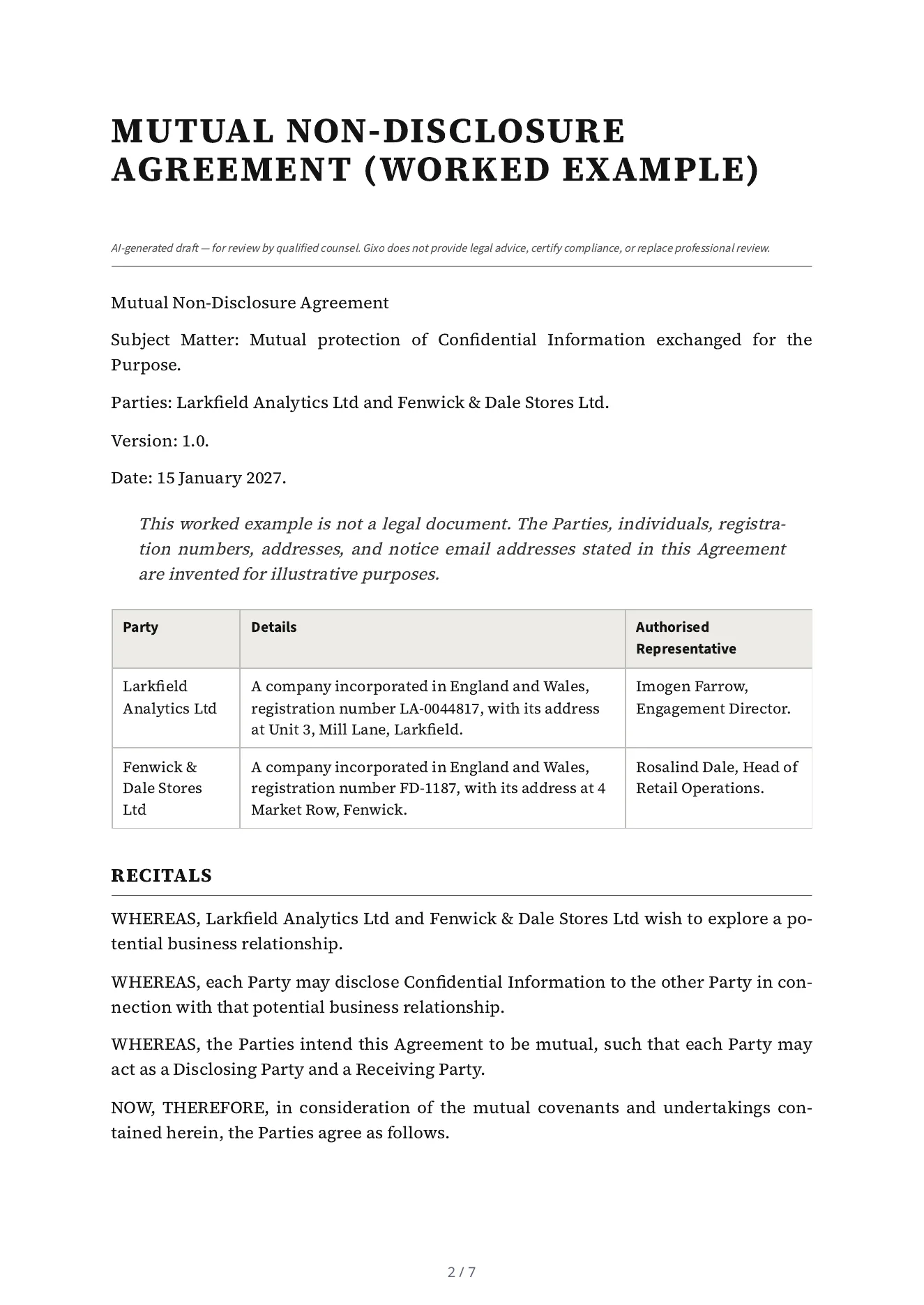
This is a real Lex export for invented parties. Inspect the input and clauses as a worked example, with professional review kept separate from automated drafting and checks.
A mutual non-disclosure agreement of 14 numbered clauses between two invented parties: definitions, what counts as confidential information, exclusions, the receiving party's obligations, permitted disclosures, return of materials, remedies, term, survival, governing law, notices and signature blocks. Its first page says it is a worked example, not a legal document.
Draft a Mutual Non-Disclosure Agreement between Larkfield Analytics Ltd (Party A) and Fenwick & Dale Stores Ltd (Party B). Governing law: England and Wales. Effective date: 2027-01-15. Term: Two years from the effective date. Confidentiality: Three years after disclosure. A mutual agreement: each party may disclose and receive confidential information. State on the first page that the parties, people and addresses in this agreement are invented and that it is a worked example, not a legal document. The notice email address of Larkfield Analytics Ltd is notices@larkfield-analytics.example and of Fenwick & Dale Stores Ltd is notices@fenwick-dale.example (both invented).
Read mechanically against the intake, not by a lawyer: all 12 facts the intake gave are in the draft, nothing is left as a placeholder, and it states no term the intake did not give.
Supply the parties, document kind, jurisdiction, obligations, dates and reference material. Review imported content and retain its source identity before using it in a new matter.
Use the legal workspace's permitted structural tools, Draft Checks and review paths. Compare proposed changes with the saved draft and original material; unsupported Word edits must be handled explicitly.
Have qualified counsel review enforceability, local requirements and the actual commercial intent. Check the current approval state and the downloaded document after a change.
Select the target clause and give Ask Lex a bounded instruction. Missing facts remain visible for review. Inspect the before-and-after proposal, required clause checks and any explicit outside-matrix or mandatory-clause override before versioned application. Use the legal workspace's structural allowlist rather than assuming every general content-editor block is available.
Inspect immutable playbook versions, anchored findings, provenance and precedent variants before staging a change. Matters retain original sources, quotation findings and source-version comparisons. Review extracted obligations for timing, ownership and source revision; negotiation turns and agreement-pack review cells have their own decisions and current-version requirements.
Original-format Word export, tracked changes against an original and saved-version redlines are separate paths. Unsupported edits must be surfaced rather than silently claimed as preserved. Inspect the layout, validator notes and downloaded file, then retain its delivery receipt. Counsel's review applies to the actual matter and version.
Lex does not provide legal advice or certify compliance. The public specimen is not a universally reusable legal template. Word fidelity depends on the supported original-document and saved-version path; unrestricted Power Edit and image insertion are not legal editing features.
There is no single official list — auditors evaluate whether your written policies support the Trust Services Criteria you're in scope for (Security is required; Availability, Confidentiality, Processing Integrity, and Privacy are optional). These are the policies most SOC 2 programs maintain. Each card is a draft you tailor.
The top-level policy that sets your security objectives, scope, roles, and governance — the umbrella the other policies sit under.
How identities, roles, least-privilege, provisioning and deprovisioning, and periodic access reviews are managed across your systems.
How security events are detected, triaged, escalated, communicated, and reviewed after the fact, with defined roles and severity levels.
How changes to production systems are requested, reviewed, tested, approved, and recorded so changes are controlled rather than ad hoc.
How you identify, rate, and treat risks on a recurring basis, including how risk decisions and residual risk are documented.
How you assess and monitor subprocessors and vendors that touch your data, including due diligence and ongoing review.
How data is classified by sensitivity and the handling, retention, and disposal rules that follow from each classification.
How you plan for availability disruptions — backups, recovery objectives, and testing — most relevant when Availability is in scope.
Acceptable-use rules, onboarding and offboarding, background checks, and security-awareness expectations for your people.
Choose which policy you're drafting and note the Trust Services Criteria in scope, your systems, and the size and shape of your organization.
Provide how things actually work — your cloud, your access tooling, your on-call model — so the draft reflects your environment rather than a generic company.
Get a first version with the standard sections and clauses, so you start from a scaffold instead of a blank page.
Rewrite anything the draft assumes. A policy you don't actually follow is worse than none — the auditor tests whether you do what the policy says.
Have an accountable owner review and approve the policy, then export it as PDF, DOCX, HTML, and TXT for your policy library.
A policy template is genuinely useful for structure and coverage. It is not the same thing as being ready for a SOC 2 audit. Keep the two straight.
| Question | A policy template | What SOC 2 also requires |
|---|---|---|
| Written policies | Gives you a structured draft to adapt | Policies approved by an accountable owner and actually followed |
| Controls in place | A document doesn't implement a control | The described controls operating in your real systems |
| Evidence | Not produced by a template | Logs, tickets, access reviews, and records the auditor tests |
| The report | A template is not an attestation | A Type I or Type II report issued by a licensed CPA firm |
| Fit to your org | Generic until you edit it | Policies that reflect how your organization actually operates |
Gixo drafts the policy documents. It does not implement your controls, collect audit evidence, monitor your systems, or issue a SOC 2 report — and it can't guarantee that any policy will pass an audit.
Updated