
AI Project Status Report Generator for Multi-Team Rollups
Roll up status from every team into one clear report. Bring each team's updates — notes, metrics, blockers — and Gixo synthesizes a structured cross-team status report with numbers checked against your sources, flagged risks, and a clean red/amber/green view. It runs on the same 8-stage pipeline as the rest of Gixo Business: you provide the updates, it does the consolidation and the writing.
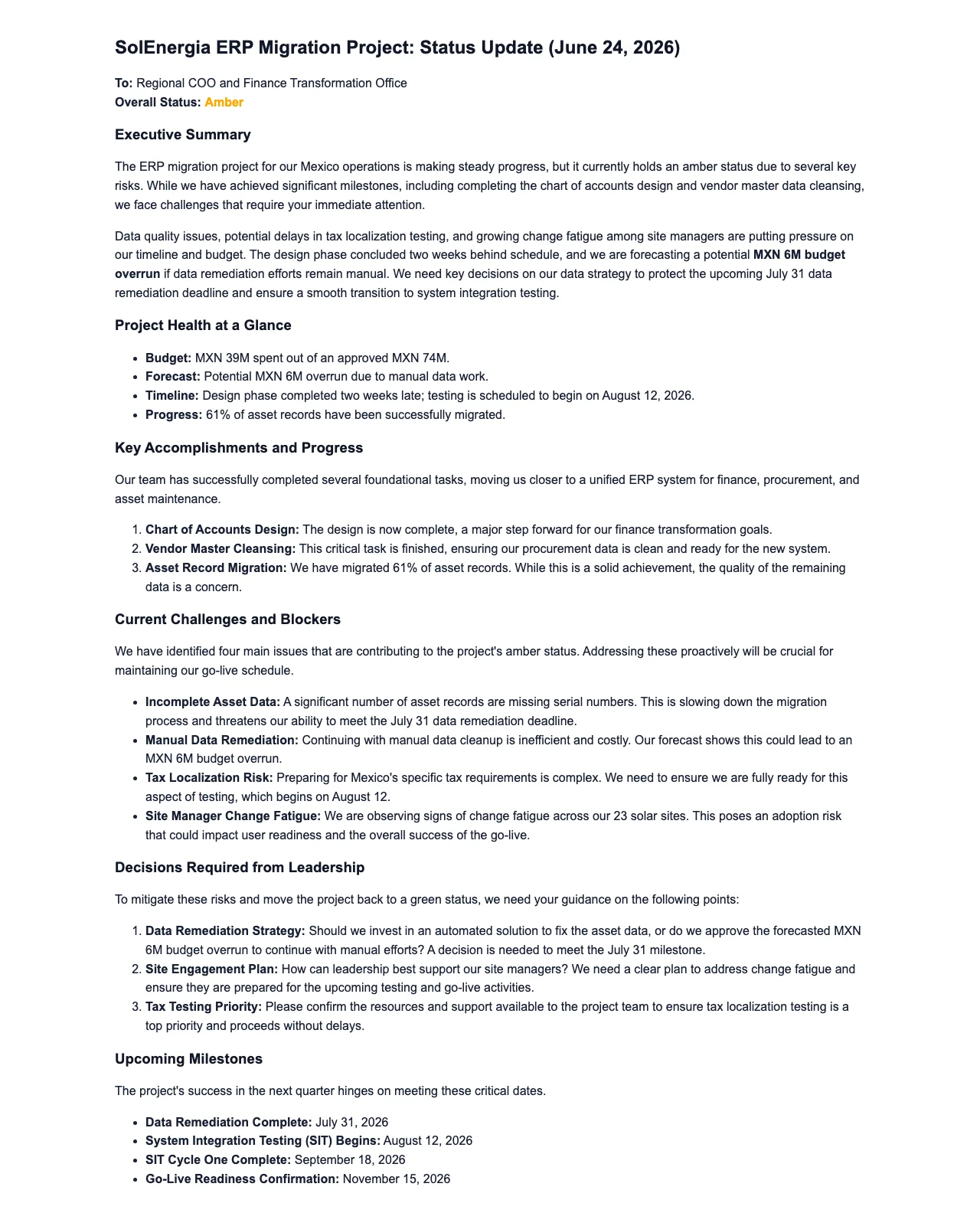
One rollup, every team, no chasing
Multi-team status is hard because the updates live in different formats, voices, and places. Gixo turns the pile of updates you collect into a single structured report leadership can actually read.
Paste or upload each team's notes, standups, and metrics. Gixo synthesizes them into one rollup with a per-team status section and a cross-team summary — instead of you stitching spreadsheets together by hand.
The rollup pulls the blockers, dependencies, and risks out of the noise and into their own section, so a stalled hand-off between two teams does not stay buried in one team's notes.
Get a red/amber/green status across initiatives at the top, with the detail underneath. Executives read the RAG; program managers read the detail — from the same document.
The 8-stage pipeline checks your figures against the source updates you provide and adds automatic [1],[2] citations. Any figure it cannot match to a source is flagged for you to check, not invented.
Each team lead can add or correct their own section in the same document with remote cursors, then use Quick AI or Power Edit to tighten it — no more merging conflicting versions over email.
Save the rollup setup — recipe, block layout, and structure — as a workspace. Next week starts from a proven template; you swap in the new updates and generate, instead of rebuilding the report from a blank page.
What goes in, what comes out: from scattered team updates to one cross-team status report
In: whatever you already have from each team — Slack thread exports, standup notes, a metrics dump, last week's update doc, a paragraph someone typed. No special format, and no integration to set up.
Out: a single structured rollup built from 20+ semantic blocks — an executive summary, a RAG status across initiatives, a per-team status section, a consolidated risks-and-blockers list, key metrics (checked against your sources and cited), and next steps. Export it to PDF, or copy it straight into your status channel.
The 8-stage pipeline does the consolidation, the number-checking, and the formatting; you bring the source updates and the judgment about what actually matters this week.
The anatomy of a status report: the seven sections that do the work
Most status reports fail the same way — they list activity instead of answering the three questions the reader actually has: are we on track, what changed since last time, and what do you need from me. These seven sections answer them.
| Section | What it answers | What breaks without it |
|---|---|---|
| Header | Which project, which reporting period, who wrote it, who it goes to | The report gets forwarded and nobody can tell whether it is this week's or last month's |
| Overall status (RAG) | Are we on track — in one word, at the top | Readers infer status from paragraphs, and two readers infer differently |
| Progress since the last report | What actually moved, measured against what was promised last period | Activity gets mistaken for progress, and a stalled workstream reads as busy |
| Work planned for the next period | What will be true by the time you write the next one | There is no baseline to score the next report against |
| Risks, issues and blockers | What could go wrong and what already has — by severity, each with a named owner and a date | Bad news arrives at the deadline instead of while there is still time to act |
| Decisions and asks | The specific thing the reader has to do, and by when | The report is read, nodded at, and nothing gets unblocked |
| Metrics: schedule, budget, scope | The numbers against plan, each traceable to a source | "On track" stays an opinion rather than a measurement |
Two rules make the difference between a status report that gets read and one that gets skimmed. Length is a discipline, not a style choice — the rollup belongs on one screen, with the detail underneath for the people who need it. And every red or amber carries a named owner and a re-assessment date: a color without an owner is decoration, not status.
A worked example: one week of a project status report
The same seven sections, filled in. The figures are illustrative — the shape is the point.
Atlas ERP migration — status report, week ending 14 March. Prepared by the program office. To: steering committee and the four workstream leads.
Overall: amber. Delivery remains on plan for the July cutover; the amber is data migration, where the second dry run finished three days late. Finance: green. Integrations: green. Data: amber. Change & training: amber.
Progress since 7 March: dry run 2 completed across all 14 source tables, against a target of 12. Integration testing closed 31 of 38 open defects. Training content signed off for finance and procurement. Not done: the vendor sandbox refresh, which slipped to 17 March.
Next period: dry run 3 on the reconciled data set, the remaining 7 integration defects closed, and the cutover runbook out for review by 21 March.
Risks, issues and blockers: High — data reconciliation is on the critical path; a third late dry run puts the July date at risk. Owner: data lead. Re-assessed 21 March. Medium — two of the four named super-users have not been released by their managers, which pushes training preparation into the cutover week. Owner: change lead. Needs a decision this week.
Decisions and asks: release the two super-users for four weeks from 24 March, or agree a reduced training cohort for go-live. That is the only ask this period.
Metrics: schedule 68% complete against a 71% plan; budget spent $1.42M of the $2.10M approved; scope: 3 change requests raised, 2 approved. Every figure here traces back to a source you supplied — the plan, the finance export, the change log — and anything Gixo cannot match to one of them is flagged for you rather than filled in.
How often should a status report go out?
Cadence is a design decision, not a habit. Match the reporting interval to how fast the project can actually change, or you will write reports nobody needed and miss the one that mattered.
Whatever interval you pick, most of the value comes from the structure staying identical between reports. A reader who knows where the RAG sits and where the asks sit is done in ninety seconds; a reader facing a new layout every cycle reads none of them. That is the argument for treating your format as a project report template rather than writing a fresh document each period — one agreed structure, settled once, filled with new content each time. In Gixo that template is a saved workspace: the recipe, the block layout and the section order carry over, so each cycle you swap in the new updates and generate instead of rebuilding the report.
How it works
Collect whatever every team already produces — notes, metrics, standup summaries — and add them as source material. The more you provide, the more grounded the rollup.
Choose a status-rollup recipe and the blocks you want — RAG, per-team sections, risks, KPIs, next steps. Save it as a workspace so the structure carries over each cycle.
Gixo synthesizes the updates into one report, checks the numbers against your sources, adds citations, and flags anything it could not confirm.
Team leads refine their own sections in real time; you tighten the summary with inline AI, then export to PDF or paste it into your update channel.
Built for the people who own the rollup
How Gixo compares
| Capability | Gixo | Manual rollup | General AI |
|---|---|---|---|
| Consolidate many teams' updates | One structured report | Copy-paste spreadsheets | One prompt, unstructured |
| Check numbers against sources | 8-stage number checks | Manual | Can drift from sources |
| Source citations | [1],[2] + Sources | Manual | Often fabricated |
| RAG + per-team structure | Semantic blocks | Hand-built | Plain text |
| Reuse each cycle | Saved workspace | Start over | Re-prompt |
| Teams co-author | Real-time cursors | Sequential | No |
What it is — and what it is not
Gixo is the consolidation, writing, and source-checking layer for status. You bring the updates; it produces the report. That keeps it useful for any team, in any tool, on day one — there is nothing to connect and no admin setup.
It is not a live project-tracking tool. Gixo does not sync with Jira, Asana, Linear, or Slack, and it does not silently pull status while you sleep. If you want a report built from updates your teams already write, that is exactly what this does. If you want a tool that reads your boards in real time, that is a different category of product.
Frequently Asked Questions
Updated