
Memorandum of Understanding Generator — Prepare MOU Drafts With Scope and Obligations Explicit
Use Gixo when teams need a memorandum of understanding shaped by collaboration scope, party responsibilities, confidentiality terms, and binding-section logic before formal agreement drafting or review.
An AI memorandum of understanding generator prepares MOU first drafts by structuring collaboration scope, party responsibilities, confidentiality and IP terms, and binding-vs-non-binding sections before formal review. Gixo supports up to 10 parties on a single MOU, keeps binding and intent sections explicit, and can use prior MOUs or reference files to inform the draft. It exports to the product's primary export formats and does not provide legal advice or replace professional review.
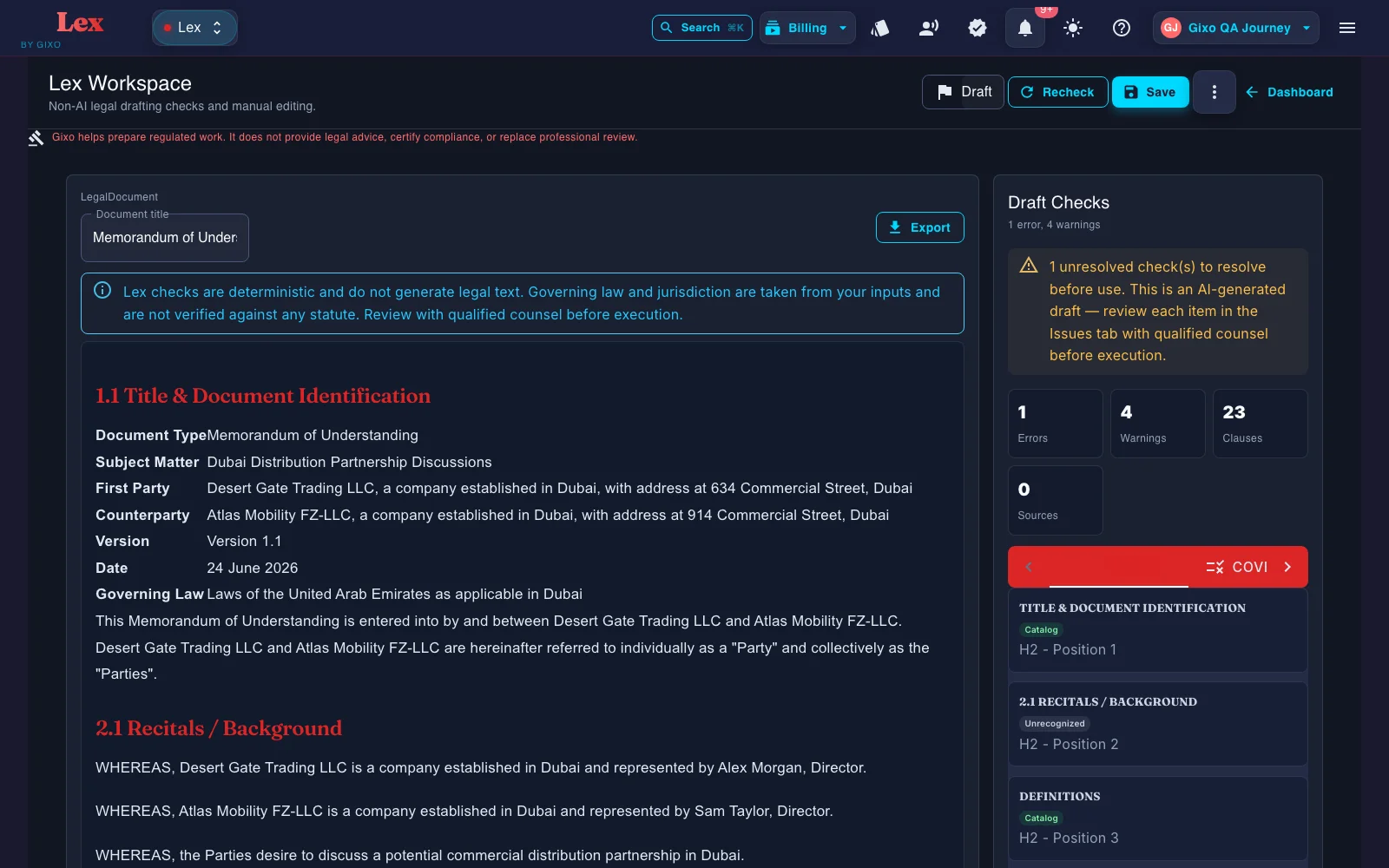
What does a useful AI-generated MOU or memorandum of agreement draft need?
The job is not to ask AI for a legal answer. The job is to prepare a draft or artifact that a qualified reviewer can actually work with.
Capture the reason for the arrangement, what each side is doing, and how the work is meant to progress before drafting begins.
Bring the obligations, milestones, and resource commitments into the draft instead of leaving them as loose narrative.
Shape the first draft around the confidentiality, data-sharing, or IP assumptions reviewers will need to see clearly.
Make it explicit which sections are meant to bind and which sections are still statements of intent before a final contract.
Reference files and governing context can shape the draft. Lex does not show clause-level source provenance, so reviewers should verify authority and supporting facts independently.
After the first draft, Lex can run a deterministic contract review: clause coverage against a versioned playbook, clause-conflict detection, and defined-term and cross-reference checks. Findings, tracked-change DOCX redlines, comments, review state, assignees, due dates, and version history all stay attached to the same document. A contract imported from Word can go back as that same DOCX, with the Lex edits shown as Word tracked changes; where Lex cannot track an edit faithfully, such as inside a field, an existing revision, a header or a footer, it refuses the export instead of altering the document. Reviewers still verify every clause and conclusion.
How does AI MOU drafting work?
Start with the collaboration type, the parties involved, and the purpose of the arrangement.
Define deliverables, milestones, responsibilities, and resource commitments before the first draft is generated.
Bring confidentiality, IP, exclusivity, and any other binding logic into the workflow so the reviewer sees the distinction clearly.
After the first draft, Lex can run a deterministic contract review: clause coverage against a versioned playbook, clause-conflict detection, and defined-term and cross-reference checks. Findings, tracked-change DOCX redlines, comments, review state, assignees, due dates, and version history all stay attached to the same document. A contract imported from Word can go back as that same DOCX, with the Lex edits shown as Word tracked changes; where Lex cannot track an edit faithfully, such as inside a field, an existing revision, a header or a footer, it refuses the export instead of altering the document. Reviewers still verify every clause and conclusion. Agreement Packs connect related documents, proposed party and obligation facts, version-bound approval receipts, and execution records on the same matter. Fields stay proposed until a reviewer confirms, disputes, or marks them inapplicable. Then export in PDF, DOCX, HTML, and TXT.
What does Gixo's AI MOU generator include compared to alternatives?
| Capability | Gixo | Static templates | General AI | Outside counsel |
|---|---|---|---|---|
| Main job | Structured first-draft preparation | Generic forms | Prompt output | Custom drafting |
| Multi-party collaboration structure | Up to 10 parties | Usually 2 parties | Inconsistent | Any number |
| Turnaround to first reviewable draft | Minutes | Hours of editing | Minutes | Days |
| Binding/non-binding distinction | Structured | Generic | Inconsistent | Yes |
| Reference-file input | Yes | Rare | Paste only | Yes |
| Legal advice | Not included | No | No | Professional |
Frequently Asked Questions
Updated