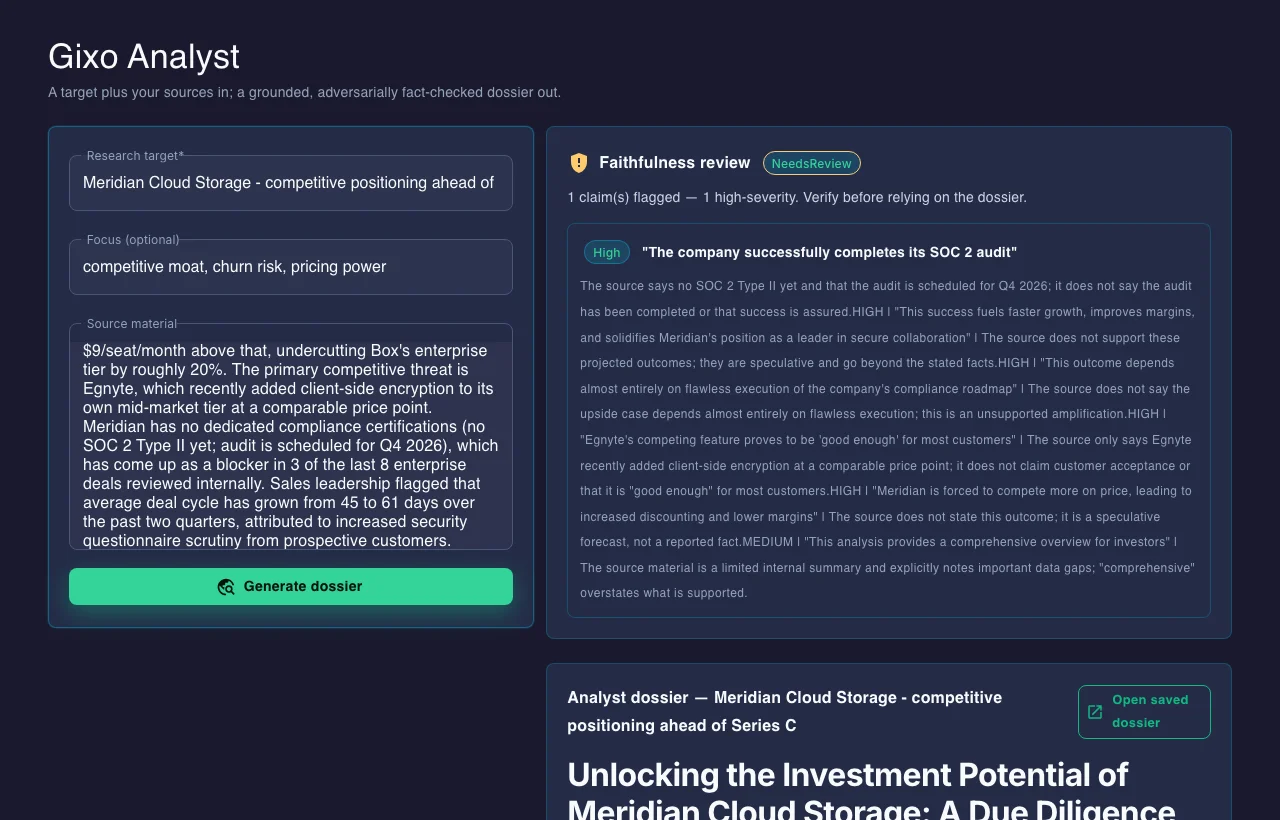
Write with Evidence, Not Guesswork

Every brief passes through an 8-stage verified pipeline that batch-verifies numbers against source documents, injects inline [1], [2] citations with a Sources section, and checks brand compliance. No hallucinated statistics. No fabricated sources. Every claim tied to data you can check.

8Verification Stages
Every #Batch-Verified
[1],[2]Inline Citations
BrandCompliance Checked

An 8-Stage Pipeline That Makes AI Writing Defensible

Most AI tools generate a single unverified draft. Gixo runs every brief through eight sequential stages: generate, word count, brand compliance, number verification, optimization, citations, normative references, and validation. The result is content you can stake your reputation on.

Number Verification

Every number in your brief is batch-verified against the original source documents. Market sizes, growth percentages, financial figures, and statistical claims are cross-checked before the brief reaches you, catching errors that manual review misses.

Automatic Inline Citations

The pipeline injects inline [1], [2] reference markers throughout the text and generates a consolidated Sources section at the end. Every factual claim links to its origin, so readers can trace any data point back to the original source with a single click.

Brand Compliance Checking

After generation, a dedicated pipeline stage checks the brief against your brand style guidelines. Tone, terminology, and formatting conventions are verified post-generation, ensuring every output matches your organization's communication standards without manual review.

Real-Time Research

The AI performs live research at generation time, pulling from current sources rather than relying on stale training data. Your briefs reflect the latest available information, not outdated snapshots from a model's training window.

Anti-Hallucination by Architecture

The 8-stage pipeline is designed to catch and eliminate fabricated content at multiple checkpoints. Number verification flags unverifiable figures, citation injection forces source attribution, and validation rejects content that fails evidence checks.

Audit-Ready Documentation

Every brief serves as a documented research trail with inline citations and a Sources section. When decisions are reviewed months later, the evidence chain is intact, providing a clear record of the information and the verification steps that produced it.

Why an 8-Stage Pipeline Beats Single-Shot Generation

Most AI writing tools generate a single draft and hand it to you. There is no verification pass, no number checking, no citation injection, and no brand compliance review. You are left to do all of that manually, which means errors slip through and the total cost of producing a trustworthy document is far higher than the AI tool's price tag suggests. Gixo's 8-stage pipeline automates what you would otherwise do by hand: after generating the initial draft, it verifies word count, checks brand compliance against your style guidelines, batch-verifies every number against the original source documents, optimizes the content, injects inline [1], [2] citations with a consolidated Sources section, aligns normative references, and runs a final validation pass. Each stage catches issues that the previous one was not designed to detect.

Number Verification: The Feature No Other Tool Offers

The most dangerous errors in AI-generated business content are wrong numbers that look right. A market size figure off by an order of magnitude, a growth rate attributed to the wrong year, or a financial metric that simply does not exist in the cited source. Gixo's number verification stage batch-checks every numerical claim in the brief against the source documents that support it. If a number cannot be verified, it is flagged before the brief reaches you. This is not a grammar check or a plausibility test. It is a systematic cross-reference against the actual source data, closing the gap between what the AI wrote and what the evidence actually says.

From Research to Cited Document in One Pipeline

Traditional business writing separates research from composition. You gather sources in one tool, organize findings in another, and write the document in a third. Gixo collapses these into a single pipeline. The AI searches for relevant data, evaluates source authority, extracts key findings, and weaves them into a structured document. The citation stage then injects inline reference markers and builds a Sources section. The brand compliance stage ensures the output matches your organizational tone and terminology. The result is not just faster output but a tighter, verified connection between evidence and narrative, where every paragraph traces directly back to its supporting data and every number has been checked.

How Evidence-Bound Writing Works

1
Specify your topic and sources

Enter the subject you need to write about and optionally upload source documents. Choose from 54 curated business recipes across 5 domains, or define a custom brief type. Saved workspaces let you reuse sources across multiple briefs.

2
8-stage pipeline generates and verifies

Gixo generates the initial draft, then passes it through seven more stages: word-count verification, brand compliance checking against your style guidelines, batch number verification against source documents, content optimization, automatic inline [1], [2] citation injection with a Sources section, normative reference alignment, and final validation.

3
Review in the block editor

The verified brief lands in a block-based editor with 20+ semantic block types. Use Quick AI for six instant refinement actions or Power Edit for a full AI dialog on any section. Collaborate with your team in real time with remote cursors.

4
Share with confidence

Distribute the evidence-bound document knowing that every number has been verified against its source, every claim carries an inline citation, and the brief conforms to your brand style. Export to PDF with all citations intact.

Where This Matters Most

Use cases where cited, verifiable content makes the difference between credible output and risky guesswork.

Board and Investor Reports
Generate quarterly market updates and competitive analyses with every figure cited. Board members and investors can trace any claim back to its original source, eliminating the credibility gap that plagues uncited AI content.
Regulatory and Compliance Briefs
Produce compliance research with citations to regulations, enforcement actions, and industry standards. When auditors or regulators ask where you got your data, the answer is embedded in every paragraph.
Due Diligence Research
Accelerate due diligence on potential acquisitions, partnerships, or investments with evidence-bound market sizing, competitor mapping, and risk assessments. Every finding links to a verifiable public source.
Grant and Proposal Writing
Build grant applications and business proposals on cited market data and research findings. Reviewers see substantiated claims rather than assertions, strengthening the credibility of every funding request.

What Changes When Every Claim Has a Source

DimensionGixoChatGPTJasperManual Research
Verified pipeline8 stagesNoneNoneManual
Number verificationBatch-verifiedNoNoManual
Inline citations[1],[2] + SourcesNoneNoneManual
Brand compliancePost-generationNoNoManual
Hallucination riskMinimalHighHighNone
Real-time dataLive researchTraining cutoffTraining cutoffCurrent
Business structureBuilt-inGenericMarketing focusManual
SpeedMinutesMinutesMinutesHours to days
Professional outputPDF readyPlain textMarketing copyManual formatting

Get Stronger Results from Every Brief

Be specific with your topic scope. Narrow topics produce more precise citations. Instead of asking for a broad industry overview, specify the exact market segment, geography, or time window you need evidence for. The tighter the scope, the more relevant every source becomes.
Layer proprietary data after generation. Use the AI-generated evidence as a public data foundation, then add your internal metrics, client research, and confidential findings. This approach keeps proprietary information secure while giving you a cited baseline to build on.
Spot-check key citations before sharing. While evidence-bound output is designed for accuracy, clicking through two or three critical citations before distribution adds an extra layer of confidence. Focus on the claims most likely to be questioned by your audience.
Regenerate for fresher sources. If you need the most current data available, regenerate the brief close to your deadline rather than days in advance. Each generation pulls from live sources, so a brief generated today reflects today's available evidence.

Frequently Asked Questions

What does evidence-bound mean in practice?
Every brief passes through an 8-stage pipeline that includes dedicated number verification and citation injection stages. Numbers are batch-verified against source documents, and inline [1], [2] references are inserted automatically with a consolidated Sources section at the end. The pipeline also includes a brand compliance check against your style guidelines. The result is a brief where every claim is traceable and every number is verified.
How current are the sources?
Gixo performs real-time research at generation time rather than relying solely on static training data. This means your briefs include the most recently available public information, industry reports, and market data at the time of generation.
Can I use this for academic or regulated content?
The citation model is valuable for any context where claims must be defensible. For academic work, you would still need to verify that citations meet your institution's standards. For regulated industries, the evidence trail provides a foundation that compliance teams can review and validate.
What if I need to cite specific proprietary sources?
Gixo cites public sources automatically. You can then add references to proprietary research, internal data, and confidential sources in the editing phase. The AI provides the public evidence base; you layer in the proprietary evidence that only your organization has access to.
How does this compare to just using Google Scholar?
Google Scholar helps you find sources. Gixo finds sources, extracts the relevant data, synthesizes findings, structures everything into a business brief, batch-verifies every number against the sources, injects inline citations, checks brand compliance, and validates the final output — all through an automated 8-stage pipeline that completes in minutes.
What types of sources does the AI cite?
Gixo pulls from publicly available industry reports, government databases, financial filings, reputable news outlets, and research publications. The citation injection stage formats these as inline [1], [2] references and builds a consolidated Sources section. The number verification stage then cross-checks every numerical claim against these sources before the brief is finalized.
Can I control the depth of evidence in my brief?
Yes. When specifying your topic, describe how much depth you need. A quick executive summary will pull top-level figures and key findings, while a deep-dive analysis will gather more granular data points, multiple supporting sources per claim, and broader coverage across subtopics.
How does evidence-bound writing handle conflicting data?
When sources disagree, the AI presents the range of findings rather than picking a single number. You will see citations to multiple sources so you can evaluate the discrepancy yourself. This transparency is critical for nuanced topics where no single source tells the full story.
Is this suitable for legal or financial documents?
Evidence-bound briefs provide a strong research foundation for legal and financial contexts. However, they are not a substitute for professional legal or financial advice. Use the cited output as a starting point, then have your legal counsel or financial advisors review and validate the content before relying on it for binding decisions.

Write with Evidence, Not Guesswork

Every claim cited. Every source verifiable. AI content your stakeholders can trust.

High Contrast Mode Disabled
An error has occurred. This application may no longer respond until reloaded. Reload 🗙