
The best AI SEO content writers, compared
Choosing the best AI SEO content writer means comparing SEO accuracy, content quality, pricing transparency, and migration ease. We evaluated Gixo, Surfer SEO, Jasper, Frase, and Clearscope across these dimensions to help you make the right buying decision.
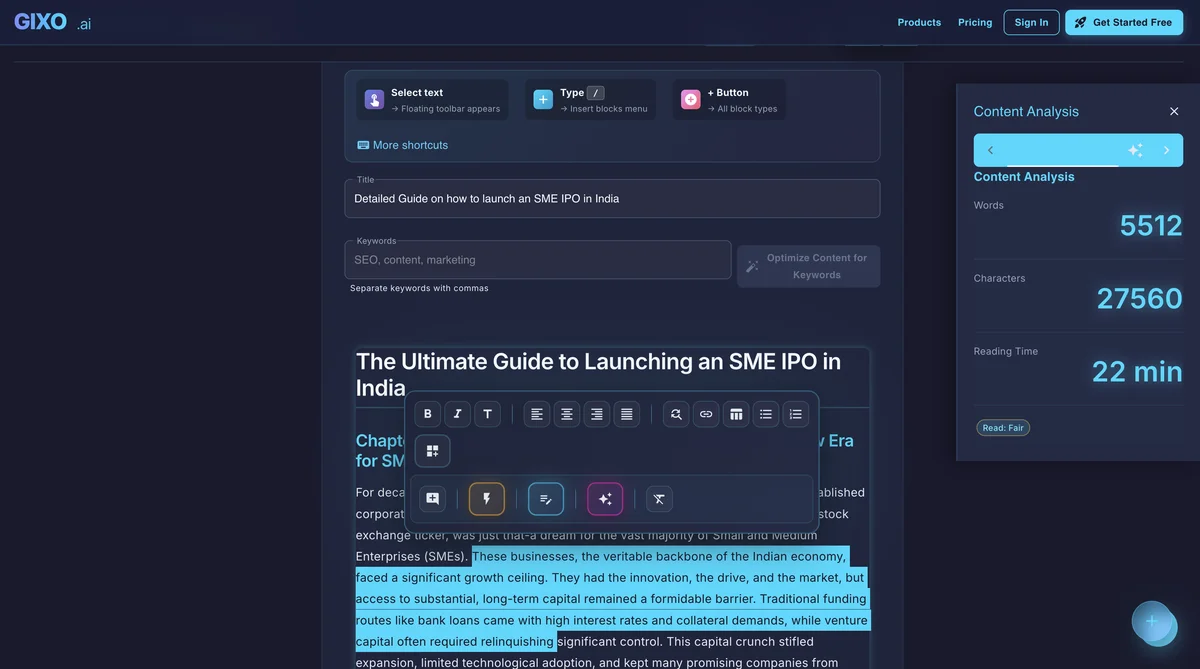
What is an AI SEO content writer?
An AI SEO content writer is a specialized tool that combines artificial intelligence with search engine optimization to produce articles, blog posts, and landing pages that are designed to rank in search results. Unlike general-purpose AI chatbots or grammar checkers, these tools analyze search intent, competitor content, and keyword data to create content that satisfies both readers and search engine algorithms.
The key distinction between an AI SEO content writer and a standard AI writing tool is the optimization layer. A general AI writer produces text based on a prompt. An AI SEO writer goes further: it researches what already ranks for your target keyword, identifies content gaps, structures headings for crawlability, manages keyword density, and generates schema markup — all within the writing workflow rather than as a separate step.
This matters because SEO is no longer optional for content marketing. Organic search accounts for a majority of website traffic across most industries, and the difference between ranking on page one and page two is often the difference between getting traffic and getting none. AI SEO content writers close the gap between writing speed and optimization depth, letting content teams publish more without sacrificing search performance.
How they work
AI SEO content writers operate through a multi-stage pipeline that combines large language model generation with real-time SEO analysis. Understanding this process helps you evaluate which tools actually optimize content versus which ones simply add a score label to generic AI output.
Keyword and Intent Analysis
The process starts with your target keyword. The tool analyzes search engine results pages to determine what type of content ranks — informational guides, product comparisons, how-to articles, or transactional pages. This intent classification shapes the article structure, tone, and depth before a single word is written.
Content Generation with SEO Constraints
The AI generates content while simultaneously adhering to SEO parameters: target keyword density ranges, semantically related terms, heading hierarchy from H1 through H4, internal linking opportunities, and optimal content length based on competitive analysis. The best tools do this in a single pass rather than requiring you to write first and optimize later.
On-Page Optimization
Beyond body text, comprehensive tools automatically generate meta titles, meta descriptions, Open Graph tags, and structured data markup. They also evaluate readability metrics — sentence length variation, paragraph density, passive voice usage — to ensure content is accessible to a broad audience while maintaining topical authority.
Quality Scoring and Iteration
Most AI SEO writers assign a real-time content score that reflects how well the article matches ranking signals for the target keyword. This score updates as you edit, letting you refine specific sections rather than rewriting entire articles. Tools vary significantly in how they calculate this score — some use simplistic keyword counting while others apply NLP-based semantic analysis.
What to look for
When evaluating AI SEO content writers, these six criteria separate the tools that deliver ROI from those that create more work than they save.
The best AI SEO writers publish clear pricing without hidden add-ons. Watch for tools that require separate SEO plugin subscriptions — like Jasper + SurferSEO — which can double your effective monthly cost.
Not all SEO scores are created equal. Look for tools that analyze keyword density, heading structure, meta tags, and readability simultaneously — not just word count targets or generic content grades.
Evaluate whether the tool produces publish-ready content or rough drafts. The best tools deliver properly structured articles with citations, coherent flow, and professional tone — not generic text you spend hours editing.
Check what export formats are available. Can you publish directly to WordPress? Export clean HTML or Markdown? Some tools trap content inside their platform with copy-paste as the only exit path.
Complex tools waste time on onboarding. The best AI SEO writers let you generate your first optimized article within minutes of signing up, without tutorials or training sessions.
Consider what happens when you get stuck. Look for responsive support, documentation, and onboarding resources. Some tools offer dedicated account managers for team plans while others rely on self-service help centers.
How to choose the right one
Follow these four evaluation steps to pick the AI SEO content writer that fits your workflow and budget.
List the SEO features you require: keyword analysis, heading optimization, meta generation, readability scoring. Use this as your evaluation checklist when comparing tools.
Add up the full cost: base subscription plus any required add-ons (SEO plugins, CMS integrations, extra seats). Some tools appear cheap but double in cost with required extras.
Generate the same article across your top 2-3 picks and compare output quality, SEO scoring accuracy, and editing effort required before committing.
If switching tools, check how easily you can transfer brand voice settings, content libraries, and team access. The best tools make migration painless.
Side-by-side comparison
How the top AI SEO content writing tools stack up across the features that matter most for search rankings.
| Feature | Gixo | Surfer SEO | Jasper | Frase | Clearscope |
|---|---|---|---|---|---|
| SEO-first generation | Built-in | Yes | Add-on | Yes | Yes |
| Full article writing | Complete articles | Outline only | Yes | Partial | No |
| Heading optimization | Automatic H1-H4 | Suggestions | Manual | Suggestions | Suggestions |
| Evidence citations | Automatic | No | No | No | No |
| Schema markup | Auto-generated | No | No | No | No |
| Brand voice | Trainable | No | Yes | No | No |
| CMS publishing | WordPress | WordPress only | Integrations | No | No |
| Content scoring | Real-time NLP | Real-time | No | Real-time | Per-report |
| Evaluation path | 14-day trial | No | No | Limited | No |
| All-inclusive pricing | Yes | Yes | SEO is add-on | Yes | Per-report |
Each tool at a glance
A closer look at what each AI SEO content writer does best — and where it falls short.
Gixo is a content operating system that combines AI content generation with built-in SEO optimization in a single workflow. Instead of writing content in one tool and optimizing it in another, Gixo handles keyword analysis, heading structure, meta tag generation, evidence citations, and schema markup as part of the generation process. Brand voice training lets you maintain consistency across content at scale, and the 14-day trial makes it easy to validate the workflow before moving to a paid seat.
- SEO scoring, citations, and schema markup included in every plan
- Trainable brand voice with unlimited profiles
- WordPress publishing with metadata preserved
- 14-day free trial with full access
Surfer SEO is primarily a content optimization and analysis tool rather than a full content writer. It excels at analyzing what already ranks for a keyword and providing a detailed content brief with recommended word count, headings, and NLP terms to include. While it offers an AI writing assistant, its strength lies in guiding human writers or optimizing existing content rather than generating complete articles from scratch. Best suited for teams that already have writers and need an optimization layer.
- Strong SERP analysis and content brief generation
- Real-time content scoring as you write
- WordPress integration for optimization audits
- NLP-based term suggestions beyond basic keywords
Jasper is a general-purpose AI writing platform that covers marketing copy, social media, emails, and long-form content. Its brand voice feature is strong, and it integrates with many marketing tools. However, SEO capabilities require a separate SurferSEO integration at additional cost. This makes Jasper a good choice for marketing teams that need multi-format content but increases the total cost significantly when SEO optimization is a priority.
- Versatile across content types (ads, emails, blogs, social)
- Strong brand voice and tone customization
- Large template library for different content formats
- Team collaboration features for enterprise workflows
Frase combines SERP research with AI content generation, making it particularly strong for content briefs and competitive analysis. It analyzes top-ranking pages for your target keyword, extracts common topics and questions, and helps you build comprehensive outlines before writing. The AI writing component generates partial content that often requires editing, but the research and briefing workflow is among the best available for content strategists.
- Comprehensive SERP analysis and content briefs
- Question research from People Also Ask data
- Topic clustering for content strategy planning
- All-inclusive pricing without hidden add-ons
Clearscope is a content optimization platform focused on content grading and term recommendations. It does not generate content — instead, it scores existing content against top-ranking competitors and suggests terms, headings, and readability improvements. Its per-report pricing model makes it more expensive for high-volume teams but cost-effective for enterprises that publish fewer, high-stakes pieces. Best for teams that want optimization guidance rather than AI-generated drafts.
- Detailed content grading against SERP competitors
- Google Docs and WordPress integrations
- Clean interface with minimal learning curve
- Strong for auditing and refreshing existing content
Who should use one?
Different roles and team sizes benefit from AI SEO writers in different ways. Here is where each user type gets the most value.
Independent creators who handle writing, SEO, and publishing themselves benefit most from all-in-one tools that eliminate the need to juggle multiple subscriptions. An affordable entry seat or time-boxed trial is essential since revenue may be limited early on. Prioritize tools that produce publish-ready content with minimal editing overhead.
In-house teams producing 10 or more articles per month need workflow efficiency above all else. Look for batch generation, brand voice consistency across multiple writers, and CMS integration that eliminates manual formatting. The time saved per article compounds significantly at higher content volumes.
Agencies managing content for multiple clients need multi-brand support, white-label export options, and the ability to maintain separate voice profiles per client. Total cost per client matters — tools that bundle SEO with writing reduce the per-client tooling cost compared to stacking separate platforms.
Product-led companies need content that drives organic traffic to product pages, documentation, and landing pages. Schema markup generation, meta description automation, and structured heading hierarchies are critical for these use cases where technical SEO directly impacts conversion rates.
Tips for using them effectively
AI SEO writers accelerate content production, but the best results come from treating them as a starting point rather than a finished product.
Can AI content actually rank on Google?
This is the most common objection from content teams evaluating AI SEO tools, and the answer is nuanced. Google has stated that its ranking systems reward high-quality content regardless of how it is produced. The focus is on the quality and usefulness of the content, not on whether a human or machine wrote it.
That said, there is a meaningful difference between AI-generated content that is published without review and AI-assisted content that goes through human editing, fact-checking, and enrichment. The former tends to be generic, repetitive across sites, and thin on original insight. The latter uses AI for speed and structure while adding the experience and expertise signals that Google's E-E-A-T framework rewards.
In practice, the most successful approach is to use AI SEO writers as an accelerator for your content workflow — not a replacement for human judgment. Generate the initial draft with SEO optimization built in, then layer on original perspectives, proprietary data, expert quotes, and real-world examples. This produces content that ranks because it genuinely serves the searcher, not because it gamed a keyword density threshold.
The tools that perform best in this workflow are the ones that produce high-quality first drafts with proper structure, reducing the editing burden while leaving room for human value-adds that search engines reward.