
How proposal software pricing usually works
Proposal tools are not all priced for the same job. Some are built for send-and-sign workflows, others for design-heavy proposals, and others for drafting from source files. The pricing only makes sense once you know which workflow you are paying for.
Proposal software pricing generally falls into three models: per-seat pricing, product-tier subscriptions, and negotiated enterprise contracts. Gixo Arc uses per-seat plans across four published tiers — $49, $129, $149, and $179 per seat per month, with seat minimums of 1, 2, 5, and 10 — billed monthly or annually after a 14-day no-card trial. There is no free Arc tier; the deterministic proposal analyzer is the part you can run without an account. The useful comparison is the total workflow you receive for that seat cost, not an unsupported flat-price claim.
See what Arc helps your team review
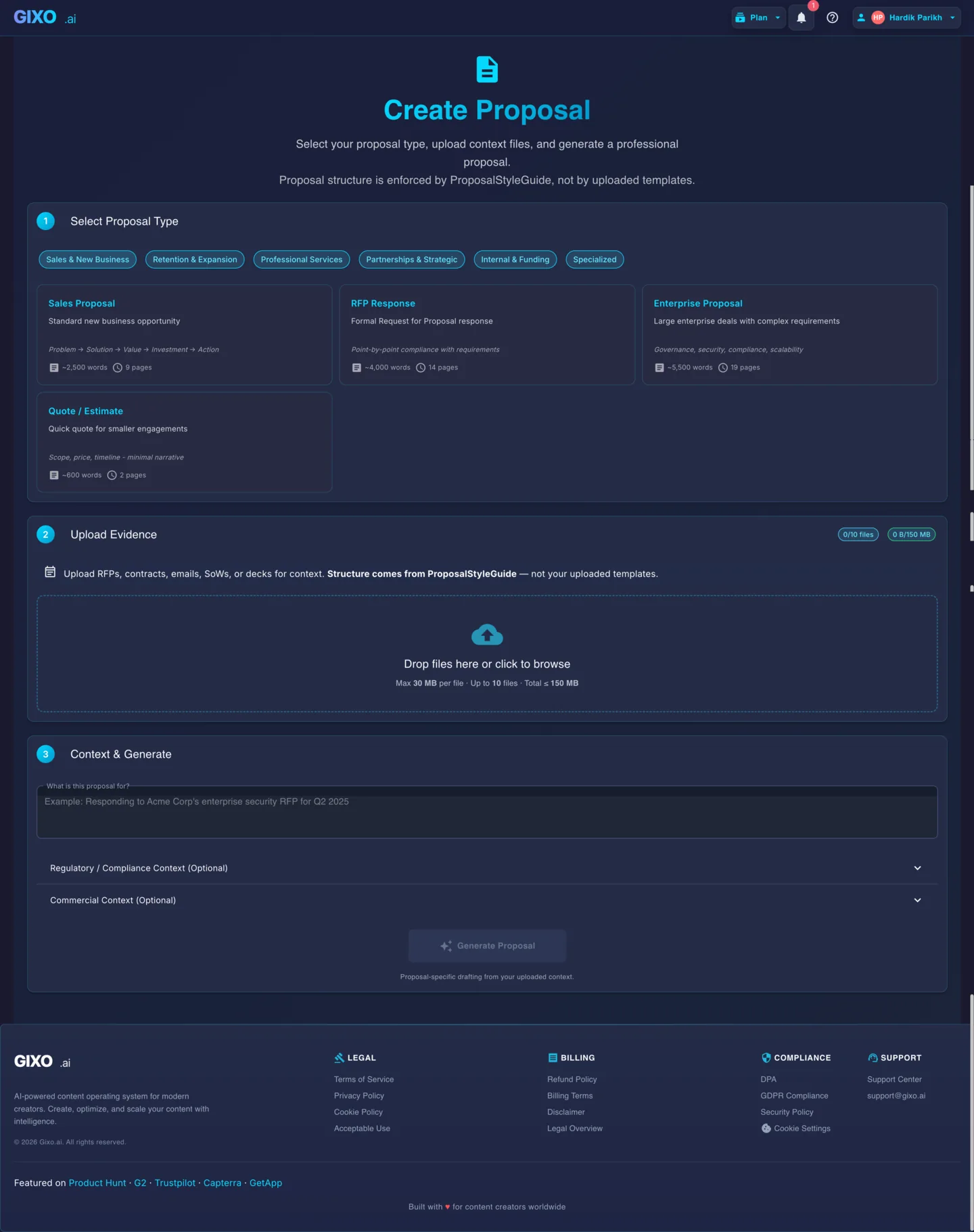
Choose the proposal type, add the RFP, brief, notes, or prior work, then review a structured first draft before it reaches a client.
- 1Add source materialRFPs, briefs, notes, decks, and prior work
- 2Draft to the proposal typeSections and structure follow the real opportunity
- 3Review before deliveryYour team checks facts, scope, pricing, and commitments
What are the pricing models for proposal software?
The right model depends on team size, proposal volume, and whether your bottleneck is drafting, workflow, or approvals.
A fixed monthly or annual fee for each user on the account. PandaDoc and Proposify use this model. Cost scales with headcount, not output. Works well for large teams with steady proposal volume where every member needs access to templates, e-signatures, and tracking.
Monthly or annual subscription tied to a defined product and team tier. Gixo Arc combines this model with per-seat pricing and tier minimums, so buyers should compare the current plan table against the number of people who need access.
Negotiated annual contract with high or unlimited usage caps. Includes onboarding, SLAs, and custom integrations. Qwilr offers enterprise tiers, and platforms like Loopio and Responsive target large RFP teams. Usually requires annual commitment and minimum seat purchases.
How do the pricing models compare?
How each pricing model charges, who uses it, and which teams it fits best.
| Pricing Model | How It Charges | Example Vendors | Best Fit |
|---|---|---|---|
| Per-Seat / Per-User | Fixed monthly or annual fee per user; scales with headcount, not output | PandaDoc, Proposify | Large teams with steady proposal volume where everyone needs templates, e-signatures, and tracking |
| Subscription / Product Tier | Monthly or annual subscription with product-specific tiers; Arc plans are priced per seat with tier minimums | Gixo Arc | Teams wanting a focused drafting workflow with clear seats and plan boundaries |
| Enterprise / Flat-Rate | Negotiated annual contract, high or unlimited usage caps, includes onboarding/SLAs/custom integrations | Qwilr (enterprise tiers), Loopio, Responsive | Large RFP teams needing annual commitments and minimum seat purchases |
What does Gixo Arc cost?
Four published tiers, all priced per seat per month at the tier's seat minimum. Evaluation is a 14-day trial with no credit card; Arc has no free tier and no standing $0 plan.
| Arc plan | Price per seat / month | Seat minimum | Annual list price per seat | Minimum monthly spend at list | Best for | What it adds | How you buy it |
|---|---|---|---|---|---|---|---|
| Starter | $49 | 1 seat | $490 | $49 | Good for one person drafting proposals and RFP responses | Source-first proposal drafting; File upload plus PDF, DOCX, and HTML export; Personal proposal workspace; Monthly paid checkout | Self-serve checkout |
| Professional (recommended) | $129 | 2 seats | $1,299 | $258 | Good for small proposal teams reviewing drafts together | Internal sharing and comments; Proposal review collaboration | Self-serve checkout |
| Business | $149 | 5 seats | $1,499 | $745 | Good for proposal operations with shared review workflows | Shared team workspaces; Proposal ops and review workflows | Self-serve checkout |
| Enterprise | $179 | 10 seats | $1,799 | $1,790 | For Azure and private-offer deployments | API access and AI provider governance; Azure Marketplace or private offer; Onboarding and enterprise rollout support | Azure Marketplace or private offer |
Every paid tier includes source-file upload, the drafting workspace, and export in six formats — PDF, DOCX, HTML, Markdown, JSON, and plain text. Higher tiers add internal sharing and comments (Professional, 2-seat minimum) and shared team workspaces with proposal review workflows (Business, 5-seat minimum). Arc also includes simple electronic signature (not a qualified or certificate-based signature), where each signer is emailed a signing link and the signed proposal is sealed as a PDF, and recipient-specific tracked links that Arc can email to the recipient or you can share yourself, with an alert when the recipient opens or downloads the proposal. It does not collect payments or offer self-serve CRM sync, so budget for those separately if your workflow needs them.
How do proposal software pricing models compare?
The useful comparison is how each platform charges and what kind of proposal work it is really built for.
| Factor | Workflow-first suite | Design-first suite | Interactive web proposal tool | Gixo Arc |
|---|---|---|---|---|
| Pricing structure | Per-seat workflow pricing | Per-seat design workflow pricing | Per-seat web proposal pricing | Product-based, per-seat pricing |
| Primary focus | Send, track, and sign | Styled proposal creation and review | Interactive web proposals | AI drafting from source files |
| Evaluation path | Check current vendor demo or trial | Check current vendor demo or trial | Check current vendor demo or trial | 14-day no-card trial, then paid plans |
| Source-file drafting | Usually secondary | Usually secondary | Usually secondary | Core product behavior |
| Delivery features | Often built in | Often built in | Often built in | Simple electronic signature (signers emailed a link) and tracked links Arc can email or you send yourself; no payments |
| Best fit | Teams centered on send-and-sign workflow | Teams centered on proposal polish | Teams centered on web-native proposals | Teams centered on better first drafts |
| Budget shape | Driven by headcount and workflow scope | Driven by headcount and design workflow scope | Driven by headcount and delivery workflow scope | Driven by seat count and proposal workflow choice |
Proposal software pricing FAQ
Updated